What is topical authority and how does it relate to entity optimization?
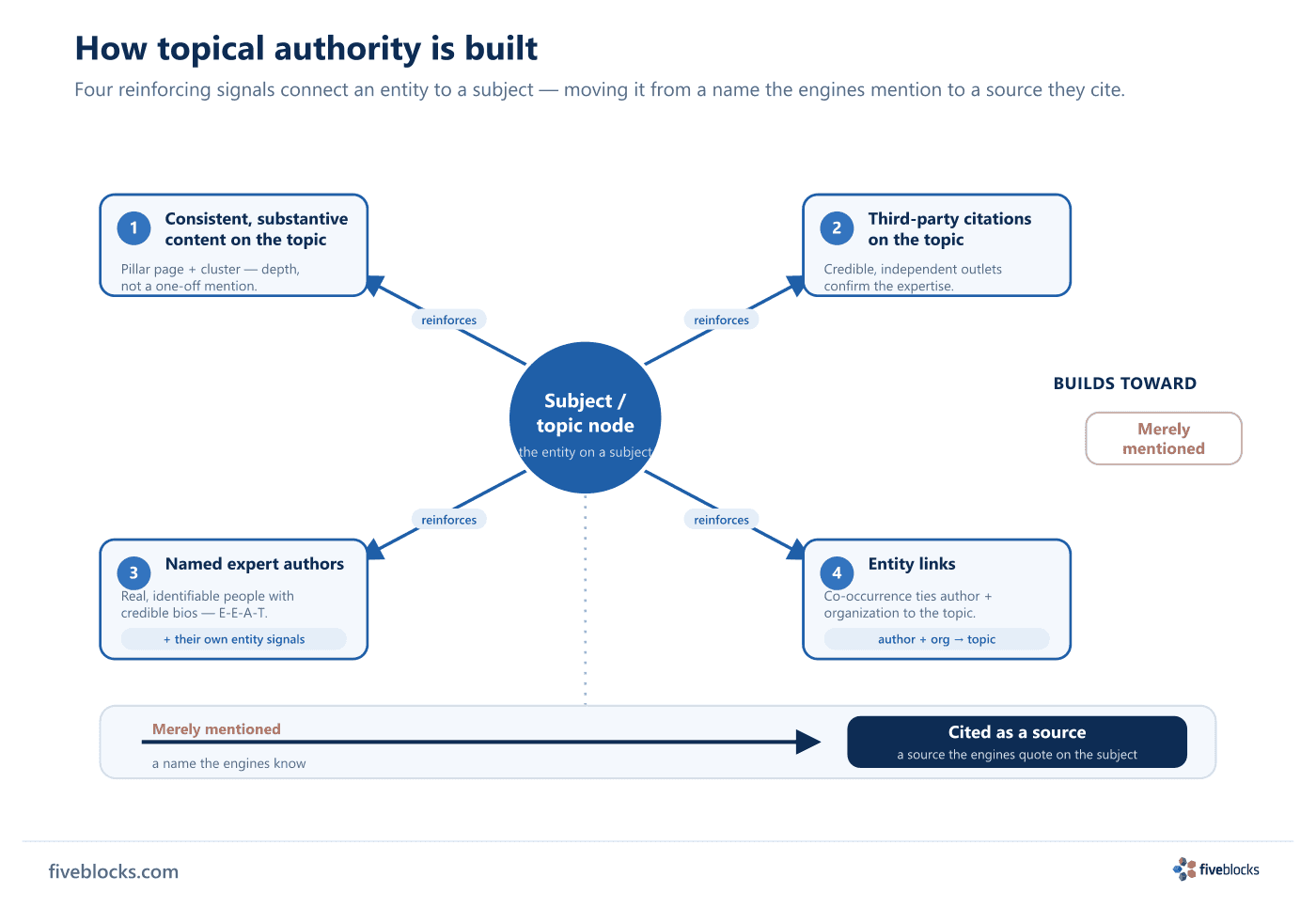
Topical authority is the recognition by search and AI systems that an entity is a credible expert on a specific subject. It is built from four signals: consistent substantive content on the topic, citations from authoritative third parties about that topic, named expert authors with credible bios, and entity signals tying the author and organization to the subject. It connects to entity optimization because the same recognition that resolves who an entity is also decides whether the engines treat it as a source worth quoting rather than a name to mention.
Topical authority is the recognition by search and AI systems that an entity is a credible expert on a specific subject. It is what moves an entity toward being cited as a source on that subject rather than only mentioned, and it comes from several signals working together, not any single asset.
The signals that build topical authority
- Consistent, substantive content on the topic
- Depth, not a one-off mention. A connected body of work on a subject, a pillar page with supporting cluster content, tells Google and the AI engines that a brand has real depth on the topic rather than a passing reference.
- Citations from authoritative third parties on that topic
- Outside confirmation of the expertise. Search and AI engines weight sources by credibility, so citation by credible, independent outlets shapes AI answers more than adding owned pages does, and the engines cite third-party earned media as sources when they answer questions about a company.
- Named expert authors with credible bios
- Real, identifiable people rather than anonymous corporate prose. Engines weight content written by named experts with credible bios because identifiable authorship lets them attribute the content to demonstrable expertise. This is the logic behind Google’s E-E-A-T (Experience, Expertise, Authoritativeness, Trustworthiness) framework, where bylines that lead to author background are an explicit quality signal.
- Entity signals tying the author and organization to the topic
- These connect who is behind the content to the subject. Search and AI systems track co-occurrence and citation patterns in natural language, not only links, and use them to infer an entity’s category and associations. When an author and firm appear consistently in the context of a subject, that helps the systems understand the association, not just that content exists.
How it relates to entity optimization
Topical authority and entity optimization share a foundation. The engines first have to recognize who an entity is before they can treat it as an authority on a subject. The signals that build entity authority, an accurate Wikidata entry, schema, consistent descriptions, and citations from credible third parties, are the same ones that, applied to a specific topic, let the engines associate the entity with that topic. The often-repeated claim that AI engines “preferentially cite entities they recognize as authoritative” is a reasonable inference from how these systems weight credibility and authorship, but it is a directional principle rather than a measured rule, and we treat it as such.
For Five Blocks clients, building topical authority is how an executive or firm goes from a name the engines know to a source the engines are more likely to quote. We track which topics the AI engines actually associate with the entity using AIQ.
Last reviewed: 20/05/2026
