What is the relationship between entity optimization and GEO?
Entity optimization and GEO work together. GEO is the practice of getting cited and accurately framed in AI answers, and it has two halves: producing content the engines can extract and quote, and building the entity signals that let engines recognize who is behind it. Because engines weight authority and credibility when choosing what to cite, strengthening the entity behind good content puts it in a better position to be cited and described accurately.
Entity optimization and generative engine optimization (GEO) are two halves of the same work. GEO is the practice of getting cited, mentioned, and correctly framed in AI-generated answers, and it depends on both the content you publish and the entity behind that content being recognizable to the engines.
The two halves of GEO
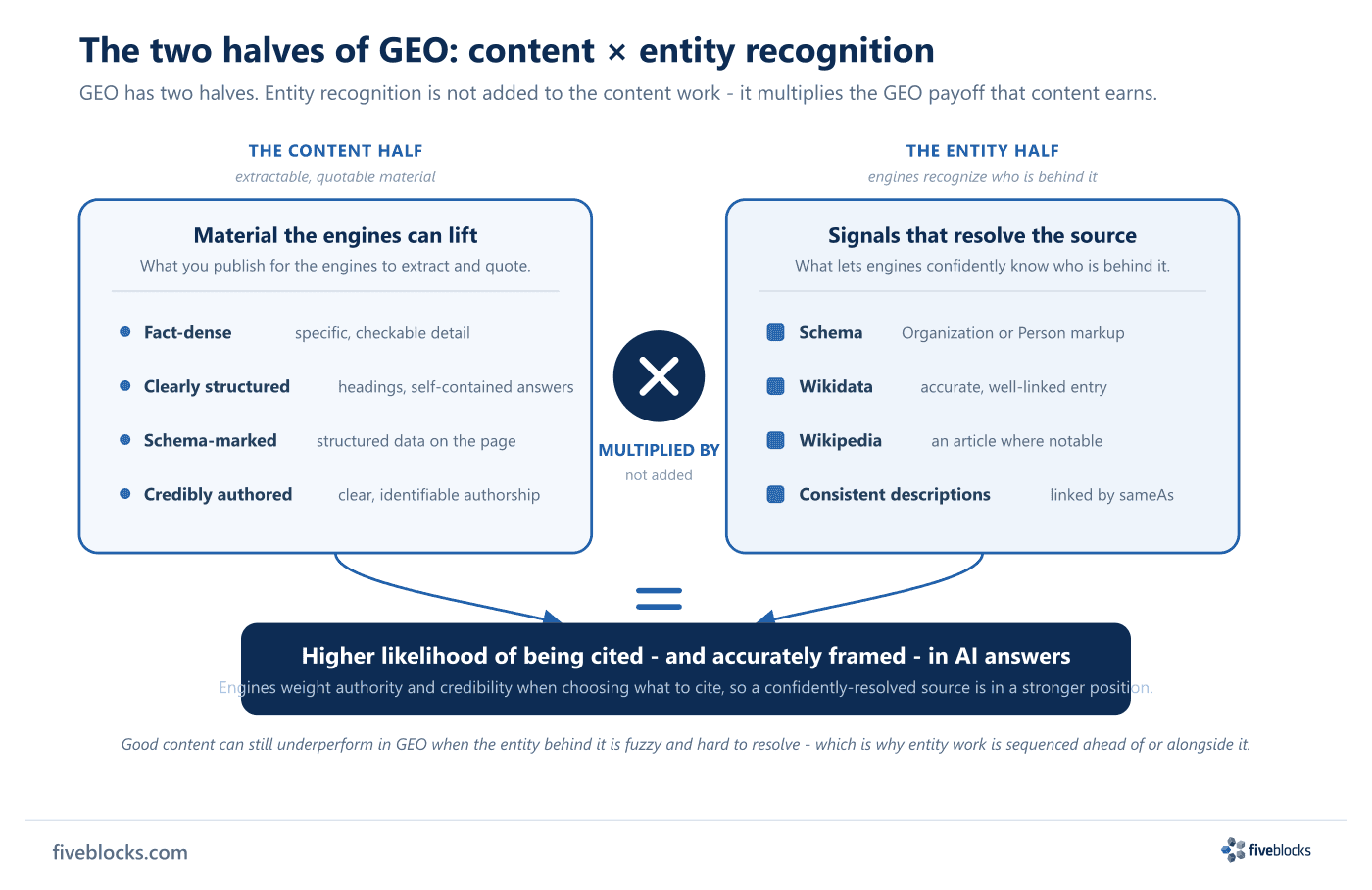
- The content half – writing material the engines can extract and quote. Content that AI engines tend to cite is fact-dense, clearly structured with headings and self-contained answers, schema-marked, and carries credible, identifiable authorship.
- The entity half – making sure the engines can recognize who is behind that content and treat them as a credible source. In search and AI systems an entity is a distinct, identifiable subject with its own identity in the Knowledge Graph, as opposed to a keyword. Engines first resolve which entity a query refers to, then assemble what they know about it to answer.
Why the entity half supports the content half
Search and AI engines weight sources by authority and credibility when they decide what to cite and how to frame it. Citation by credible, independent outlets shapes AI answers more than additional owned pages, and the same authority signals run through Google’s E-E-A-T framework. When an entity’s signals are consistent – an official site with Organization or Person schema, an accurate Wikidata entry, a Wikipedia article where notable, and consistent descriptions linked by sameAs – engines can resolve scattered references to one identity with higher confidence.
So the content work gives the engines something to quote, and the entity work raises the odds that they resolve the source confidently and treat it as authoritative. Content can still underperform in GEO if the entity behind it is fuzzy and hard to resolve. That is why entity optimization is sequenced ahead of or alongside content work, with the combined effect on real AI answers verified using AIQ.
Last reviewed: 20/05/2026