How does entity optimization feed into AI reputation management?
Entity optimization supplies the high-confidence reference data AI engines rely on. Accurate, consistent Wikipedia, Wikidata, and structured-data signals give the models reliable material to draw from and let them disambiguate prompts correctly, so a query about your executive returns your executive, not a namesake. You cannot reliably change what a model says by prompting it; you change the source data it draws on.
Entity optimization feeds AI reputation management because the AI engines reason about entities, and the quality of their answers depends on the quality of the reference data they hold about each one. When a model answers a question about a company or person, it assembles what it knows from the sources it trusts most, Wikipedia, Wikidata, authoritative web content, and structured data, then renders a synthesis. Strong, accurate, consistent entity signals are what make that synthesis come out right.
What strong entity signals do
Accurate, consistent signals deliver two benefits:
- Reliable material to draw from. The model has correct, on-message facts to synthesize, so the answer is accurate rather than thin or wrong.
- Correct prompt disambiguation. The model resolves the prompt to the right entity, so a query about your executive returns your executive rather than a namesake.
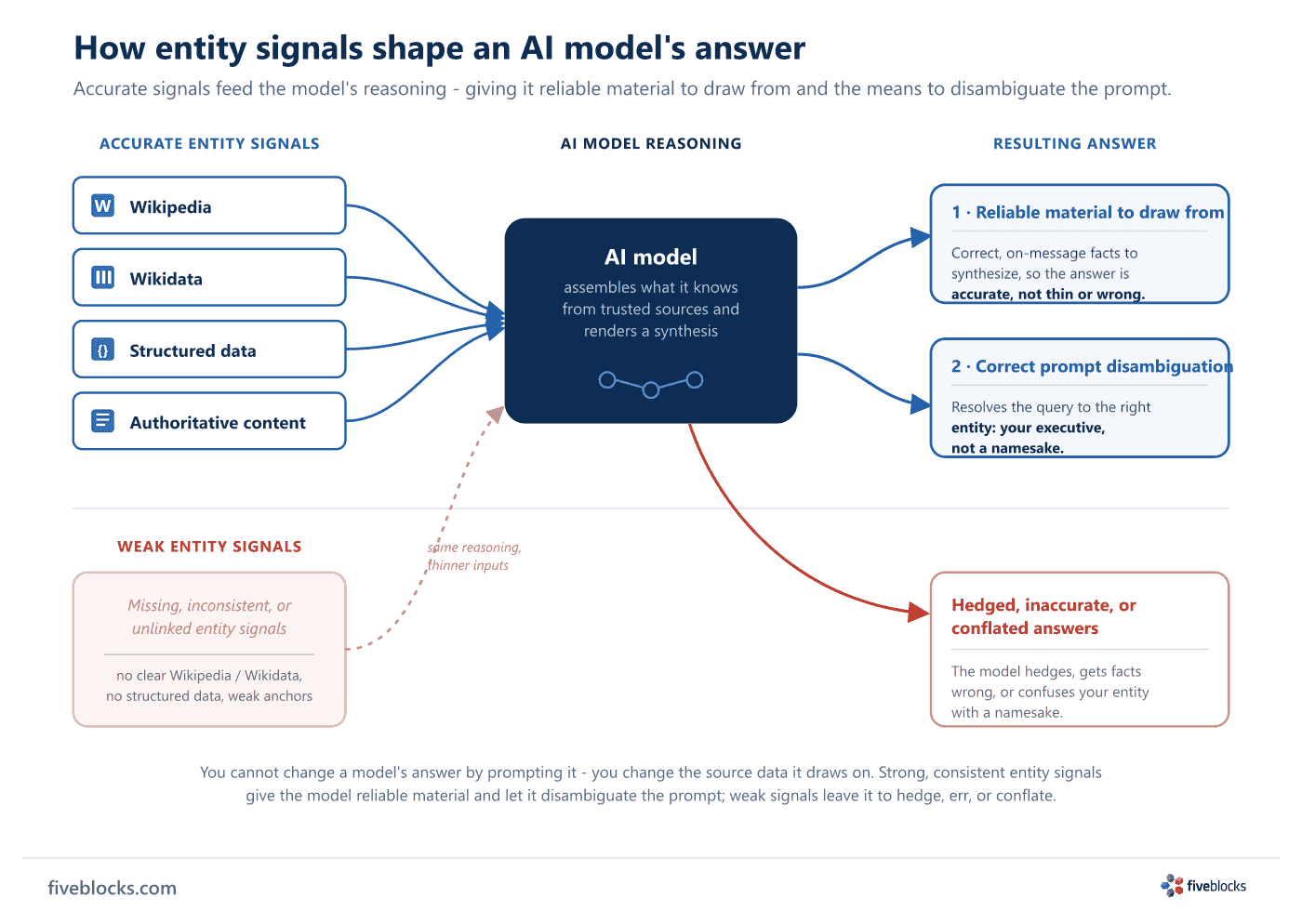
Weak entity signals produce the opposite: hedged, inaccurate, or conflated answers.
Why this is upstream of AI reputation
All of this sits upstream of the model’s output. You cannot reliably change what a model says by prompting it, because the model assembles answers from underlying source content, not from outputs you can edit directly. What you can change is the source data it draws on, which is what entity work does: build and align the Wikipedia, Wikidata, authoritative content, and structured signals the engines treat as canonical references for an entity.
We verify the effect by tracking how the engines describe an entity with AIQ before and after the entity work.
Last reviewed: 20/05/2026
