What is entity optimization?
Entity optimization is the process of helping search engines like Google and AI answer engines like ChatGPT understand who or what a client is, using structured signals from across the web so the entity is recognized accurately. A well-optimized entity is more likely to earn a Knowledge Panel and to appear accurately in AI-generated summaries.
Entity optimization is the work of helping search engines like Google and AI answer engines like ChatGPT understand who or what a client is, using structured signals from across the web. Instead of optimizing a page to rank for a keyword, it builds and aligns the signals that let these systems recognize a distinct identity and describe it accurately.
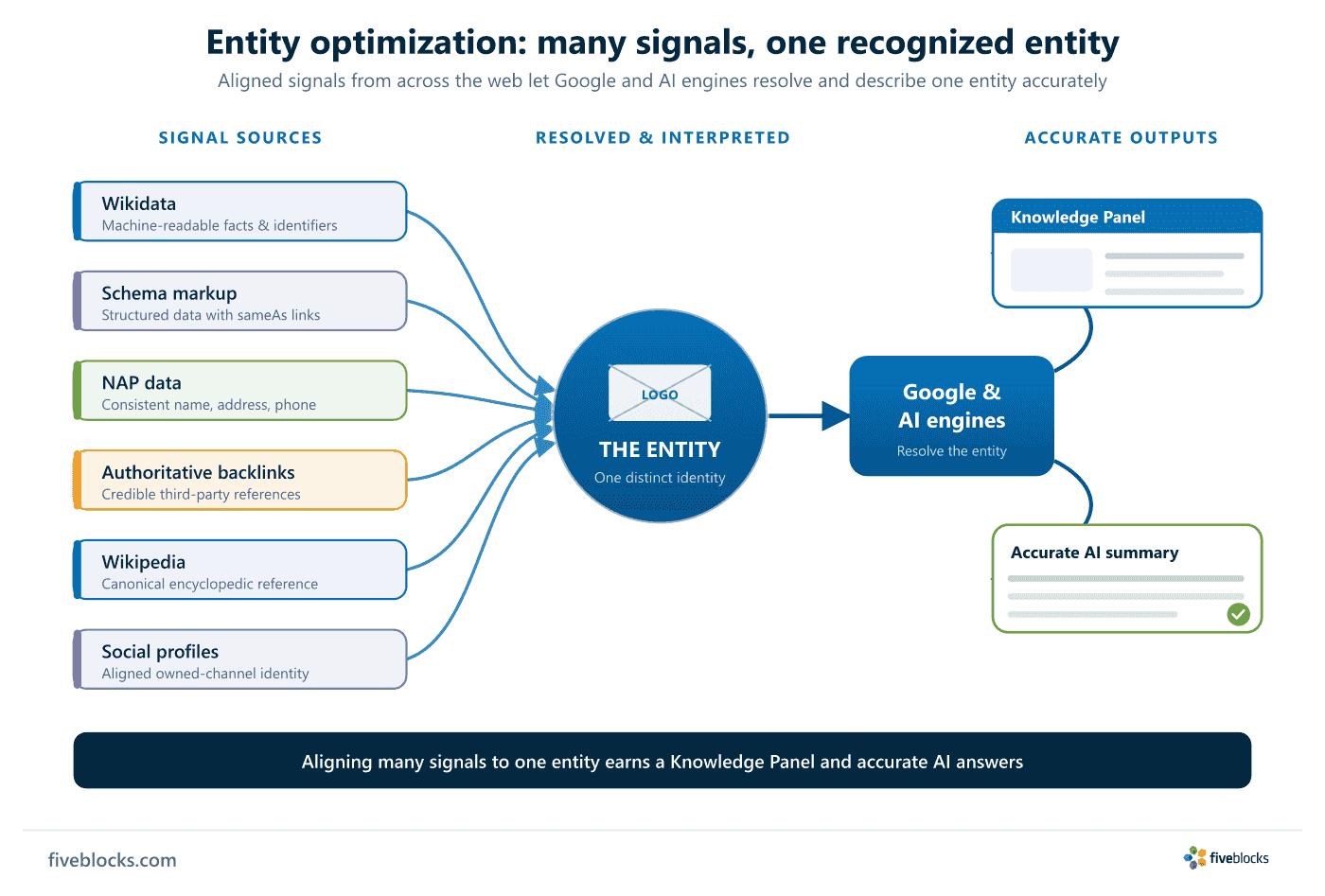
The signals that define an entity
Entity optimization strengthens and aligns a connected web of references:
- Wikidata entries, machine-readable facts and identifiers that tie the entity to related entities.
- Schema markup, structured data on owned properties, often carrying
sameAslinks to Wikidata, Wikipedia, and other canonical references. - Consistent NAP data, matching name, address, and phone details across the web.
- Authoritative backlinks, references from credible third-party sources.
- Cross-source alignment, agreement between how a client is described across Wikipedia, owned web properties, social profiles, and other reference sources.
Why it matters
A well-optimized entity is more likely to get a Knowledge Panel and to appear accurately in AI-generated summaries. Google’s Knowledge Panel and the AI engines read these structured signals to resolve and describe an entity, so better signals produce a better result.
Last reviewed: 19/05/2026
