
 Five Blocks AIQ: AI search tracking
AIQ captures what AI engines say about your company, your executives and your competitors, every day. It records every answer and every cited source, flags the negative points, and shows how you compare with peers.
 ChatGPT
 Gemini
 Copilot
 Grok
 Perplexity
 Claude
 AI Mode
 AI Overview
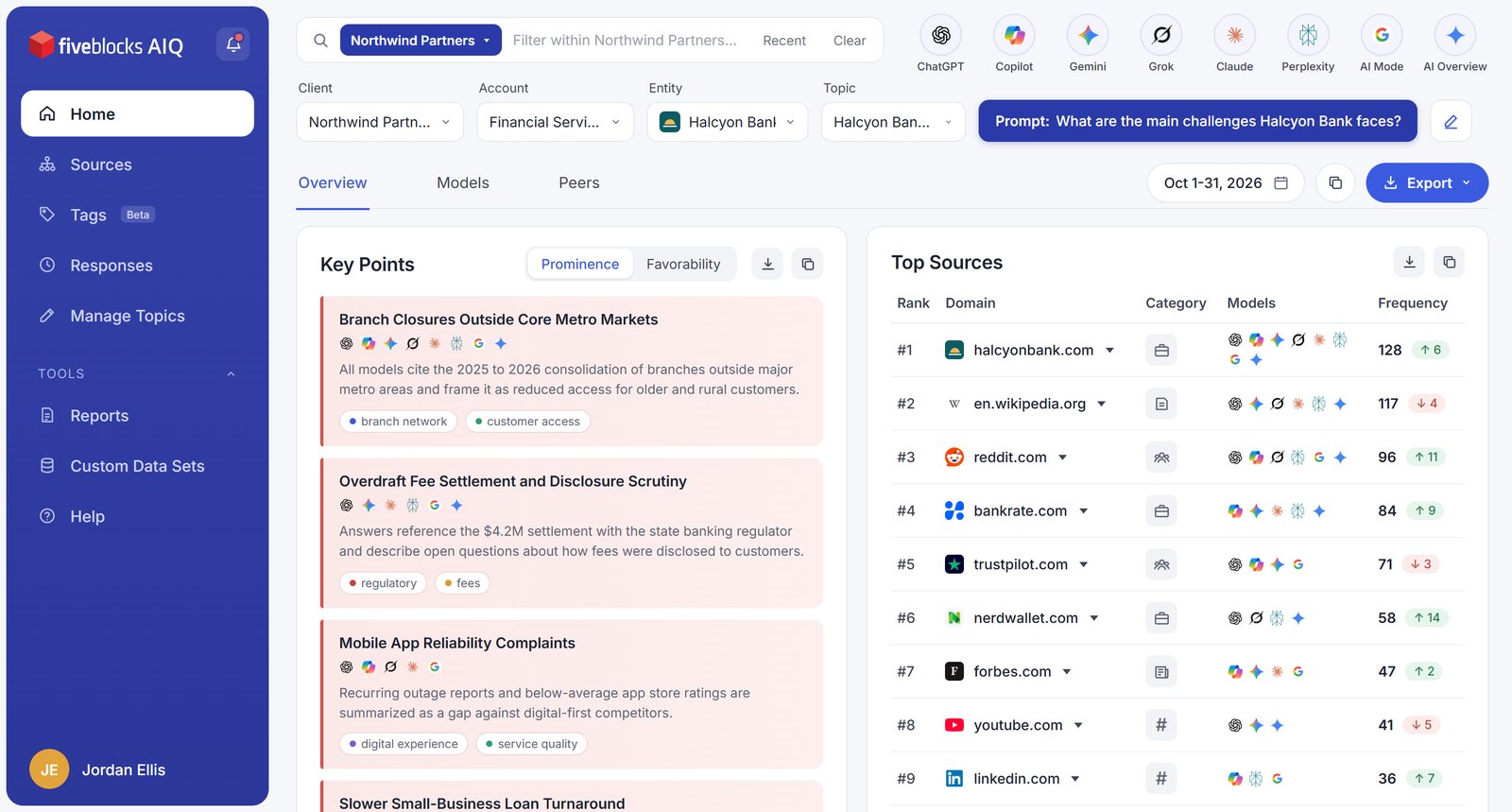
Every answer broken into points, with the sources behind them.
AIQ breaks each answer into points, flags the negative ones by severity, and groups the same point across engines. You see which engine raises an issue, how often, and which sources it relies on.
Ask the questions people ask.
Every engine, every day.
You define the topics and questions about your brand. AIQ puts them to the AI engines daily, then aggregates the answers and the sources they cite, so you know what AI is saying about you, and why.
Choose the questions
A topic is a question AIQ monitors across AI engines, for your brand, your executives and the peers you want to compare against.
Topics & peersAsk every engine
AIQ asks all eight engines every day and records every answer and every cited source.
DailyBreak it into points
Each answer becomes key points. Negative points are flagged by severity, and the same point is grouped across engines.
Points & sourcesRead the change
Compare with peers, follow changes week to week, and see which websites shape the answers.
Week to weekTell me about [brand]
What recent news is there about [brand]?
How does [brand] compare to its competitors?
Our research runs on AIQ data.
How AI describes the Fortune 100
We asked eight AI engines to “tell me about” every Fortune 100 company, every day from September 6 to October 6, 2026. Our studies of how AI describes data centers and other industries are built on AIQ data too.
- 24,675AI answers analyzed
- 181,334citations to 2,581 websites
- 82%of answers cite the company’s own website
- Engines disagree35%of negative points come from a single engine. The engines agree on facts, not problems.
- Wikipedia56%of answers cite Wikipedia, and 92% of AI Mode answers do. ChatGPT: 3%.
- Long memory43%of dated serious negatives are about events from 2020 or earlier.
More on AIQ.
Why it matters
People ask AI about you and get an answer, not a list of links.
Read more →What AIQ tracks
What AI actually says about you, not where you rank.
Read more →How it guides the work
Where the work will change what AI says.
Read more →Our other platforms
Google search, Wikipedia and location.
Read more →AIQ, answered.
What is AIQ? +
Which AI engines does AIQ track? +
How is this different from traditional media monitoring? +
How is AIQ different from GEO and AEO tools? +
Can AIQ track executives as well as companies? +
Can Five Blocks change what AI says about us? +
Can we use AIQ ourselves? +
See what AI says about your company.
We can show you what AIQ captures for your company and its peers, engine by engine, and what to do about it. Reach a senior specialist directly. For active crises, we respond promptly.
● Confidential by designA senior member of our business development team reads these. We are happy to sign an NDA in advance of your sharing anything sensitive, and we typically respond within one business day.
Members of our team, some of whom you may work with



Held in strict confidence. This site is protected by reCAPTCHA and the Google Privacy Policy and Terms of Service apply.