How does entity optimization help with Google Knowledge Panels?
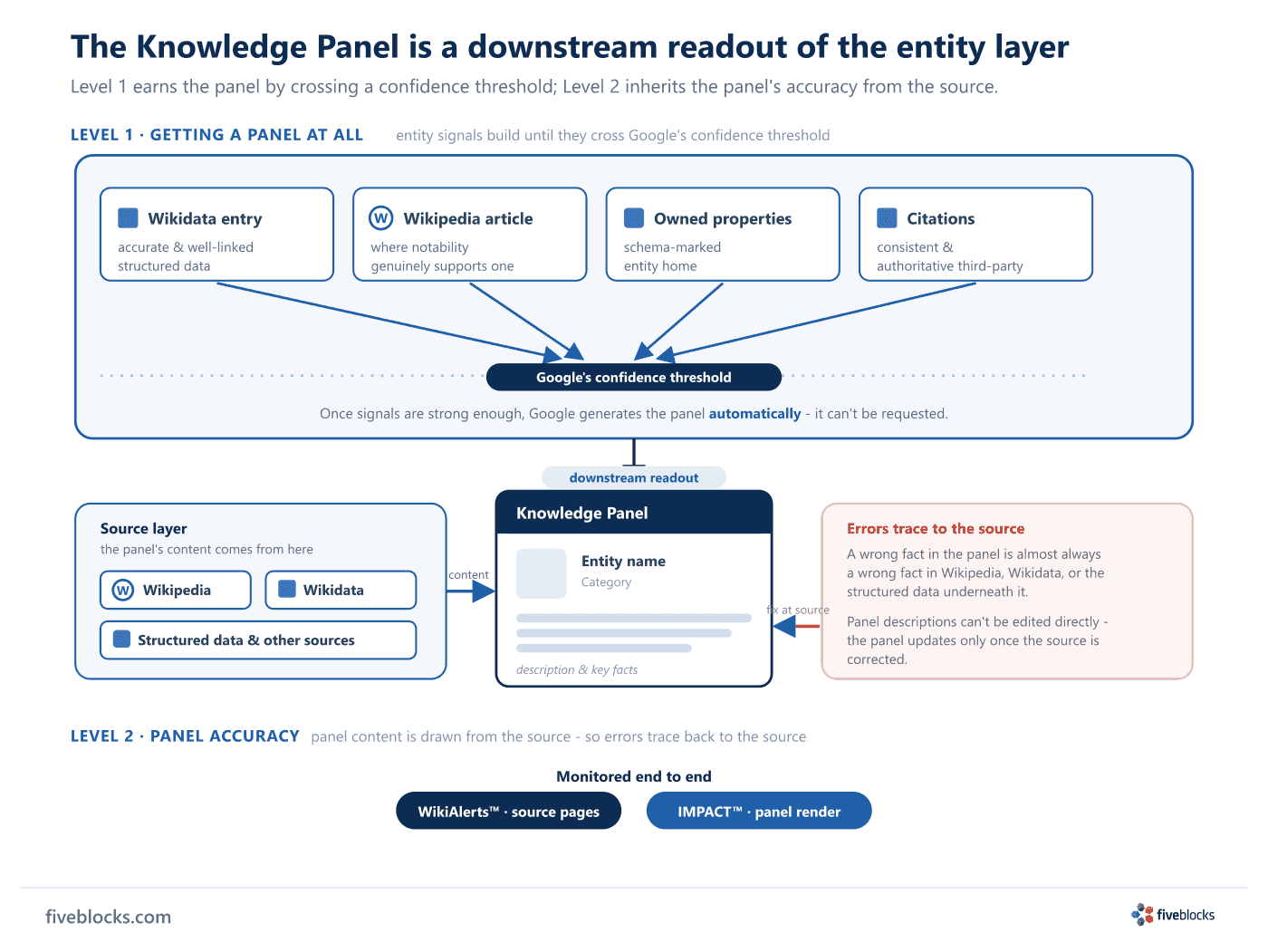
Entity optimization is what produces a Knowledge Panel. Google generates the panel automatically once an entity's signals are strong enough, and the panel's accuracy is inherited from the sources behind it, chiefly Wikipedia, Wikidata, and structured data. Treat the panel as a downstream readout of the entity layer, so errors in it are almost always errors at the source.
Entity optimization is what produces a Knowledge Panel. You cannot request a panel; Google generates it automatically once it is confident enough about an entity, and that confidence comes from the entity signals. The work runs on two levels: getting a panel at all, and getting the panel right.
Level 1: Getting a panel at all
A Knowledge Panel appears only once Google has resolved an entity with enough confidence to display it, and that confidence is built from the entity signals. The job is to strengthen those signals until they cross the threshold where Google decides the entity is real and well-defined enough to show:
- An accurate, well-linked Wikidata entry
- A Wikipedia article where notability genuinely supports one
- Schema-marked owned properties (the entity home)
- Consistent, authoritative third-party citations
Google states plainly that it decides when, where, and how a panel displays automatically, and that this is not something the company can or would influence on request. You cannot order a panel; the underlying signal strength earns it.
Level 2: Panel accuracy
Once a panel exists, what it says is drawn from those same sources. Knowledge panels are automatically generated, and the information in them comes from various sources across the web; the description and key facts in particular trace back to Wikipedia and Wikidata. This determines how you fix errors:
- An error in the panel is almost always an error in Wikipedia, Wikidata, or the structured data underneath it.
- The panel updates only once the underlying source is corrected. You cannot edit the panel descriptions directly, so you have to fix them at the source.
The panel as a downstream readout
This is why we treat the panel as a downstream readout of the entity layer rather than something to manage directly. Both mechanisms, threshold-to-display and accuracy-from-source, point to the same place: the work happens in the entity signals, and the panel reflects it. We monitor the source pages with WikiAlerts™ and track how the panel renders with IMPACT™, because the panel shows how strong the entity signals are.
Last reviewed: 20/05/2026
Sources (4)
- Submit feedback on content about you - Knowledge Panel Help support.google.com
- How Google's Knowledge Graph works (and where panel info comes from) blog.google
- How Google's Knowledge Graph works - Knowledge Panel Help support.google.com
- About knowledge panels - Knowledge Panel Help support.google.com
