How do I get a Google Knowledge Panel?
You cannot request a Knowledge Panel directly. Google generates one automatically once it is confident enough about an entity. The way to earn a panel is to build the entity signals Google reads: an accurate Wikidata entry, a Wikipedia article where notability supports one, structured data on your own site, and consistent third-party references that all describe the same entity the same way.
There is no form to fill out and no way to ask Google for a Knowledge Panel. Google’s automated systems decide when, where, and how a panel appears, and Google generates one on its own once it is confident enough about an entity. The panel reflects how well Google understands you; it is not something you publish. The real work, then, is building and aligning the entity signals Google draws on until they cross the point where Google resolves you as a distinct entity and shows the panel.
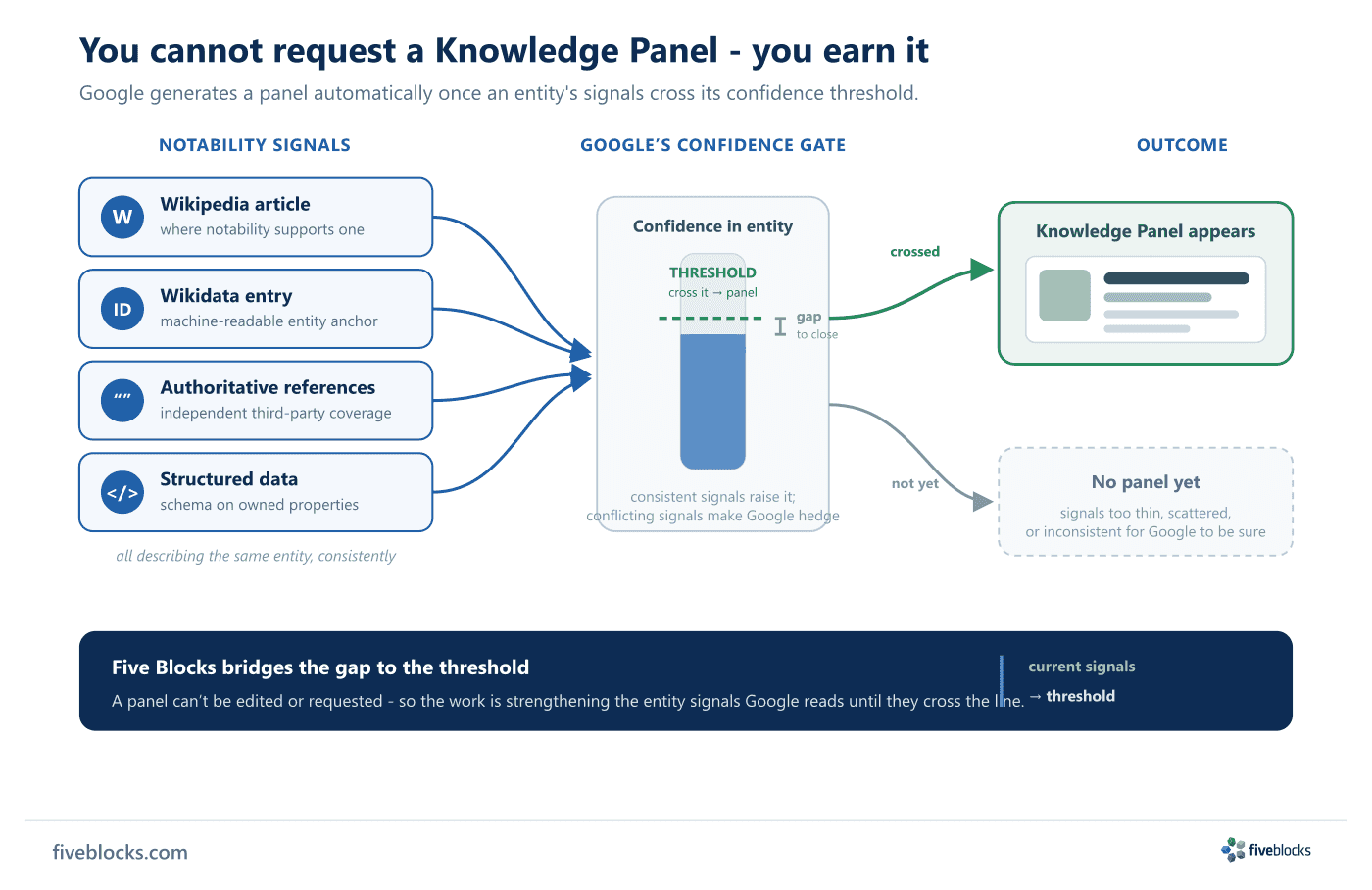
What Google reads when deciding
Google’s Knowledge Graph, the database behind the panel, is fed by sources across the web. Google has said Wikipedia is one common source but not the only one, and that it draws from hundreds of sources plus open-source and licensed databases. For an organization or person, these signals carry the most weight:
- Wikidata: a free, structured, machine-readable entry maintained by the Wikimedia Foundation that gives Google a clean entity anchor. It is one of the primary sources Google uses to populate Knowledge Panels.
- Wikipedia, where notability supports it: a Wikipedia article is viable only when the subject has significant coverage in reliable, independent secondary sources. There is no fixed number of sources, and the bar for companies (WP:NCORP) is stricter than for people or places, excluding press releases and routine business announcements.
- Structured data on your own properties: Organization or Person schema markup tells Google what your site is about and lets it gather information about the people and companies the markup describes.
sameAslinks connect that markup to your Wikipedia article, Wikidata entry, and authoritative profiles. - Consistent third-party references: directories, business references, and credible coverage that describe the same entity with the same name, description, and attributes.
A practical sequence
- Anchor the entity. Create or clean up a Wikidata entry with accurate core facts and links. It is the most achievable machine-readable anchor.
- Mark up your owned properties. Add Organization or Person schema to your official site, with
sameAslinks to your Wikidata entry, social profiles, and any Wikipedia article. - Make every signal say the same thing. Align name, description, and attributes across your site, profiles, directories, and citations. Consistent signals raise a search system’s confidence; conflicting ones make it hedge.
- Build independent coverage. Earn sustained coverage in reliable independent sources, the same evidence Wikipedia notability requires, and pursue a Wikipedia article only where that coverage genuinely supports one.
Why the gap matters
A Knowledge Panel means Google has resolved the entity with enough confidence to display it. Its absence usually means the signals are too thin, too scattered, or too inconsistent for Google to be sure. An entity with consistent signals across its website, structured data, and authoritative third-party sources is more likely to get a panel. Five Blocks works on the gap between an entity’s current signals and what a panel requires, strengthening the sources Google reads, because the panel cannot be edited or requested directly. It follows the entity layer beneath it.
Last reviewed: 19/05/2026
