What is a knowledge panel claim and how does it work?
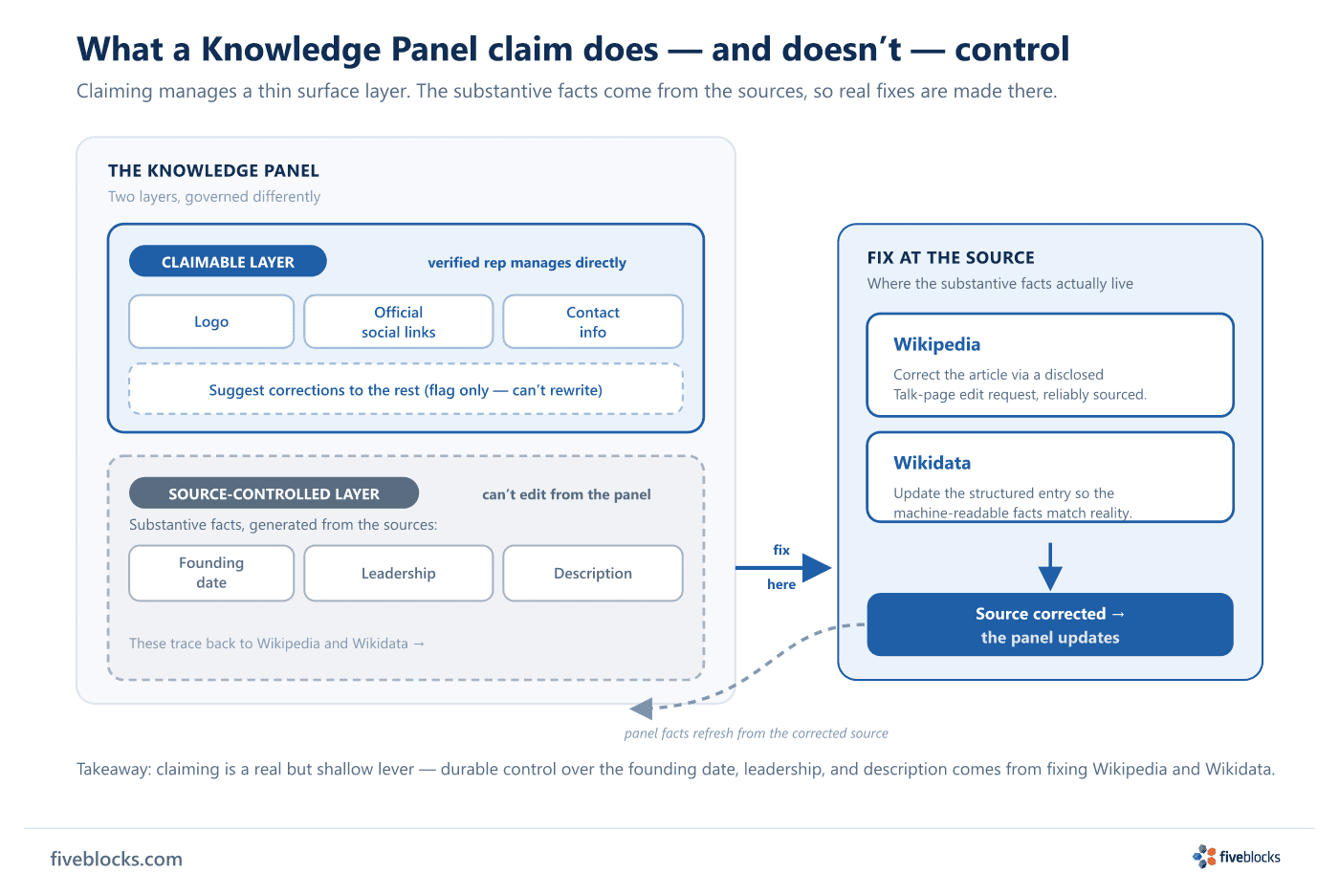
A verified representative can claim a Knowledge Panel to manage a limited set of fields - logo, official social links, and contact information - and to suggest corrections to the rest. The substantive facts trace back to Wikipedia and Wikidata, so real errors must be fixed at those sources, after which the panel updates.
A Knowledge Panel claim lets a verified representative manage a limited set of fields directly and suggest corrections to the rest. Claiming controls the surface layer; the substantive facts come from the sources behind the panel. Knowing which fields respond to which action is the difference between a cosmetic edit and a fix that holds.
Step 1: Verify and claim the panel
Google offers a verified correction process for Knowledge Panels, but first you have to prove you represent the entity. Once your identity is verified, Google can make some changes directly and opens a channel for the rest.
Step 2: Understand what claiming does – and does not – control
Claiming splits the panel into two layers, and you need to know which fields you can manage and which you can only flag:
- Claimable layer (you manage directly): the logo, official social links, and contact information, plus the ability to set certain display preferences.
- Source-controlled layer (you can only suggest corrections): the substantive facts – founding date, leadership, and the description – which are generated from underlying sources, chiefly Wikipedia and Wikidata, and cannot be rewritten from the panel.
Step 3: Fix substantive errors at the source
Because the panel’s core content is drawn from those underlying sources, a panel error is almost always an error in Wikipedia, Wikidata, or the structured data behind it. If the panel is wrong about a founding date, leadership, or description, the fix is at the source:
- Wikipedia: correct the article through disclosed conflict-of-interest editing – filing an edit request on the article’s Talk page, with reliable secondary sourcing, for independent editors to review.
- Wikidata: update the structured entry so the machine-readable facts match reality.
The panel updates only once the source is corrected. The claim is a shallow lever; lasting control over a Knowledge Panel comes from managing the entity layer underneath it.
Step 4: Monitor the source pages
Since a change at the source is what actually moves the panel, the source pages are worth watching. We monitor those pages, Wikipedia in particular, with WikiAlerts™ (wikialerts.fiveblocks.com), which tracks edits to the Wikipedia articles that feed the panel.
Last reviewed: 20/05/2026
