Does having a Wikipedia page actually improve our Google Knowledge Panel?
Yes. Wikipedia and Wikidata are among the primary sources Google uses to populate Knowledge Panels. The Wikipedia article's opening description and key facts, together with the linked Wikidata entry, typically inform the panel's content, which makes Wikipedia work one of the most reliable ways to improve Knowledge Panel quality and accuracy.
Yes, and the connection is direct. Google’s Knowledge Panel is generated automatically from its Knowledge Graph, a database of facts about entities. Wikipedia and its structured counterpart Wikidata are among the primary public sources that feed the Knowledge Graph. Improving Wikipedia and Wikidata content is one of the most consistent ways to improve a Knowledge Panel.
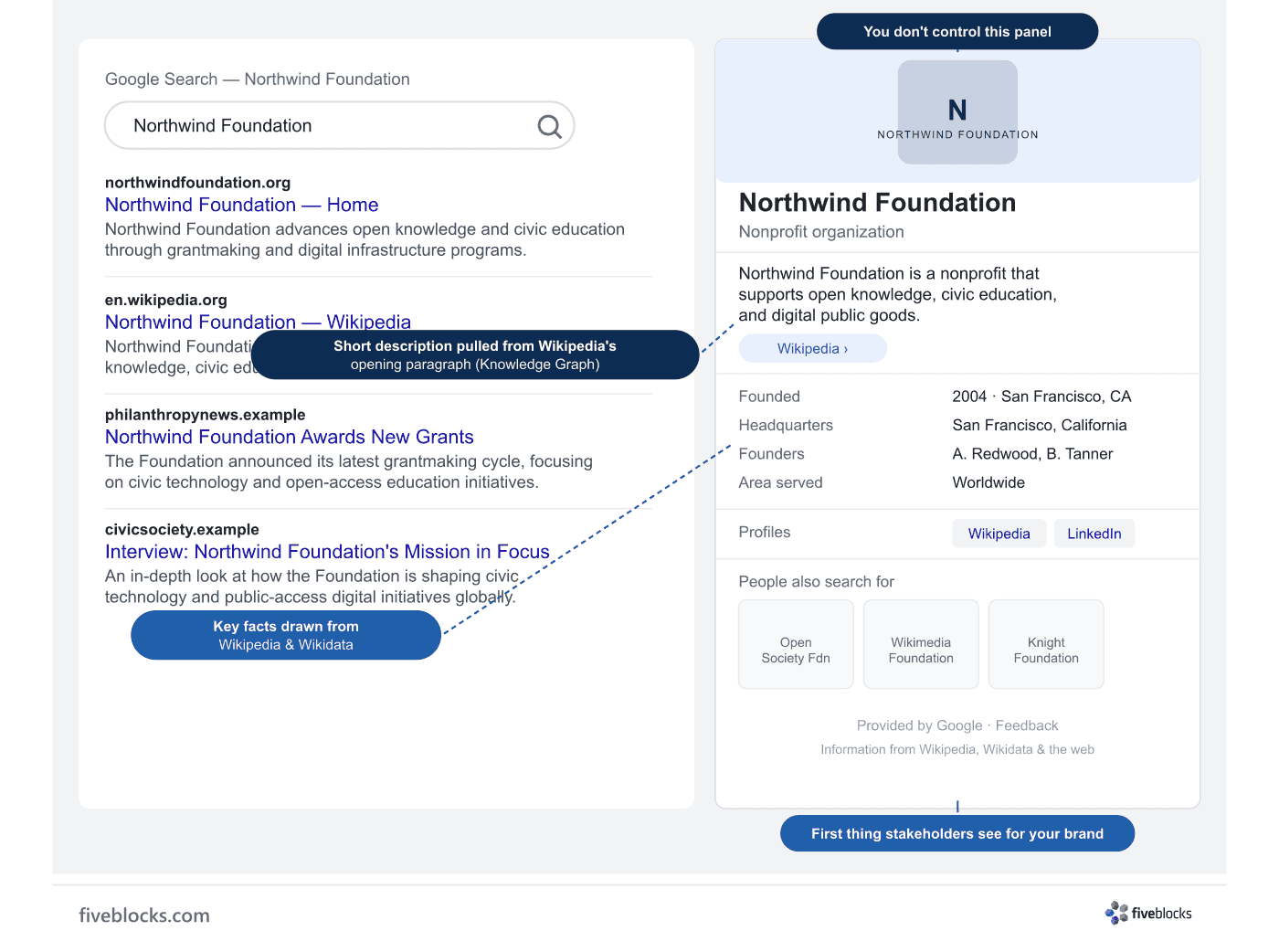
How the Wikipedia-to-panel chain works
- Short description. The panel’s one-line descriptive text is typically drawn from the opening of the Wikipedia article. Google says Knowledge Panel information comes from various sources across the web, and names Wikipedia among them.
- Key facts. Core entity facts, such as founding details, headquarters, and leadership for an organization, or occupation and education for a person, are drawn from Wikipedia and Wikidata, the structured public sources that feed the panel’s data layer. (Google does not publicly document how individual infobox fields map to individual panel fields; the relationship holds at the aggregate level.)
- Wikidata link. The Wikidata entry that mirrors a Wikipedia article gives Google a machine-readable layer to connect the entity to related entities and resolve it reliably across surfaces.
The parallel schema layer
A Knowledge Panel also draws on structured sources beyond Wikipedia and Wikidata, including the organization’s own website with schema markup, authoritative third-party listings, and licensed data feeds. So a Knowledge Panel program runs Wikipedia and Wikidata work alongside schema markup on owned properties, rather than treating one as a substitute for the other. A solid Wikipedia article with a well-linked Wikidata entry, plus correct schema markup on the client’s own site, produces a more complete and accurate panel than either does alone.
What this means for reputation work
For an entity that does not currently have a Knowledge Panel, a Wikipedia article is one of the most reliable triggers for panel generation. For an entity whose existing panel is inaccurate or incomplete, fixing the underlying Wikipedia article and its linked Wikidata entry is more dependable than Google’s direct panel feedback interface, which in practice can be slow and unpredictable. The same Wikipedia and Wikidata signals carry across AI surfaces: Google’s AI Overviews and Gemini draw on the Knowledge Graph to resolve and verify entity facts, so the accuracy work pays off beyond the panel itself.
Last reviewed: 19/05/2026
