What percentage of Google Knowledge Panels are sourced from Wikipedia?
Google does not publish the exact percentage of Knowledge Panel content sourced from Wikipedia, but Wikipedia and Wikidata are confirmed primary data sources for the Knowledge Graph that powers those panels. For most entities with a Wikipedia article, the panel's core descriptive content traces back to it, making Wikipedia work the most reliable lever for improving a Knowledge Panel in practice.
Google does not publish the exact percentage of Knowledge Panel content sourced from Wikipedia, and the breakdown varies by entity type. Google confirms only that Knowledge Panels are automatically generated from various sources across the web. Independent research and Google’s own disclosures make clear that Wikipedia and Wikidata are the leading sources among them.
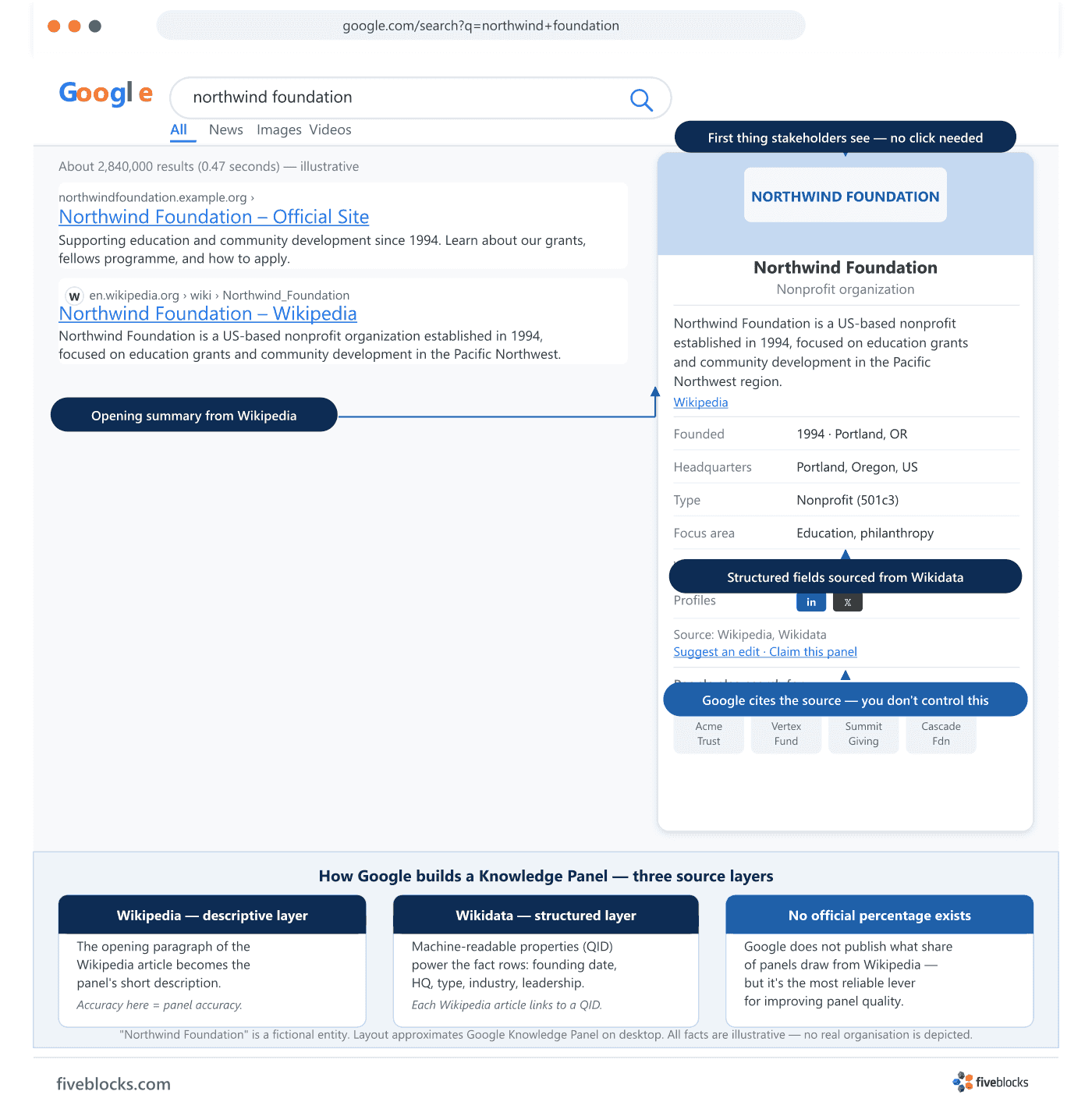
How the Wikipedia, Knowledge Panel connection works
- The Knowledge Graph is the underlying dataset. Knowledge Panels are information boxes drawn from Google’s Knowledge Graph, a large structured database of entities, relationships, and facts. Wikipedia and Wikidata are among the primary sources Google used to build that graph, and they remain ongoing inputs.
- Wikipedia supplies the descriptive layer. For most entities that have a Wikipedia article, the panel’s short description and key facts trace back to that article. Entities without a Wikipedia article often display a thinner panel, or no descriptive section at all, relying only on structured signals from other authoritative sources (such as founding date or headquarters from schema markup).
- Wikidata supplies the structured layer. Each Wikipedia article links to a Wikidata item identified by a unique QID. Wikidata stores machine-readable, language-agnostic properties, industry, founding date, CEO, parent company, and hundreds more, that Google can query directly and display as structured panel fields.
What happens without a Wikipedia article
Entities without a Wikipedia presence tend to have thinner Knowledge Panels. The descriptive layer that normally leads the panel may be absent, leaving only whatever structured signals Google can pull from other authoritative sources, schema markup, Google Business Profile, or licensed data. This is one reason Wikipedia coverage sits at the base of entity-signal work.
Last reviewed: 19/05/2026
