What is the role of Wikidata in supporting a Wikipedia page?
Wikidata is the structured-data sibling of Wikipedia: a free knowledge database run by the Wikimedia Foundation that stores machine-readable facts for every entity and links all language versions of the same article through one canonical identifier (a Q-ID). Because Google's Knowledge Graph draws on both Wikipedia and Wikidata when building Knowledge Panels, improvements to the Wikidata entry feed into how a subject is described in Google Search and in AI engines that query the Knowledge Graph.
Wikidata is a free, collaboratively edited multilingual knowledge graph hosted by the Wikimedia Foundation, the same organisation that runs Wikipedia. Wikipedia stores narrative encyclopedic text; Wikidata stores structured, machine-readable facts, the kind a computer can query directly. For reputation work, the two databases go together, and maintaining one without the other leaves value on the table.
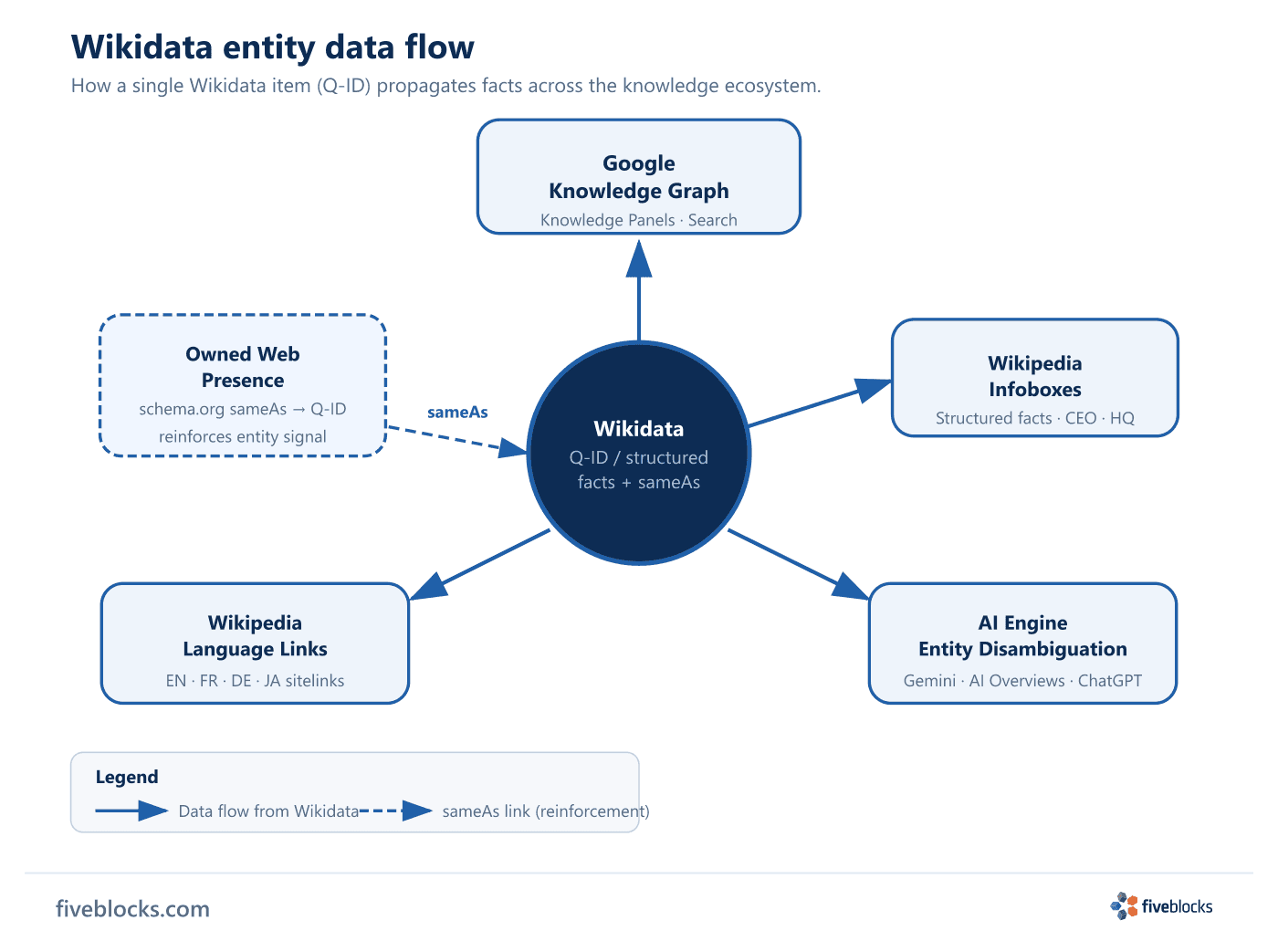
What Wikidata does
- Canonical entity identifier (Q-ID)
- Every Wikidata item receives a unique persistent identifier, a Q-number such as Q312 for Apple Inc., that anchors the entity across all languages and all platforms that read from Wikidata. This identifier lets search engines and AI systems refer to one specific entity rather than a string of text.
- Language sitelinks
- Wikidata links the English Wikipedia article, the French Wikipedia article, the Japanese Wikipedia article, and every other language version of the same topic to one central item through sitelinks. This produces the language-navigation sidebar in Wikipedia and lets Google recognise all those articles as describing the same entity.
- Structured properties
- Each Wikidata item carries structured statements: founding date, headquarters location, chief executive, parent company, industry classification, official website, and so on. These are the machine-readable facts that external systems, including Google’s Knowledge Graph, can read directly rather than parsing prose.
- sameAs links to external databases
- Wikidata items can hold identifiers from other authoritative registries (company registration numbers, regulatory IDs, social media profile identifiers). These connections are one way the entity becomes recognisable across separate systems.
Why Wikidata matters for Knowledge Panels and AI engines
Google’s Knowledge Graph draws on multiple sources when building the Knowledge Panel that appears alongside branded search results. Wikipedia and Wikidata are among its primary documented inputs. An accurate, complete Wikidata entry with clean statements feeds the structured-data layer that Google reads when it assembles the Knowledge Panel: the name, description, facts, and related entities shown to the right of search results.
AI engines that rely on Google infrastructure, including Gemini, use the Knowledge Graph to resolve entity facts. Search-backed engines such as Google AI Overviews and Gemini draw on the Knowledge Graph when summarising a subject. So an error in Wikidata, a wrong founding date, a stale CEO name, a missing parent-company relationship, can propagate into the Knowledge Panel and into AI engine outputs at the same time.
Note: The precise weight Wikidata carries relative to other inputs (Wikipedia prose, schema markup, third-party sources) in any given Knowledge Panel or AI engine response is not publicly documented by Google. The connection between Wikidata edits and Knowledge Panel updates is directional and commonly observed in practice, but the mechanism is not fully exposed.
A concrete example of what a Wikidata edit produces
Suppose a company’s Wikidata item carries the wrong CEO name because a leadership transition was updated on Wikipedia but not on Wikidata. Google’s Knowledge Panel may keep showing the previous executive’s name even after the Wikipedia article is corrected. Updating the chief executive officer statement on the Wikidata item, with the change cited to a reliable source, is the step that feeds the correction into the structured-data layer. Editors and reputation practitioners who update only the Wikipedia prose, without checking the corresponding Wikidata statements, run into this lag regularly.
The Wikidata and Wikipedia relationship in practice
- They are maintained separately. Wikipedia editors and Wikidata editors overlap but are distinct communities. A change to a Wikipedia infobox does not automatically update the corresponding Wikidata statement, and vice versa. Both need to be maintained.
- Wikidata is the interlanguage hub. Adding sitelinks in Wikidata connects a newly created English Wikipedia article to existing articles about the same entity in other languages.
- Entity disambiguation runs through Wikidata. When an AI engine meets a company name that matches multiple entities, the Wikidata Q-ID is one of the signals that helps the engine route to the correct entity. Weak or missing Wikidata entries raise the risk of conflation.
- Schema markup can reinforce Wikidata. Organization and Person schema on owned web properties can carry a
sameAslink pointing to the entity’s Wikidata Q-ID URL, strengthening the connection between the owned web presence and the structured knowledge layer.
Last reviewed: 19/05/2026
