What is the role of Wikidata in AI reputation?
Wikidata is a free, collaboratively edited knowledge graph maintained by the Wikimedia Foundation that stores entity facts as machine-readable structured data. Google's Knowledge Graph, and the Knowledge Panels it powers, is built substantially on top of Wikidata. A complete, accurate Wikidata entry is therefore the foundation of entity-optimization work.
Wikidata is the structured-data sibling of Wikipedia: same foundation, different output. Wikipedia is narrative text; Wikidata is machine-readable facts stored as property-value statements. That includes founding dates, leadership, headquarters, parent and subsidiary relationships, regulatory identifiers, and sameAs links to other databases.
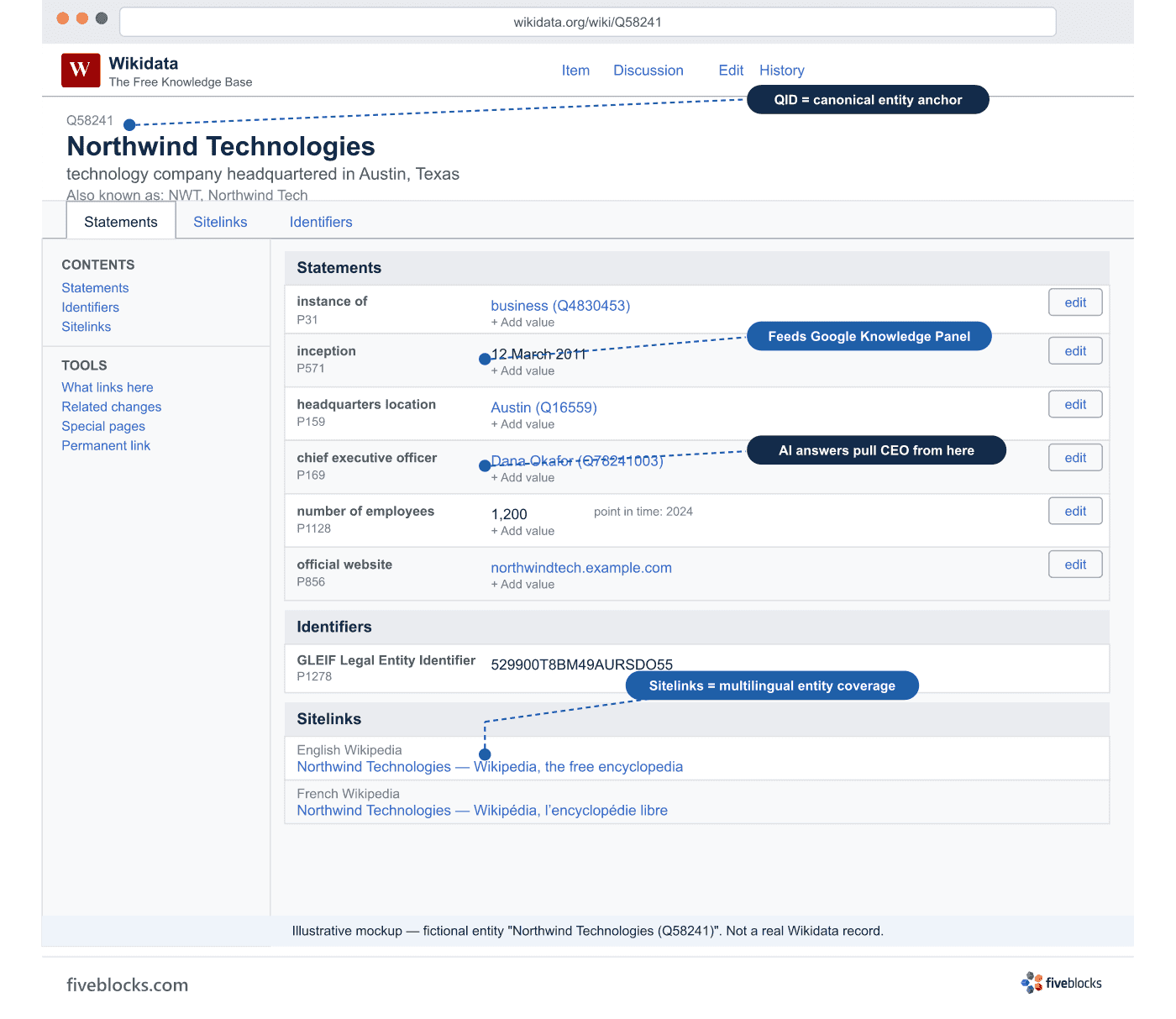
What Wikidata stores
- Unique entity identifier (QID)
- Every item on Wikidata gets a stable, globally unique QID (e.g., Q12345). This QID is the canonical anchor for the entity across all downstream systems.
- Structured property statements
- Facts are recorded as explicit property-value pairs: inception, headquarters location, chief executive officer, parent organization, subsidiary. Statements connect items to each other, which creates a linked-data structure.
- Sitelinks
- Each item can carry sitelinks that point to corresponding pages across Wikimedia projects (Wikipedia in any language, Wikisource, Wikivoyage). This makes Wikidata the multilingual hub that ties all language editions together.
- External identifiers
- Properties such as GLEIF LEI, Bloomberg company ID, and company registry numbers connect the Wikidata item to authoritative external databases. These links make the entity easier to disambiguate.
How Wikidata reaches engines and panels
- Google Knowledge Graph: Google’s Knowledge Graph draws substantially on Wikidata (and Wikipedia) as primary sources. The Knowledge Panels users see in search results are populated from this graph.
- AI Overviews and Gemini: Google AI Overviews, AI Mode, and Gemini all draw on the Knowledge Graph to resolve entities and verify facts. Wikidata errors can propagate directly into AI-generated answers.
- Language-edition coverage: Wikidata holds a single canonical item linked to all language Wikipedias via sitelinks, so a well-maintained entry improves entity recognition across every language Google (and other engines) index.
Why errors in Wikidata matter
A missing or incorrect Wikidata entry produces visible errors in AI responses: wrong founding dates, wrong leadership, wrong affiliations. The engines do not correct these errors themselves. They persist until someone edits the Wikidata item. Because the same facts replicate across Knowledge Panels, AI Overviews, and Gemini answers, a single inaccurate property can generate consistent misinformation across every surface a user might encounter.
Practical implication
Auditing and correcting a brand’s Wikidata entry is high-leverage entity-optimization work. A few hours of structured editing can correct facts that have been propagating across engines for months. Verify these fields first: founding date, headquarters, current CEO/leadership, parent organization, and external identifier links.
Last reviewed: 19/05/2026
