What is the role of knowledge panels and structured data in AI search?
Quick answer
Knowledge Panels and the Knowledge Graph are direct inputs to AI engines: Gemini and Google AI Overviews draw on the Knowledge Graph for canonical entity facts, so errors there propagate into AI answers. Fixing the entity layer (Wikidata, schema markup, and Wikipedia) is therefore one of the highest-leverage interventions in AI reputation management.
Knowledge Panels are the visible surface of Google’s Knowledge Graph, the same entity data that Gemini and Google AI Overviews query when generating answers. Several major AI engines share this underlying source, so accurate entity signals upstream translate into accurate AI outputs across multiple engines at once.
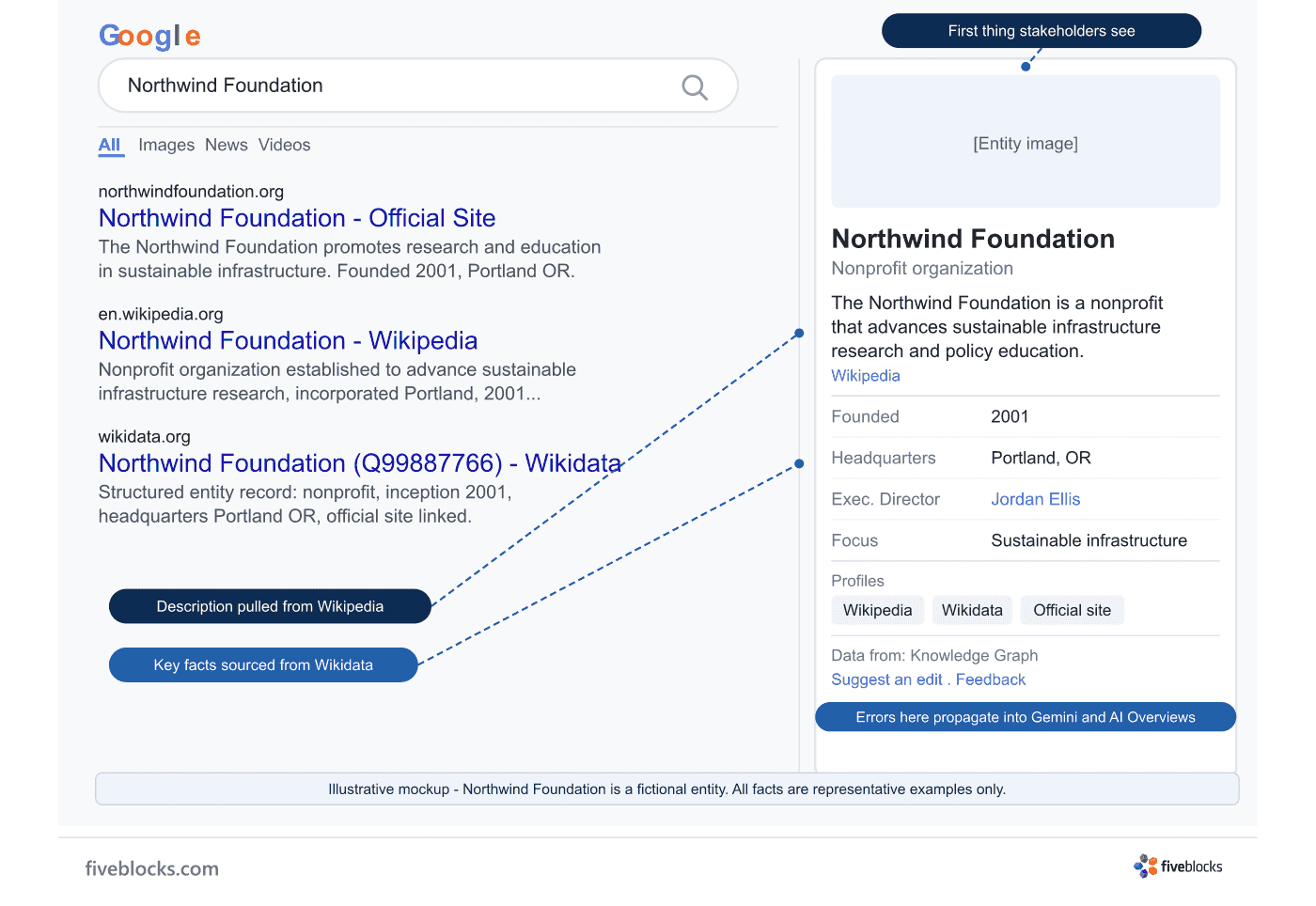
How the data flows
- Knowledge Graph
- Google’s internal database of entities (people, organizations, places, things). It is the canonical source that powers Knowledge Panels in standard search results and supplies entity context to Gemini and AI Overviews. Wikipedia and Wikidata are primary inputs into the Knowledge Graph.
- Wikidata
- A free, machine-readable structured knowledge database maintained by the Wikimedia Foundation. It assigns each entity a unique persistent identifier (QID) and supplies properties, such as founding date, headquarters, leadership, and industry, that feed both Wikipedia and the Knowledge Graph.
- Wikipedia
- A primary narrative and structured source for the Knowledge Graph. Google has confirmed its Knowledge Graph draws on Wikipedia. Wikipedia is also one of the most-cited domains across major AI engines (ChatGPT, Gemini, AI Overviews, Perplexity), so it influences AI answers through two paths: the Knowledge Graph, and direct training and retrieval.
- Schema markup / structured data
- On-page structured data (using Schema.org vocabulary) helps search and AI engines understand what a page asserts and attach that content to the correct entity. It is an authoritative first-party signal that complements third-party sources such as Wikidata and Wikipedia.
- Knowledge Panel
- The information box displayed in Google results when someone searches a known entity. It is generated automatically from the Knowledge Graph. Its visible fields, such as description, founding date, headquarters, and leadership, reflect what the Knowledge Graph has on file for that entity.
Why this matters for AI reputation
- Gemini and Google AI Overviews both draw on the Knowledge Graph to resolve entity facts and supply context in synthesized answers.
- When the Knowledge Graph holds an error, such as a wrong founding date or a former executive still listed as current CEO, Gemini and AI Overviews frequently repeat that error.
- Correcting the entity layer (Wikidata properties, Wikipedia content, schema markup on the official site) tends to propagate corrections across multiple AI engines at once, because those engines share the same upstream sources.
- AI model outputs cannot be edited directly. Influence works by improving the sources the models draw on.
Last reviewed: 19/05/2026
