How do you prepare a company for Wikipedia readiness over 12-18 months?
A 12 to 18 month Wikipedia readiness program runs four parallel tracks: Press strategy, Authority development, Entity work, and quarterly readiness re-assessments. It moves to Draft and Submit only when the source record clearly supports it. Build the source base first; write the article second.
For borderline corporate subjects, a 12 to 18 month readiness program is the standard path to a Wikipedia article that survives. Acting before the source record supports it produces drafts that get challenged or deleted. The program runs four tracks at once, with a gate before any drafting begins.
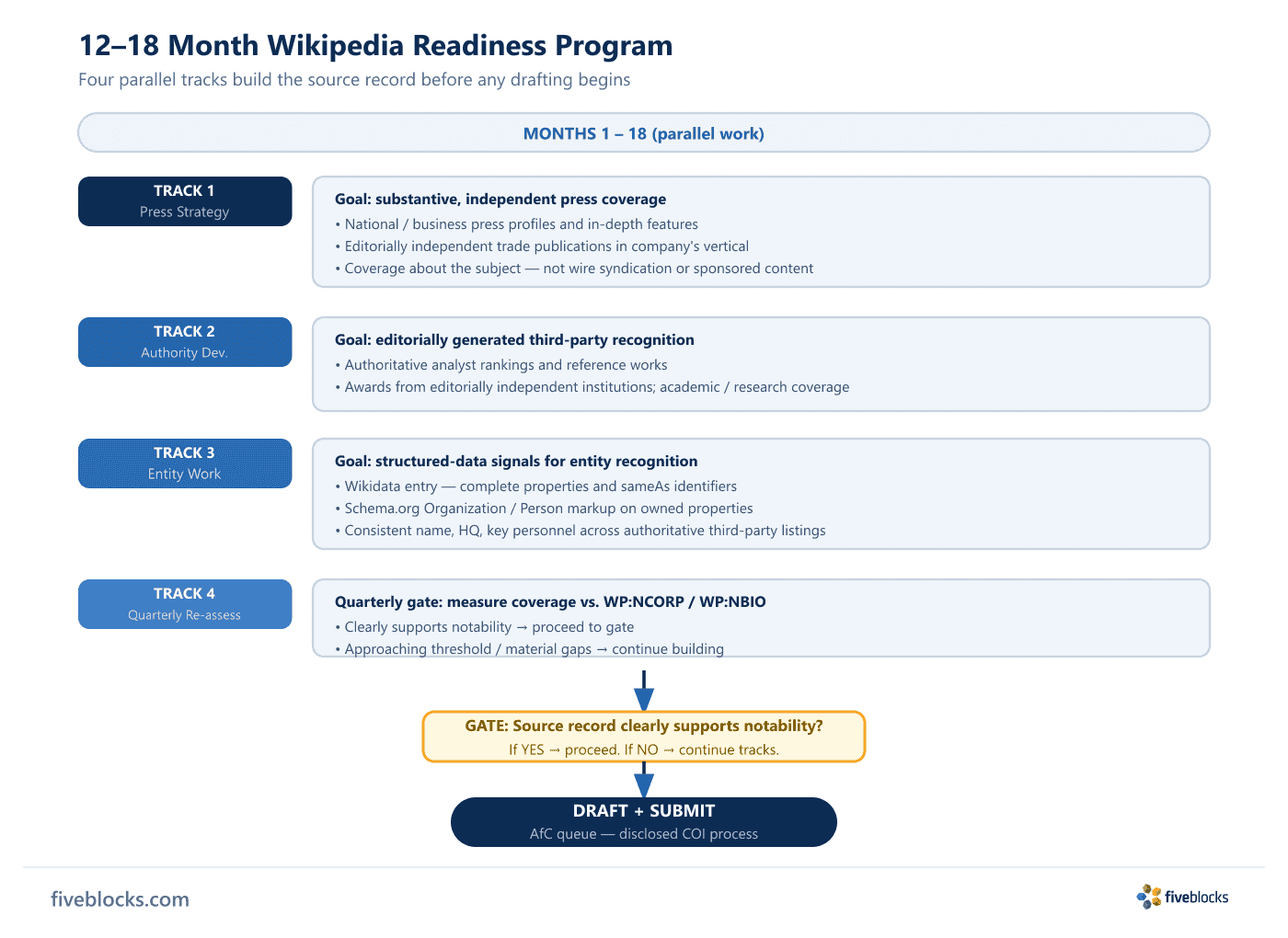
Track 1: Press strategy
Aim for substantive, independent coverage in outlets Wikipedia editors treat as reliable sources. That means:
- Profiles and in-depth features in major national and business press, not announcements or passing mentions
- Substantive coverage in editorially independent trade publications in the company’s sector
- Coverage that is about the subject, not a quote from an executive in an unrelated story
- Wire-service syndication and sponsored content do not count toward notability
Track 2: Authority development
Independent recognition from established bodies strengthens the notability case when it is editorially generated:
- Inclusion in authoritative analyst rankings or reference works
- Awards from established institutions with editorial independence
- Academic or research coverage that treats the subject in depth
Track 3: Entity work
Structured-data signals improve entity recognition and help any future article hold:
- Wikidata entry with complete, accurate properties and sameAs identifiers
- Schema.org Organization or Person markup on owned properties
- Consistent entity attributes (name, HQ, senior personnel) across authoritative third-party listings
- Disambiguation signals where needed
Track 4: Quarterly readiness re-assessment
Every quarter, the source record is measured against Wikipedia’s notability standard (WP:NCORP for organizations; WP:NBIO for biographies). The assessment answers whether the existing coverage clearly supports notability, is approaching the threshold, or still has material gaps. Drafting is not recommended until the record clearly passes this gate.
Gate: Draft + Submit
Only when the quarterly assessment confirms the source record supports notability does the engagement move to drafting. The draft is submitted through the disclosed conflict-of-interest (COI) process via the Articles for Creation (AfC) review queue. Source base first, draft second: that order is what produces articles that survive instead of articles that get nominated for deletion.
Last reviewed: 19/05/2026
