What if my company does not have a Wikipedia page?
Whether a missing Wikipedia article is a problem depends on whether the subject meets Wikipedia's notability standard: significant coverage in reliable, independent sources. Subjects that meet the threshold move directly to drafting and disclosed COI submission. Those that do not have to build the underlying source record first, because forcing an article without adequate coverage produces deletions, not articles.
A missing Wikipedia article is not always a problem to fix right away. The question to answer first is whether the subject already meets Wikipedia’s notability standard, which is a factual question, not a marketing one. The answer decides which of two paths applies.
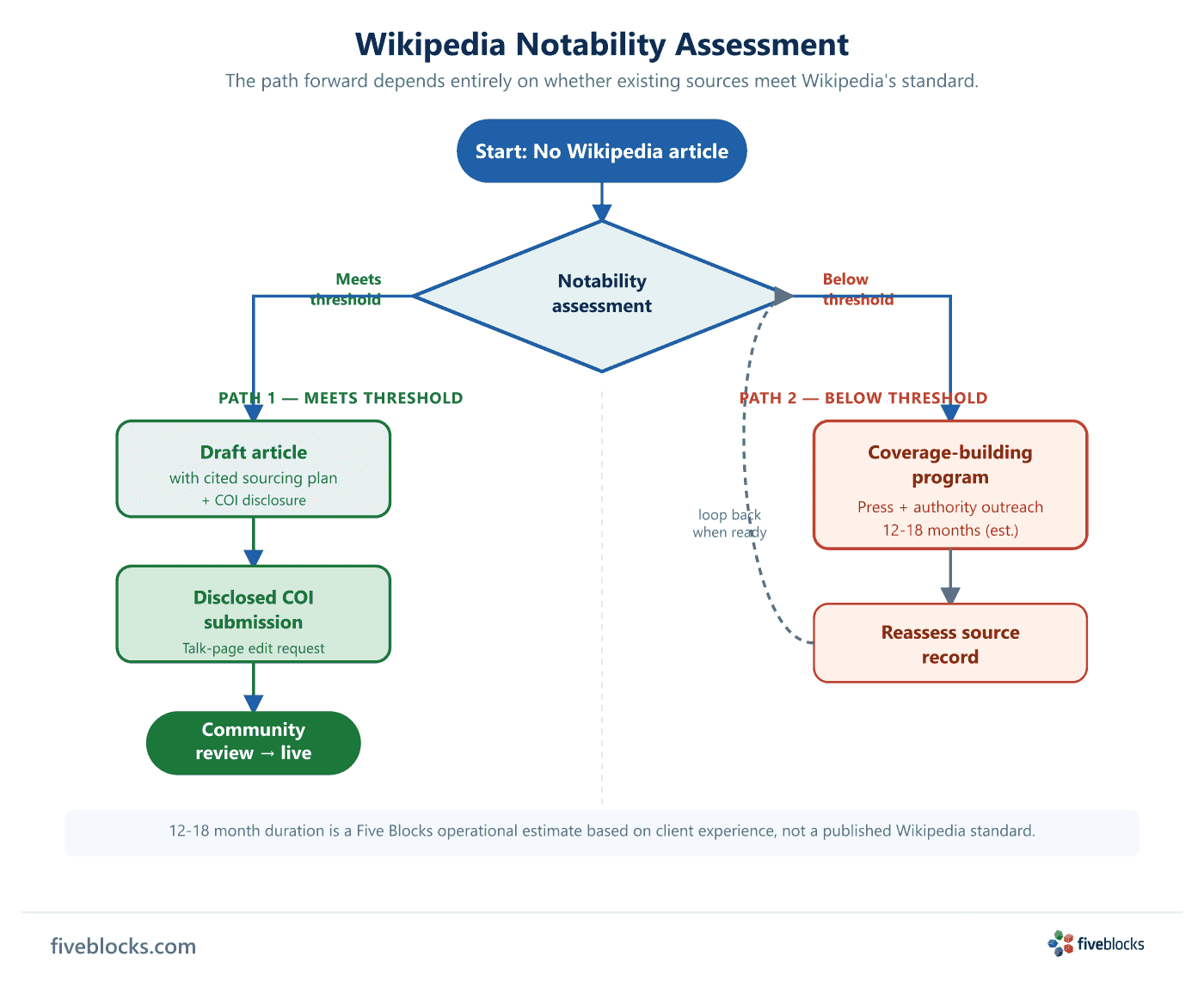
Path 1: meets the notability threshold, proceed to drafting
When a subject already meets the threshold, the work moves directly to drafting and submission through the disclosed conflict-of-interest (COI) process. Wikipedia’s rules require paid editors to disclose their relationship and propose changes through Talk-page edit requests rather than editing the article directly, and an uninvolved community reviewer evaluates the draft before it reaches mainspace. A sourcing plan and realistic expectations about community review are part of that workflow.
Path 2: below the threshold, build the source record first
When a subject does not yet meet the threshold, pushing for an article through procedural channels is the wrong move. An under-sourced submission produces deletions, not articles, and a deleted article is harder to recreate than one that was never submitted. The better route is a press and authority program that builds the underlying coverage until the source record supports the article. The drafting is then straightforward.
Note on timeline: how long a coverage-building program takes depends on how close the subject is to the threshold. Borderline cases usually need sustained effort over an extended period. This is a Five Blocks operational estimate based on client experience, not a published Wikipedia standard.
What “meets the threshold” means in practice
Wikipedia’s notability standard (WP:N) requires that a topic has received significant coverage in reliable sources independent of the subject. For companies and organizations, Wikipedia applies a stricter guideline (WP:NCORP) that emphasizes source quality and independence and excludes routine business coverage. These criteria govern the assessment:
- Multiple sources required. No fixed number is prescribed, but multiple sources are expected, and quality and depth weigh more than count.
- In-depth, independent coverage. Each source must cover the subject directly and substantively, not in passing and not as a quotation inside a story about something else.
- Reliable, secondary sources. Sources must be professionally published, fact-checked, and editorially independent of the subject.
- Excluded source types. Press releases, sponsored content, wire-service syndications of company announcements, routine business notices (capital transactions, personnel announcements, product launches), and the company’s own materials do not count toward notability, wherever they appeared.
- Span and diversity. Coverage concentrated in a single outlet or a single news cycle carries less weight than coverage across several editorially independent outlets over time.
We catalog the existing source record against these criteria during the readiness assessment, and that determines which path applies.
Last reviewed: 19/05/2026
