What is Wikipedia readiness and how do you assess it?
Wikipedia readiness is the assessment of whether a subject's existing third-party coverage meets Wikipedia's notability standard before drafting begins. It produces one of three results: ready (proceed to drafting), close but gaps (specific sourcing work needed first), or not ready (coverage does not yet exist). Running the assessment first avoids the more expensive outcome of pursuing an article that gets nominated for deletion.
Readiness is the first question to answer before recommending a Wikipedia article: does this subject have the source record to clear the notability bar, and how likely is acceptance? Skipping that question wastes the client’s time and risks a deletion that makes a future article harder to create.
Step 1: Catalog the source record
We assemble every substantive piece of independent third-party coverage that counts as a reliable secondary source: in-depth profiles in major newspapers, analytical features in trade publications with editorial standards, books, and peer-reviewed references. We exclude what does not count: press releases, wire-service syndications of company announcements, sponsored content, and the subject’s own materials.
Step 2: Evaluate against the applicable notability standard
Wikipedia’s notability rules differ by subject type. Companies are assessed under WP:NCORP, a stricter bar that requires in-depth independent coverage and excludes routine business announcements. Individuals are assessed under WP:NBIO. The General Notability Guideline applies as a baseline to all subjects. We identify which standard applies and measure the assembled sources against it.
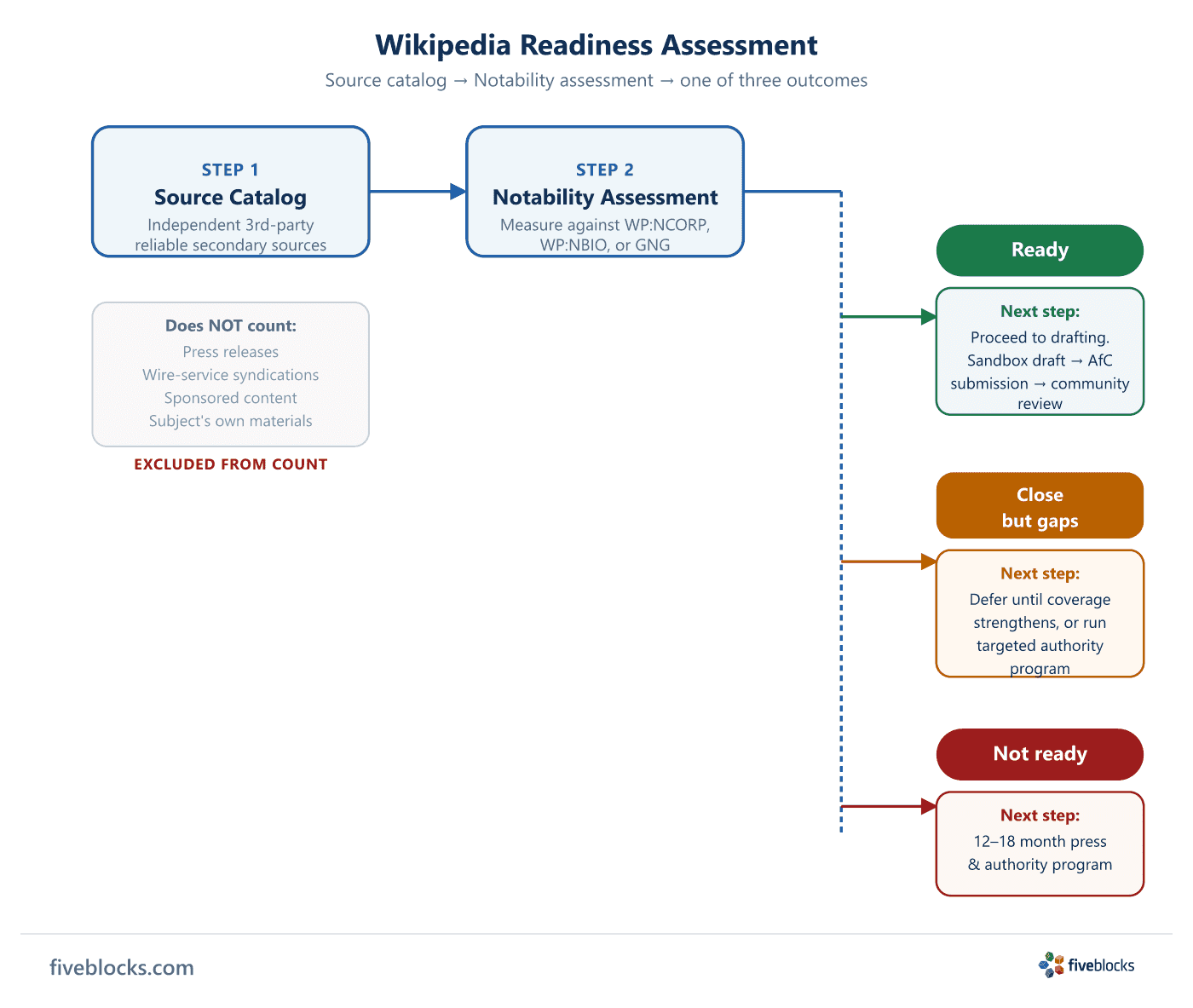
Step 3: Deliver one of three readiness outcomes
- Ready, proceed to drafting. The source record supports notability. We move into the disclosed conflict-of-interest creation process: sandbox drafting, submission through Articles for Creation, and open engagement with community review.
- Close but gaps. Coverage is substantive but falls short on one or more of the required dimensions (depth, independence, source variety, span of time). We identify the specific gaps and recommend either a deferral until coverage strengthens or a targeted authority program to fill the named gaps before attempting the article.
- Not ready. The underlying coverage does not yet support notability. We say so directly and recommend a 12 to 18 month press and authority program to build the source record before the Wikipedia question is revisited. Pursuing an article now would produce a deletion, and a deletion makes the next attempt harder.
Running this assessment first, with an honest read across the three outcomes, saves clients from the far more expensive downstream problem of an article nominated for deletion shortly after creation.
Last reviewed: 19/05/2026
