What are common reasons Wikipedia pages get rejected?
Wikipedia Articles for Creation submissions are most often declined for four reasons: insufficient notability (sources too few, too shallow, or not independent), promotional language that reads as marketing copy, undisclosed conflicts of interest, and thin secondary coverage that cannot support the article's substance. Each is fixable, but the fix belongs in the readiness work that should precede submission, not in the article text itself.
Wikipedia rejections at Articles for Creation follow predictable patterns. Most trace back to problems that should have been caught during the readiness assessment, before the draft was written. The four causes below account for most declines.
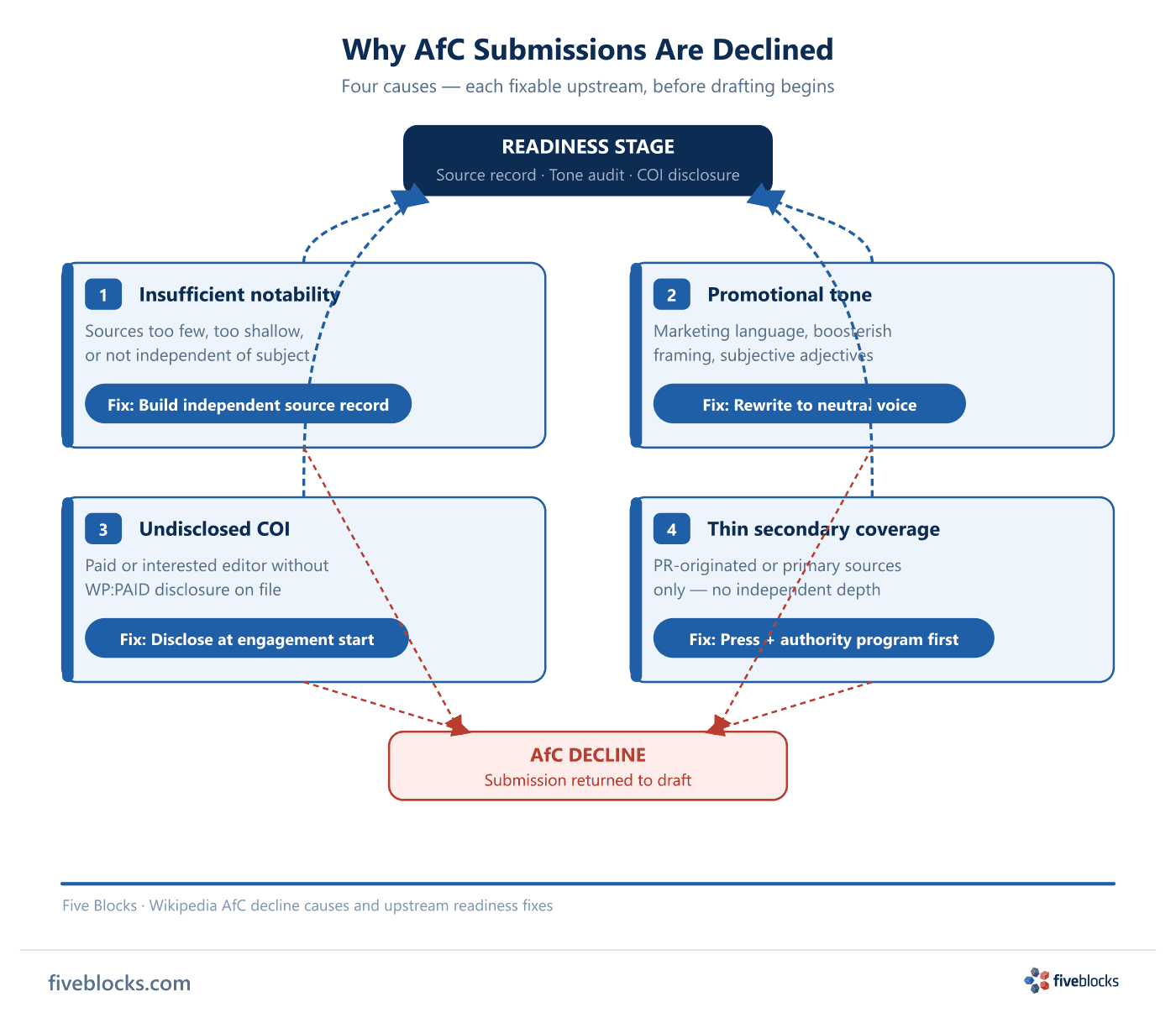
- Insufficient notability
- The most common cause. The sources cited in the draft do not establish that the subject deserves encyclopedic treatment: there are too few of them, they are not deep enough, or they are not genuinely independent of the subject. Wikipedia’s notability standard requires significant coverage in multiple reliable, independent, secondary sources. Sources that quote the subject in passing, or that originate from the subject’s own communications, do not count toward that bar. The fix comes earlier: build the source record before submission, not after a decline.
- Promotional tone
- Language that reads as marketing copy, subjective adjectives, and undue emphasis on awards or rankings is grounds for decline. Wikipedia requires a neutral encyclopedic voice throughout. Promotional content is one of the clearest signals to reviewers that a draft was not written with the encyclopedia in mind. The fix is rewriting to the facts: sourced, neutral, and proportionate in what it emphasizes.
- Undisclosed or inadequately disclosed conflict of interest
- A paid or interested editor who submits without disclosing the relationship risks having the submission flagged and returned. Wikipedia’s terms of use require disclosure of the paid relationship on the editor’s user page and the draft’s Talk page before submission. Transparency also matters in practice: reviewers recognize the patterns of interested editing, and an undisclosed relationship discovered during or after review does more damage than one disclosed upfront. The fix is disclosure at the start of the engagement, not as an afterthought.
- Thin or non-independent secondary coverage
- Even a well-written, neutrally framed draft is declined when the underlying source material cannot support the article’s substance. Press releases, wire-service syndications of company announcements, sponsored content, and the subject’s own materials do not count as independent secondary sources, wherever they were published. If the only available sources are primary or PR-originated, the article cannot yet be submitted, and the right path is to build the independent source record first. Submissions with this problem often need a press and authority program before any article work can proceed.
Each cause has a clear fix, and each fix sits earlier than the article itself. A readiness assessment that catches these problems before drafting produces a submission that moves through review cleanly. Skipping that step produces a decline that makes the next submission harder.
Last reviewed: 19/05/2026
