What is the role of Crunchbase and Bloomberg in entity optimization?
Crunchbase and Bloomberg are widely-cited business-entity references that feed Google's entity systems. A complete, accurate Crunchbase profile supplies structured business data - founding, funding, leadership, category - that the systems use to define and corroborate a company entity, and it is one of the easier authoritative anchors to secure for a company without a Wikipedia article.
Crunchbase and Bloomberg are authoritative business-entity references, and they carry more weight than their direct traffic suggests because Google’s entity systems treat sources like them as credible, structured third-party information about companies. A claimed, complete profile becomes a corroborating anchor in the entity stack, and it is especially useful for a company that does not yet have a Wikipedia article.
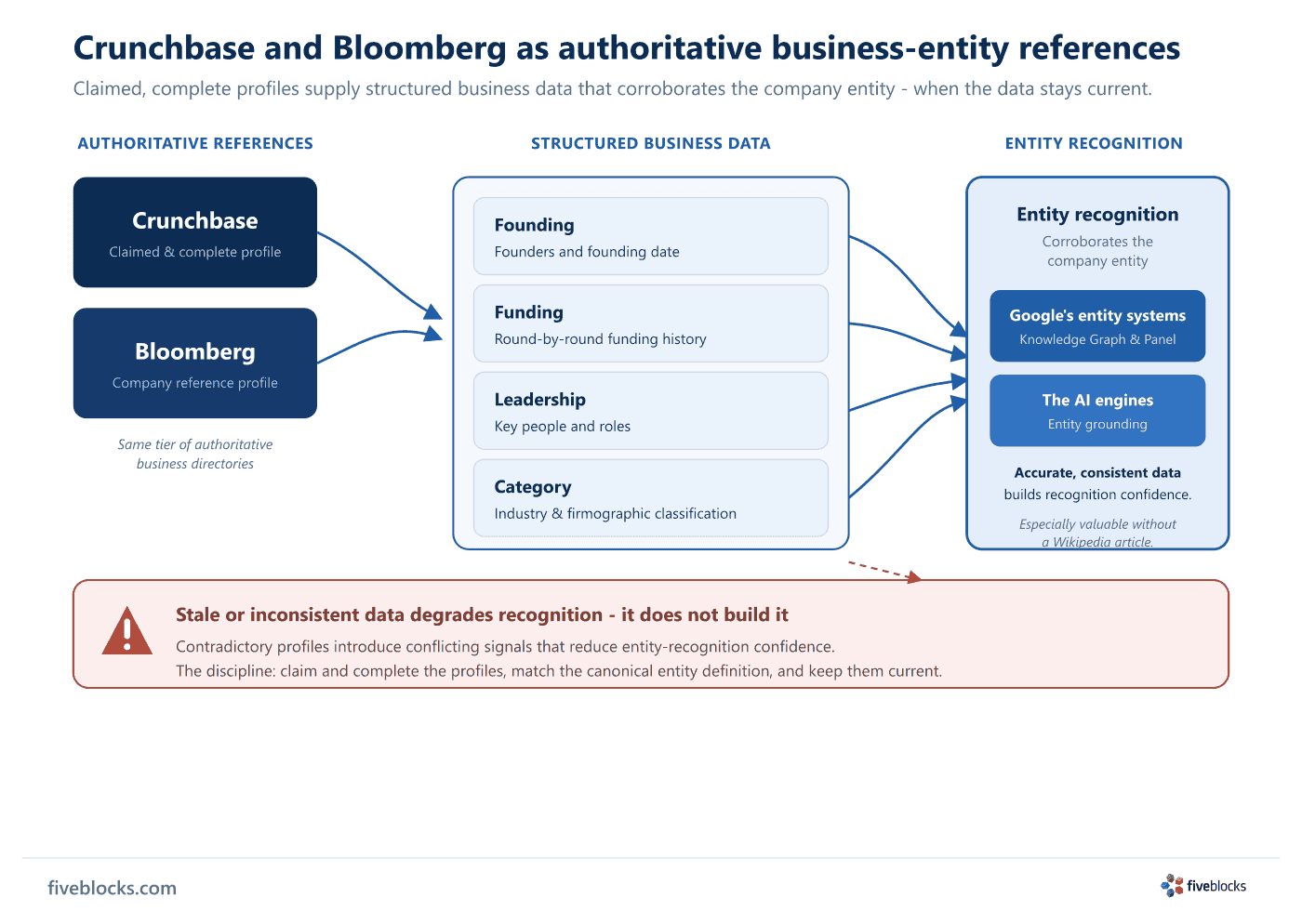
What data these references supply
A complete, accurate Crunchbase profile supplies the structured business data the systems use to define and corroborate a company entity:
- Founding, founders and founding date.
- Funding, round-by-round funding history.
- Leadership, the people in charge and their roles.
- Category, industry and firmographic classification.
Bloomberg’s company references sit alongside Crunchbase in the same tier of authoritative business directories within the company entity stack.
Why they matter more than their traffic
Google pulls information into the Knowledge Graph from reputable business profiles, Crunchbase among them. Because these references are treated as credible structured sources, an accurate profile does a lot of the work of defining the entity, and Crunchbase in particular is one of the easier authoritative anchors to secure for a company without a Wikipedia article.
Claim, complete, keep current
The work is to claim and complete these profiles, make the data match the canonical entity definition across the rest of the stack, and keep it current. Inconsistent signals across a company’s references introduce conflicting information that can reduce entity-recognition confidence, so stale or contradictory data on a widely-cited reference degrades recognition instead of building it. We treat these as priorities in company entity work and check their contribution with AIQ.
Last reviewed: 20/05/2026
