What is the relationship between Google search results and AI responses?
Google web results and AI responses draw from the same source signals: Wikipedia, the Knowledge Graph, authoritative news, structured data, and owned-property content. They combine those signals differently and update on different clocks. A reputation program that strengthens the shared source layer moves both outputs, on different timelines.
Google web results and AI responses look like separate outputs, but the same source signals feed both: Wikipedia, the Knowledge Graph, authoritative news, structured data markup, and owned-property content. The difference is not in the inputs. It is in how each output combines them and how quickly each one updates when those inputs change.
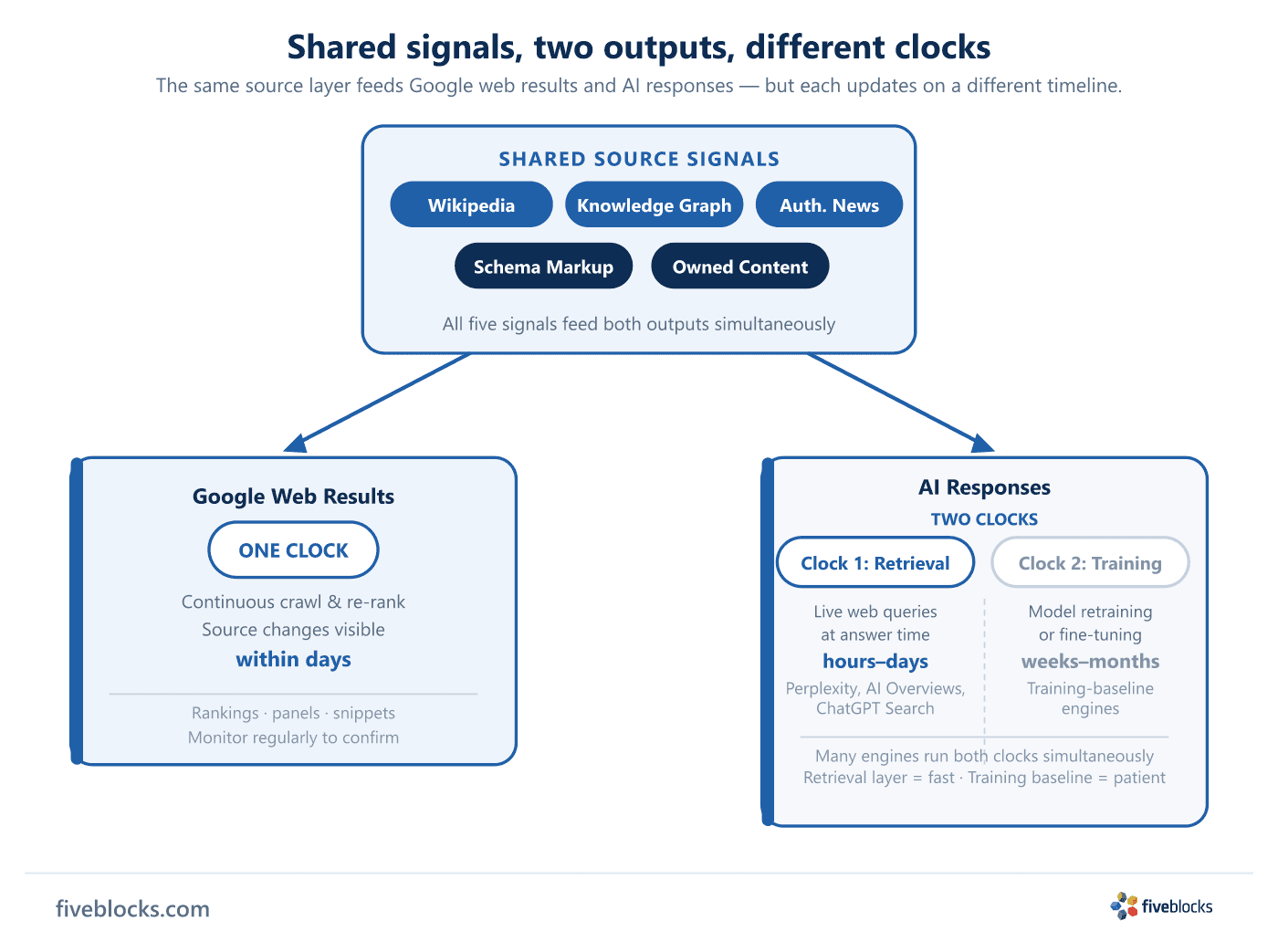
Shared signals, different outputs
| Google web results | AI responses | |
|---|---|---|
| Primary input signals | Wikipedia, Knowledge Graph, authoritative news sources, structured data (schema markup), owned-property quality | |
| Output type | Ranked links with SERP features (Knowledge Panels, featured snippets) | Narrative answers assembled across retrieval and training modes |
| Update mechanism | Re-ranks with each crawl cycle; index refreshes are continuous | Two clocks: retrieval-equipped engines (Perplexity, ChatGPT Search, AI Overviews) fetch live at query time; training-baseline responses change only at the next model update |
| Update speed | New or changed content typically visible in results within days | Retrieval-mode: hours to days; training-baseline: weeks to months, depending on the engine’s retraining cycle |
| Practical implication | Source improvements show up quickly; monitor regularly to confirm | Retrieval engines respond quickly; training-baseline engines need patience and a sustained source presence |
The two-clock model for AI responses
AI engines do not run on a single update cycle. Retrieval-augmented engines, including Perplexity, ChatGPT Search, and Google AI Overviews, issue live web queries at answer time and can reflect a source change within hours or days. Engines that rely mainly on their training baseline change only when the model is retrained or fine-tuned, a cycle that runs over months. Many engines combine both modes: a retrieval layer for freshness and a training layer for deeper context. Source improvements feed the retrieval layer quickly. Shifting the training baseline durably takes a sustained, authoritative source presence over time.
Why source-layer work moves both outputs
Because the inputs are shared, a reputation program does not need a separate playbook for Google versus AI. Strengthening Wikipedia coverage, earning links from authoritative news sources, applying schema markup correctly, and publishing credible owned content all feed both layers at once. The response curves differ: Google web results shift within days, retrieval-mode AI within days, and training-baseline AI over months. Expect fast visibility on the Google side and build patience into the AI side.
Last reviewed: 19/05/2026
