How does Wikipedia content feed into AI model responses?
Heavily. Wikipedia was part of the training corpus for every leading LLM and remains one of the most-cited sources in AI retrieval today. It also feeds the Google Knowledge Graph and Wikidata that engines like Gemini query directly for entity facts, so the article you have (or don't have) affects what every major engine says about your brand.
Wikipedia is central to how AI engines describe most companies, people, and topics. It contributed to the training corpus of every leading language model, it is one of the most-cited sources in retrieval-augmented AI engines, and it feeds the Google Knowledge Graph and Wikidata that engines such as Gemini query directly for entity facts.
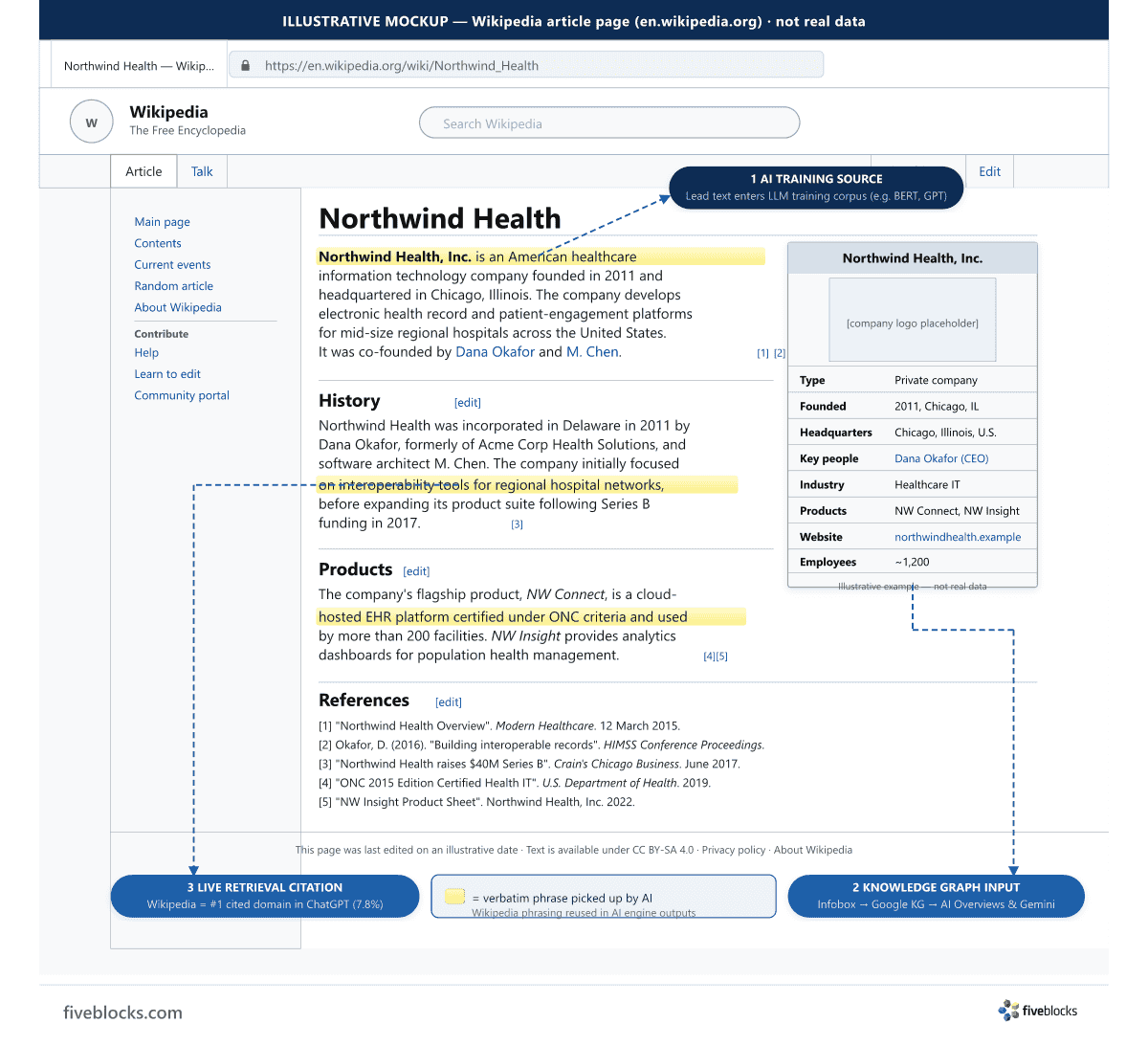
Three routes from Wikipedia to an AI response
- Training data. Wikipedia has been part of LLM training since the earliest models. BERT was trained on 2,500 million Wikipedia words; GPT-3 drew roughly 3 billion tokens from Wikipedia. Every major model that followed used a comparable or larger Wikipedia component.
- Live retrieval. Retrieval-equipped engines favor Wikipedia at query time and often cite it directly with an inline link. A Profound analysis of ChatGPT citation patterns found Wikipedia is ChatGPT’s most-cited single domain at 7.8% of total citations. A Semrush three-month study found Reddit and Wikipedia are ChatGPT’s two most-cited domains.
- Knowledge Graph and Wikidata. Wikipedia and Wikidata are primary inputs to Google’s Knowledge Graph, which populates Knowledge Panels and feeds AI Overviews, AI Mode, and Gemini’s entity synthesis. When the Knowledge Graph has a fact wrong, those downstream engines tend to repeat it.
What this means in practice
For any subject that has a Wikipedia article, AI engines will draw on that article when asked, paraphrasing its structure, its framing, and the sources it cites. For any subject that does not have one but meets Wikipedia’s notability standard, the absence matters too: the engines fall back on weaker, less consistent sources, and the picture they produce is less reliable and harder to shape.
That is why Wikipedia work belongs at the center of any AI reputation program rather than at the edges: disclosed COI editing, edit requests on Talk pages, sourcing improvements, NPOV maintenance, and careful article development where notability is met.
Last reviewed: 19/05/2026
