Why does ChatGPT seem to pull my company’s Wikipedia article verbatim when I ask about us?
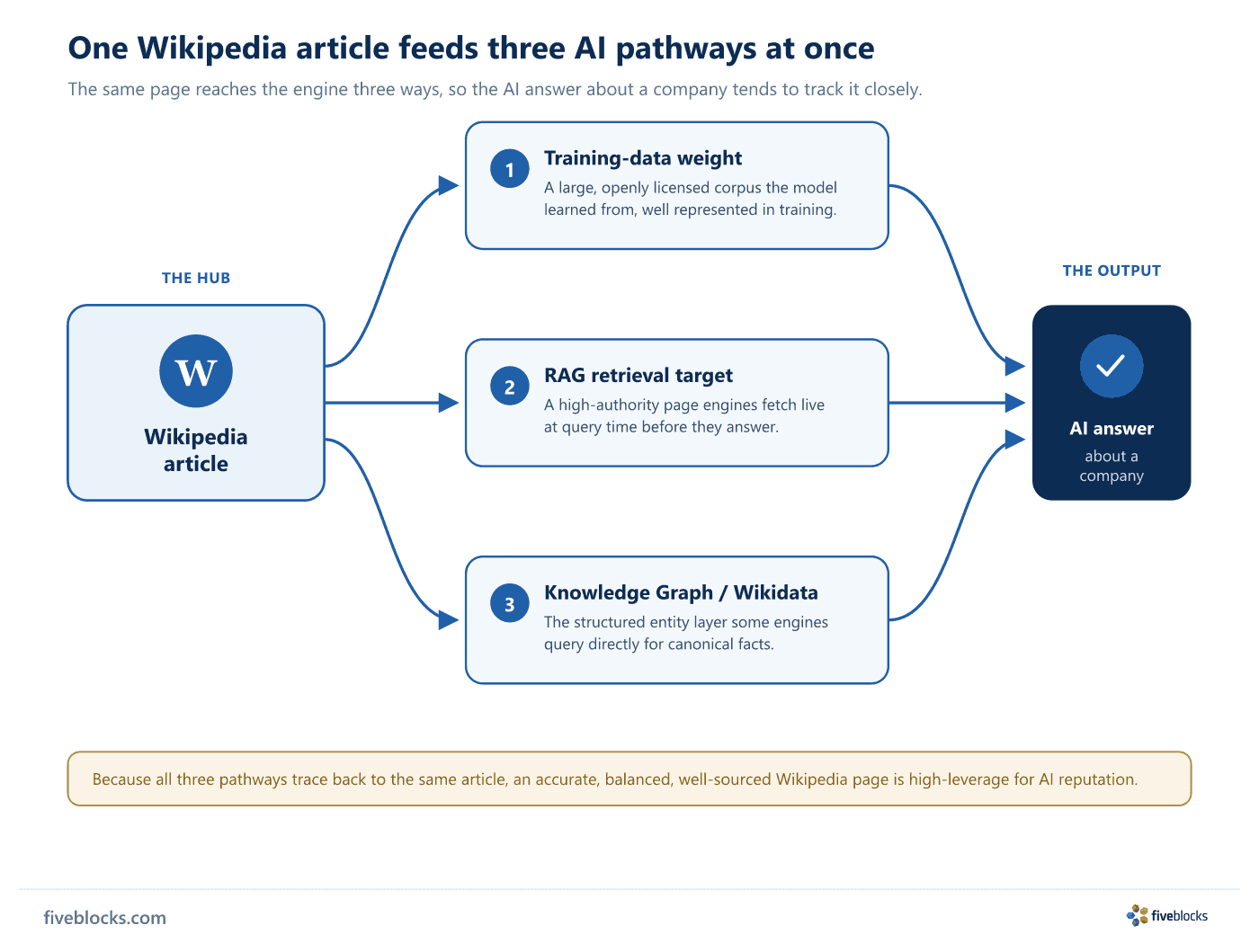
Because Wikipedia is simultaneously baked into the model's training data, a preferred live-retrieval target, and the source that populates the structured entity layer (Knowledge Graph and Wikidata) that some engines query directly. All three pathways point at the same article, so when a company has one, the AI response tends to follow it closely.
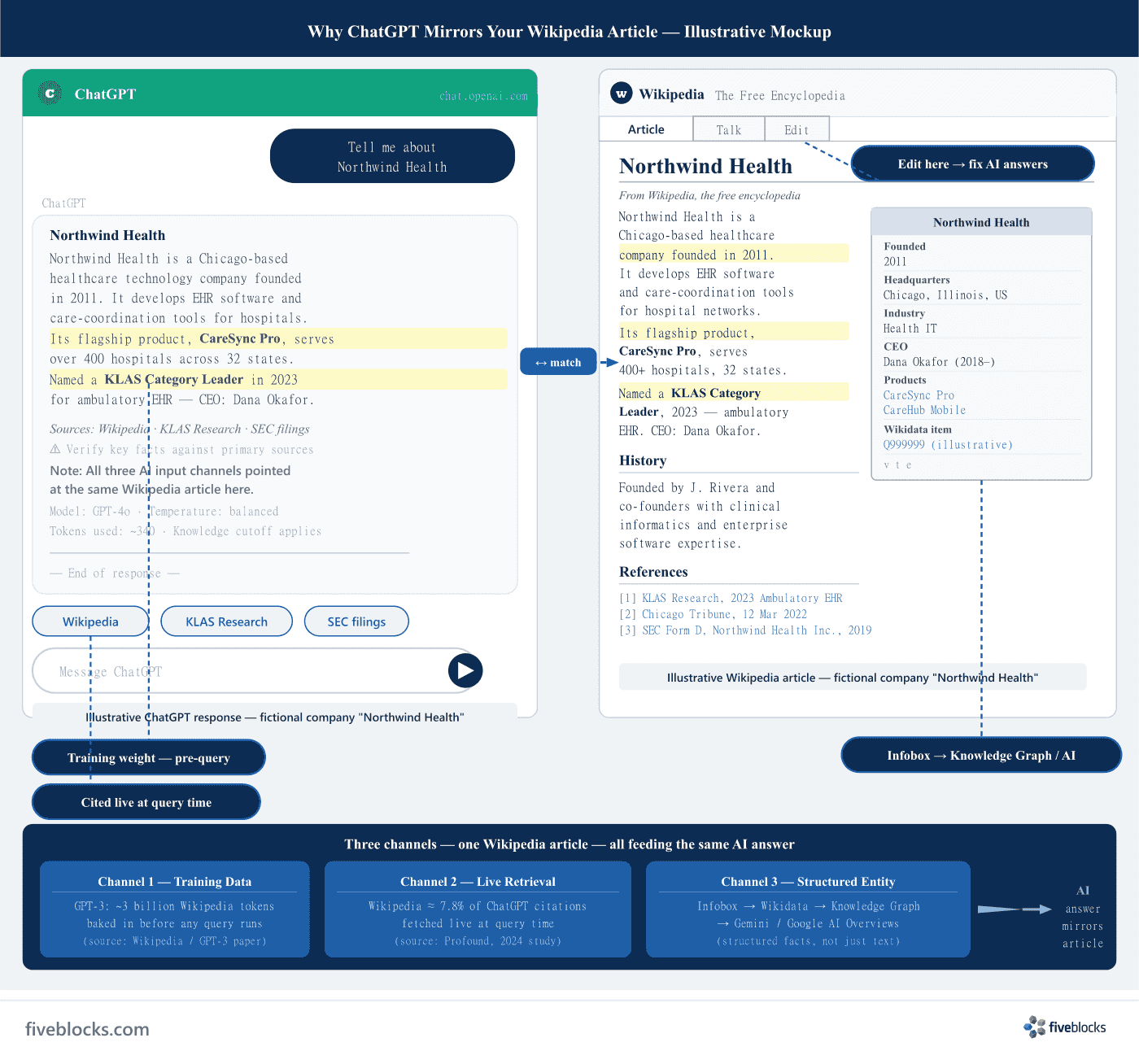
When ChatGPT seems to be reading your Wikipedia article back to you, there is a structural reason. Wikipedia reaches an AI engine through three separate channels at once: training data, live retrieval, and structured entity data. Because all three converge on the same page, the AI response about a company tends to track the Wikipedia article closely. Here is how each channel works.
Channel 1, training data
Wikipedia was part of the foundational training corpus for the leading AI models. BERT, one of the architectures that influenced most modern language models, was trained on roughly 2.5 billion words of English Wikipedia alongside book text. GPT-3 included approximately 3 billion Wikipedia tokens in its training mix. Because this training happens before any specific query is asked, the model already has a baseline description of most entities with Wikipedia articles before it ever touches the live web.
Channel 2, live retrieval
Retrieval-equipped engines, those that issue live web searches at query time, consistently cite Wikipedia among their highest-weighted sources. Semrush data from a multi-month citation study found that Reddit and Wikipedia remained ChatGPT’s two most-cited domains. Profound’s analysis of citation patterns across AI platforms found that Wikipedia is ChatGPT’s most cited single source, accounting for around 7.8% of total citations in the measured period. When an engine fetches pages to build an answer, the Wikipedia article for the named entity is typically one of the first pages it pulls.
Channel 3, structured entity data
Wikipedia is closely tied to Wikidata, which acts as a central hub linking all language versions of an article to one underlying entity record. Wikidata’s sitelinks allow easy navigation between language versions using the linked Wikidata item as a reference point, which is part of why consistent facts surface across language editions. Google’s Knowledge Graph, which powers Knowledge Panels and feeds Gemini and AI Overviews, draws on this same layer. So even an engine that is not reading the Wikipedia article text may be retrieving entity facts, founding date, headquarters, leadership, category, that originate from the same article’s infobox.
Why the verbatim feel happens, and what the evidence supports
AI text that closely tracks specific Wikipedia phrasing is the output of all three channels reinforcing the same source. The training weight, the live-retrieval preference, and the entity-data layer all point at the same article, so the synthesis follows it. How closely any specific model echoes the exact article wording varies by model architecture and query type, and no published measurement has quantified a verbatim match rate. What the citation data does establish is that Wikipedia is one of the heaviest-weighted inputs. If the article contains an error, an awkward framing, or an outdated description, that version of the company is what the AI tends to surface.
What to do about it
Because all three channels trace back to the same article, improving the article is one of the highest-leverage interventions in an AI reputation program. The work runs through proper disclosed conflict-of-interest channels: edit requests on the Talk page citing reliable secondary sources, sourcing improvements, and neutral-point-of-view maintenance. The aim is not a flattering article but an accurate, balanced, well-sourced one, because those are the qualities that keep the article credible enough for the engines to keep relying on it.
Last reviewed: 19/05/2026
