How does Wikipedia affect what AI models like ChatGPT say about you?
Wikipedia is among the references ChatGPT relies on most when it answers questions about an entity. It reaches the answer two ways at once: the article was part of what the model learned during pre-training, and ChatGPT Search can look the article up and cite it at query time. So when a company has a Wikipedia article, ChatGPT's answer usually tracks it closely, often mirroring the structure of the Wikipedia lead section.
Wikipedia is among the references ChatGPT relies on most when it answers questions about an entity, and it reaches the answer through two routes at once: what the model absorbed during pre-training, and what ChatGPT Search looks up at query time. Because both routes point back to the same page, ChatGPT’s answer about a company often tracks the Wikipedia article closely, frequently echoing the structure of its lead section.
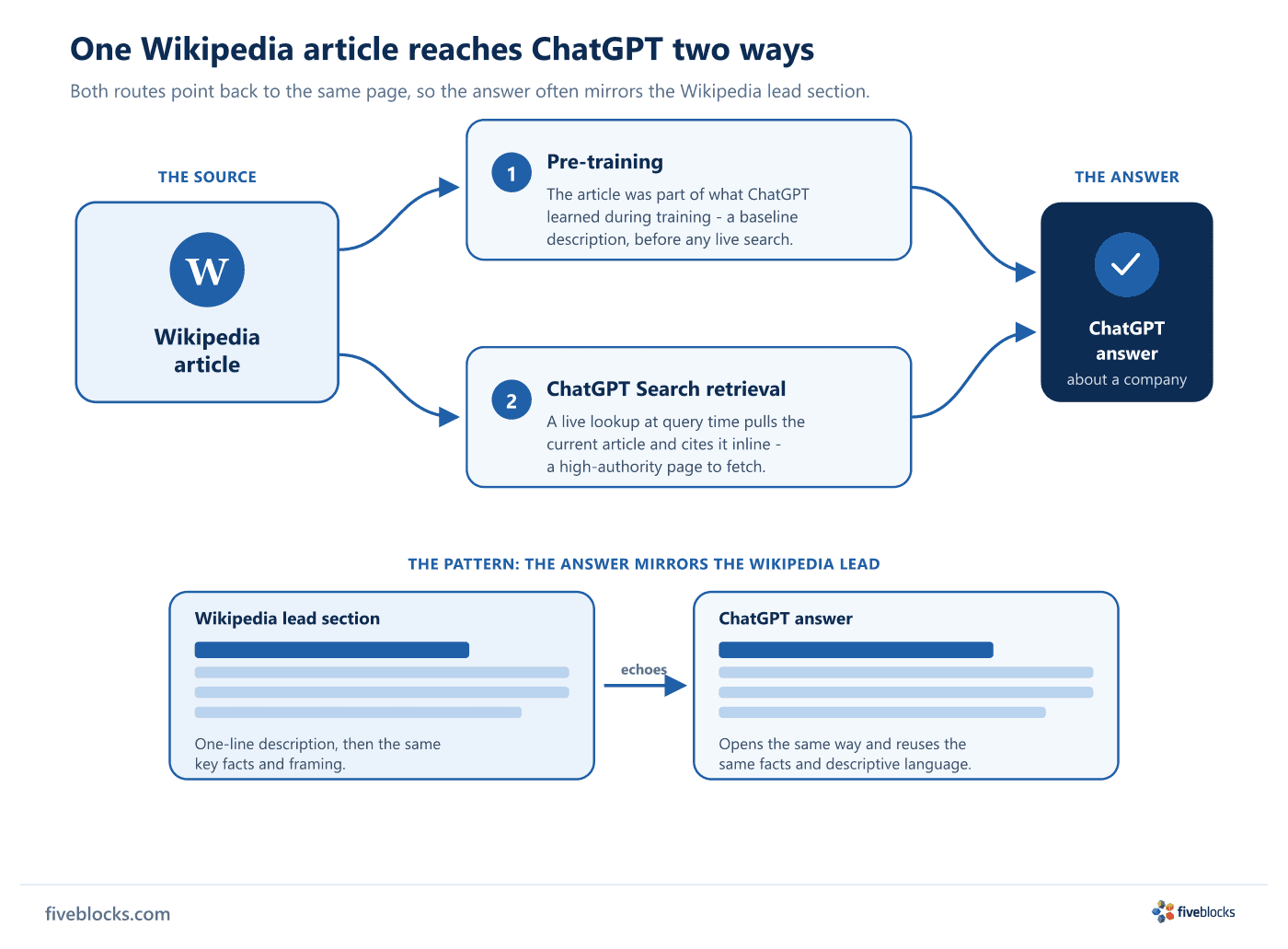
The two routes Wikipedia reaches ChatGPT
- Through pre-training. Wikipedia is a large, openly licensed, broadly edited reference, which makes it a natural and well-represented input to the data a model like ChatGPT learned from. That gives ChatGPT a baseline description of the entity before any live search happens.
- Through retrieval. When ChatGPT Search is active, a query about an entity can trigger a live lookup, and a current Wikipedia article is a high-authority page to pull, which is why ChatGPT will sometimes cite the article directly with an inline link in its answer.
The recognizable pattern is that ChatGPT’s answer about a company tends to follow the shape of the Wikipedia lead section: it opens with the same kind of one-line description, relies on the same facts, and often reuses the same framing and descriptive language.
Why the Wikipedia article matters most
Because both routes trace back to one page, the Wikipedia article is usually the best place to work when ChatGPT is describing a client unfairly. The aim is not a flattering article but an accurate, balanced, well-sourced one, since those are the qualities that make an engine willing to rely on the page. A correction made on Wikipedia tends to propagate into ChatGPT and the other major engines on their respective update cycles: quickly for retrieval-driven answers, more gradually for answers shaped by pre-training.
Last reviewed: 19/05/2026
