How does Wikipedia affect what AI chatbots say about you?
Wikipedia reaches AI answers through two routes: it was part of the training corpus for every leading model, and retrieval-equipped engines also favor it at query time, often citing the article directly. When an entity has an article, AI engines tend to use it as the default narrative source.
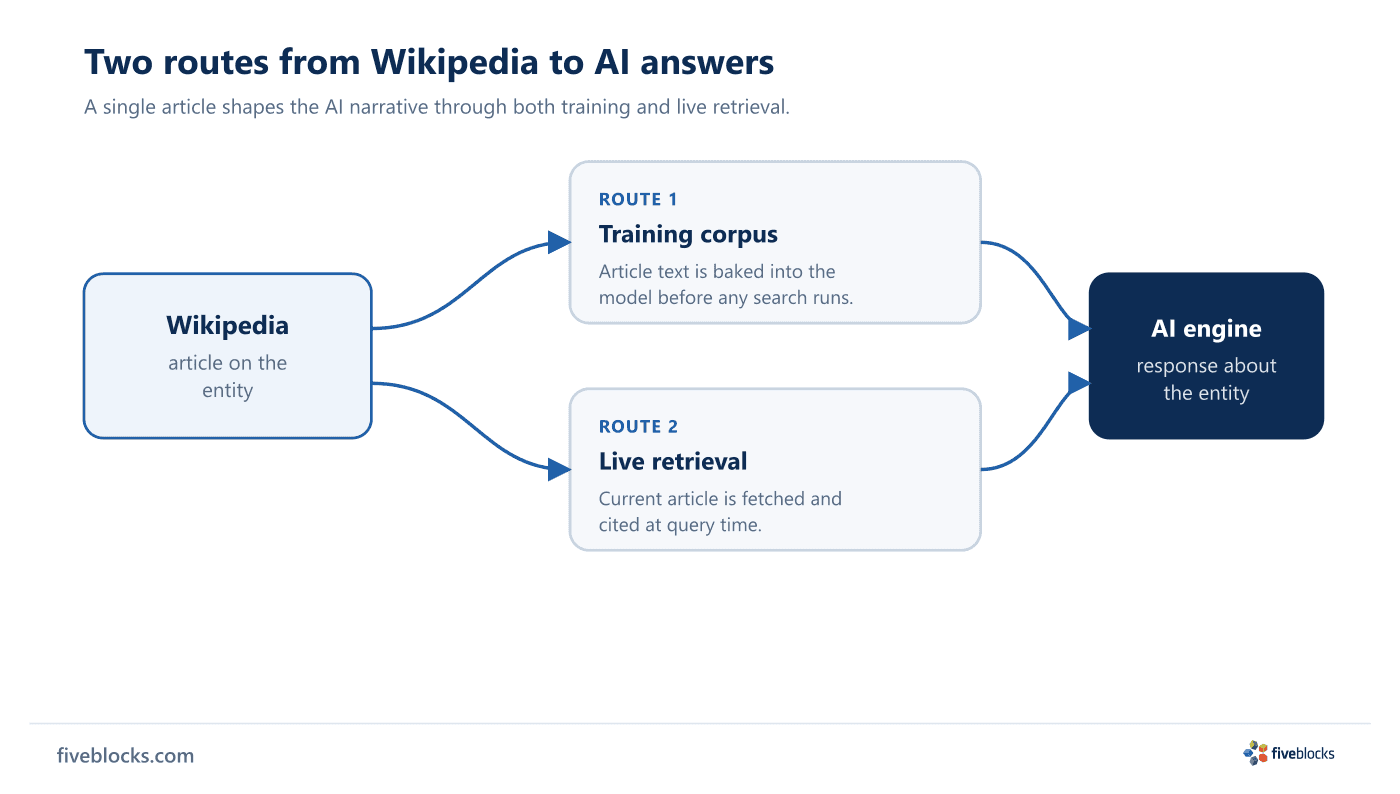
Wikipedia shapes what AI chatbots say about an entity through two routes. The first is training: Wikipedia was part of the corpus every leading model learned from, so the article’s framing is built into the model itself. The second is live retrieval: engines that search the web at query time favor Wikipedia and frequently cite it directly, with an inline link, in the answer they return.
Route 1: the training corpus
Every major model was trained on English Wikipedia as a core source. It is one of the largest high-quality text sets available, so it carries substantial weight in what a model “knows” before it ever runs a search. Public model documentation shows the scale: GPT-3’s training mix drew roughly 3 billion tokens from Wikipedia, and earlier models such as BERT were trained on the full English Wikipedia (about 2,500 million words). Once an entity’s article is part of that corpus, its content influences answers even when the engine performs no live lookup.
Route 2: live retrieval
Retrieval-equipped engines, including ChatGPT Search, Gemini, Perplexity, Copilot, and Google AI Overviews, run live web searches when answering, and they favor Wikipedia among the sources they pull. They often cite the article directly with an inline link and paraphrase its passages into the response. Because this route reads the current article rather than a frozen snapshot, recent edits can surface in AI answers within days or weeks, even when the model’s training cutoff was months earlier.
Why both routes point to the same article
The effect is that a single Wikipedia article drives the AI narrative through both channels at once. Independent citation studies support this: one analysis found Wikipedia to be ChatGPT’s most-cited source, and multiple studies place it among ChatGPT’s top two most-cited domains. So when an entity has an article, AI engines typically treat it as the default narrative source, and when that article has gaps, errors, or neutrality problems, those issues tend to appear in AI answers across engines at the same time. This is why the article matters so much for AI reputation work: improving it tends to improve the AI narrative everywhere at once, quickly for retrieval-heavy engines and more gradually for those that rely mainly on training.
Last reviewed: 19/05/2026
