How do you handle Wikipedia content that appears in AI-generated answers?
Fix the Wikipedia article, not the engine: correct it through a disclosed conflict-of-interest edit request, base the change on reliable secondary sources, then track how each AI engine picks it up. Retrieval engines (Perplexity, Google AI Overviews, ChatGPT Search) reflect the edit within hours to days; pre-training-based responses shift over months.
When Wikipedia content surfaces in an AI-generated answer, the thing to fix is the article, not the engine. A Wikipedia article is a frequent retrieval target for AI engines and a primary data source for the Google Knowledge Graph that engines like Gemini query, so when a subject has an article, engines routinely paraphrase or summarize it. The practical move is to correct the source: fix the article through a disclosed conflict-of-interest (COI) edit request, base the change on reliable secondary sources, and then track how each engine takes it up.
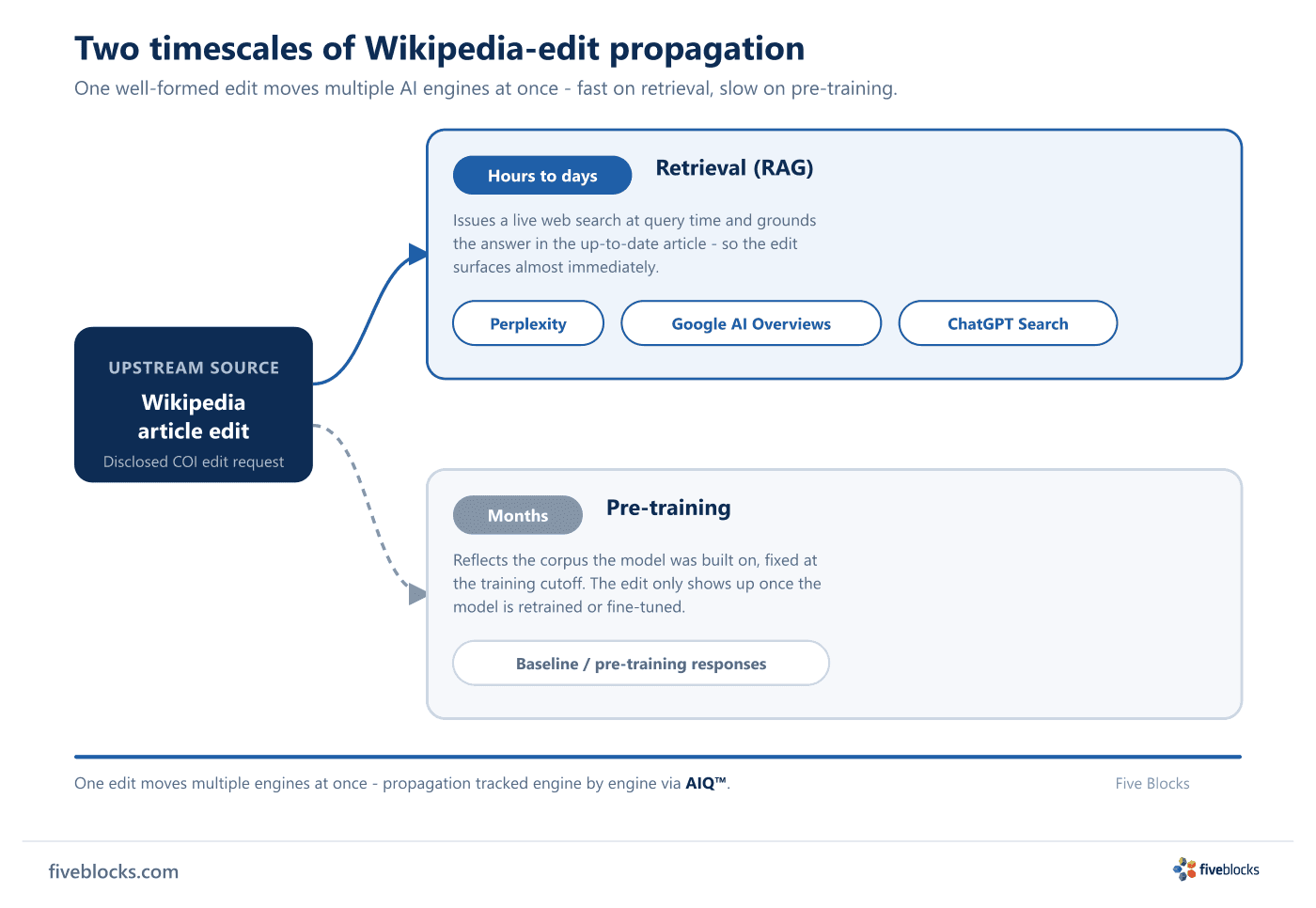
Two propagation speeds
An edit to a Wikipedia article does not reach every engine at the same speed. There are two paths, and they move on very different clocks:
| Path | How the engine uses Wikipedia | How fast an edit shows up |
|---|---|---|
| Retrieval (RAG): Perplexity, Google AI Overviews, ChatGPT Search | Runs a live web search at query time and grounds the answer in current pages | Hours to days after the edit lands |
| Pre-training, the model’s baseline knowledge | Reflects the corpus the model was built on, fixed at the training cutoff | Months, as the model is retrained or fine-tuned |
Because the article is the upstream source that multiple engines draw on, a single well-formed edit can improve the answer across several engines: quickly for the retrieval engines, and more slowly for the responses that lean on baseline training.
How to act on it, not just watch it
Seeing Wikipedia-derived content in an AI answer is the cue to work the source. The sequence we use:
- Fix the article at the source. Propose the correction through a disclosed COI edit request on the Talk page rather than editing directly, so uninvolved editors judge it on its merits.
- Base it on reliable secondary sources. Changes backed by independent, professionally edited coverage are the ones that hold, and the ones engines are most likely to carry forward.
- Track it engine by engine. Watch the fast retrieval engines first for the edit to surface, then monitor the slower pre-training responses over the following weeks and months. We run this monitoring across eight AI engines: ChatGPT, Copilot, Gemini, Google AI Overview, Perplexity, Grok, Claude, and Google AI Mode, through AIQ.
This is why Wikipedia work pays off in AI reputation management: the same edit feeds a source that several engines draw on, so one edit can move multiple engines instead of being spent one engine at a time.
Last reviewed: 19/05/2026
