How do you correct AI-generated misinformation about your brand?
Correcting AI misinformation is a source-attribution problem first. AIQ identifies which source the engine is anchored to, then the correction targets that source directly: a Wikipedia Talk-page edit request, a press correction, a Wikidata or Knowledge Graph fix, or stronger competing content. Retrieval-heavy engines update within days once the source changes; training-baselined engines update on their next retraining cycle.
AI engines do not invent misinformation on their own. They repeat and amplify whatever their anchor sources say. Correcting what an engine says about your brand therefore starts not with the engine but with identifying the specific source it is anchored to, then fixing or countering that source. AIQ shows this directly for retrieval-based engines, where the cited sources are visible in the response, and pattern-matches against likely training sources for engines that do not surface citations.
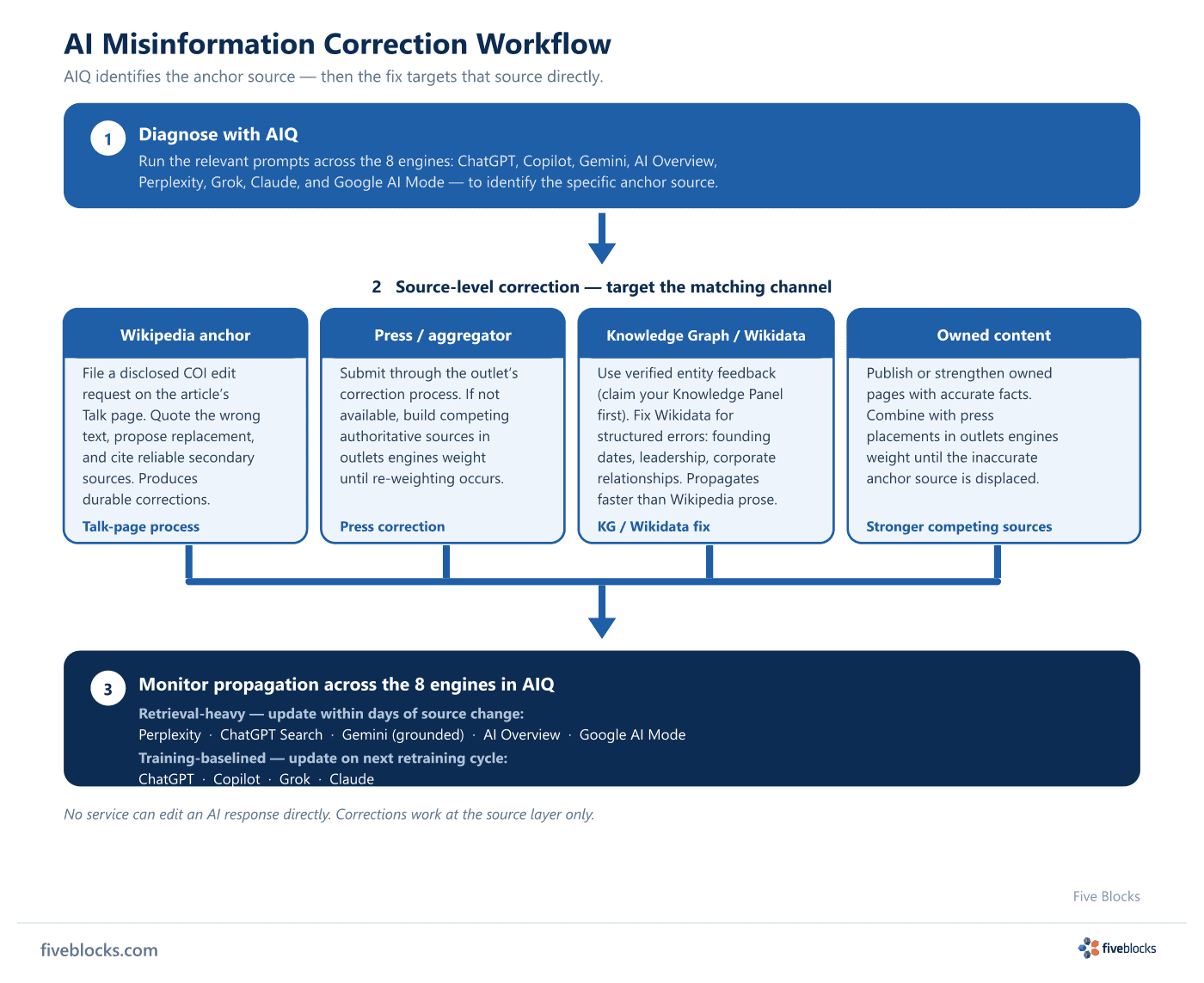
Correction workflow by source type
-
Identify the anchor source.
Run the relevant prompts through AIQ across the eight engines AIQ currently tracks: ChatGPT, Copilot, Gemini, AI Overview, Perplexity, Grok, Claude, and Google AI Mode. For retrieval-heavy engines (Perplexity, ChatGPT Search, Gemini with Google Search grounding), the cited sources appear inline. For training-baselined engines, compare the exact phrasing of the misinformation against Wikipedia, aggregators, and major press to find the likely source. -
If Wikipedia is the anchor: file a Talk-page edit request.
Wikipedia is one of the most heavily weighted sources across AI engines and a primary input to Google’s Knowledge Graph. Corrections go through the standard disclosed-COI edit-request process on the article’s Talk page: quote the wrong text, propose the exact replacement, and cite reliable secondary sources. Direct edits from a conflict-of-interest account get reverted even when the correction is accurate. Done correctly, the Talk-page process produces durable corrections that the engines then absorb. -
If a specific article or aggregator is the anchor: pursue a press correction or strengthen competing sources.
Most reputable news outlets have published correction processes, and documented factual errors submitted through the right channel are corrected more often than practitioners expect. Where a correction is not available, build authoritative competing sources that describe the same facts accurately: press placements in outlets the engines weight, and updated owned content, until the engines re-weight away from the inaccurate anchor. -
If a Knowledge Graph or Wikidata value is wrong: submit corrections through the appropriate channel.
Google’s Knowledge Graph can be corrected through verified entity feedback, available once identity is verified via the Knowledge Panel claim process, and indirectly through Wikidata corrections, which flow into the Knowledge Graph. Wikidata updates reach AI engines faster than Wikipedia narrative changes and should be a priority for structured-data errors such as wrong founding dates, leadership, or corporate relationships. -
Monitor propagation across the eight engines AIQ tracks.
Once source-level corrections are in place, track daily in AIQ until each engine reflects the accurate information. Retrieval-heavy engines, which perform live web searches when a query arrives, typically update within days of the underlying source changing. Training-baselined engines update only on retraining cycles, which can take longer. The engines do not all move at once, so monitoring across the eight AIQ tracks stops you from trusting one engine’s correction while others still carry the error.
What cannot be done
No service or technical capability lets anyone, including the companies that build the engines, edit a specific AI response directly. The work is always at the source layer. Any firm claiming direct control over AI output is misrepresenting what the discipline can do. Source-level corrections, sustained over time and monitored through AIQ, are what produce durable results.
Last reviewed: 19/05/2026