What does it mean that AI models are citing us wrong?
When an AI engine says something inaccurate about your brand, the fix is to find the source, not to argue with the answer. AIQ identifies which source is feeding the error, and the remediation targets that source directly: a Wikipedia edit request, a press correction, a structured-data fix, or an owned-content addition.
“Citing us wrong” means something specific in AI reputation work: an engine is stating something about the brand that is factually wrong or misleading, and it does so in the same confident tone it uses for true statements. The temptation is to argue with the response. What works is to find the source and then apply the fix that matches it.
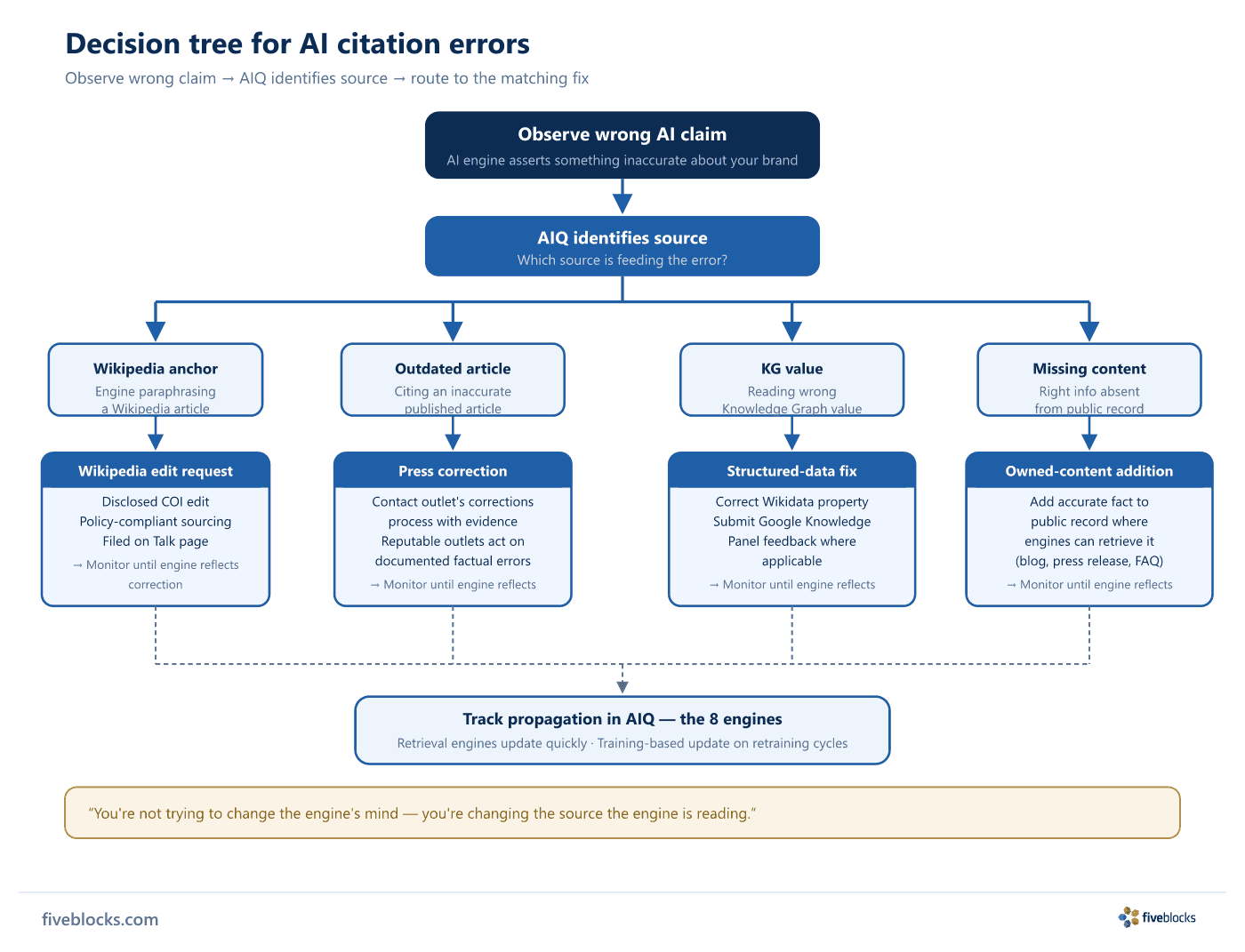
Step 1: Identify what the engine said and what it drew on
Write down the exact claim and, where the engine shows citations, which sources it names. Where citations are not shown, AIQ surfaces the source patterns that match the response. The step comes down to one question: which source is feeding the error, and can it be moved?
Step 2: Match the diagnosis to the fix
Each type of source error has its own remediation path. Once you know the source, the fix is usually clear:
| What the engine is doing | The matching fix |
|---|---|
| Paraphrasing a Wikipedia article | Wikipedia edit request, disclosed conflict of interest, policy-compliant sourcing, filed on the article’s Talk page |
| Citing an outdated or inaccurate published article | Press correction through the outlet’s corrections process; reputable publications act on documented factual errors |
| Reading the wrong Knowledge Graph value | Structured-data fix: Wikidata property correction and, where applicable, Google Knowledge Panel feedback |
| Missing the right information entirely | Owned-content addition that puts the accurate fact into the public record where engines can retrieve it |
Step 3: Track until the correction propagates
After the source-level fix is made, monitor in AIQ across the eight engines it currently tracks until the correction shows up in responses. Retrieval-heavy engines reflect updated sources faster; training-baselined engines update on their own retraining cycles. Monitoring confirms when the fix is complete and catches any regression.
Once you have the source identification right, the work is narrow. You are not trying to change the engine’s mind; you are changing the source the engine is reading.
Last reviewed: 19/05/2026