How do AI models weight different types of sources when discussing companies?
AI engines weight sources first by authority (a domain's reputation, how often other authoritative domains cite it, and structural signals such as clean schema), then by recency, topical relevance, and how consistently multiple credible sources say the same thing. These signals add up, so strengthening a handful of the right sources usually moves the engines more than any single page does.
The weighting logic is broadly consistent across the major engines even where the implementations differ. When an engine builds an answer about a company, it finds the relevant sources, weights them by authority and relevance signals, prioritizes the strongest, and writes a response from them. Four inputs carry most of the weight.
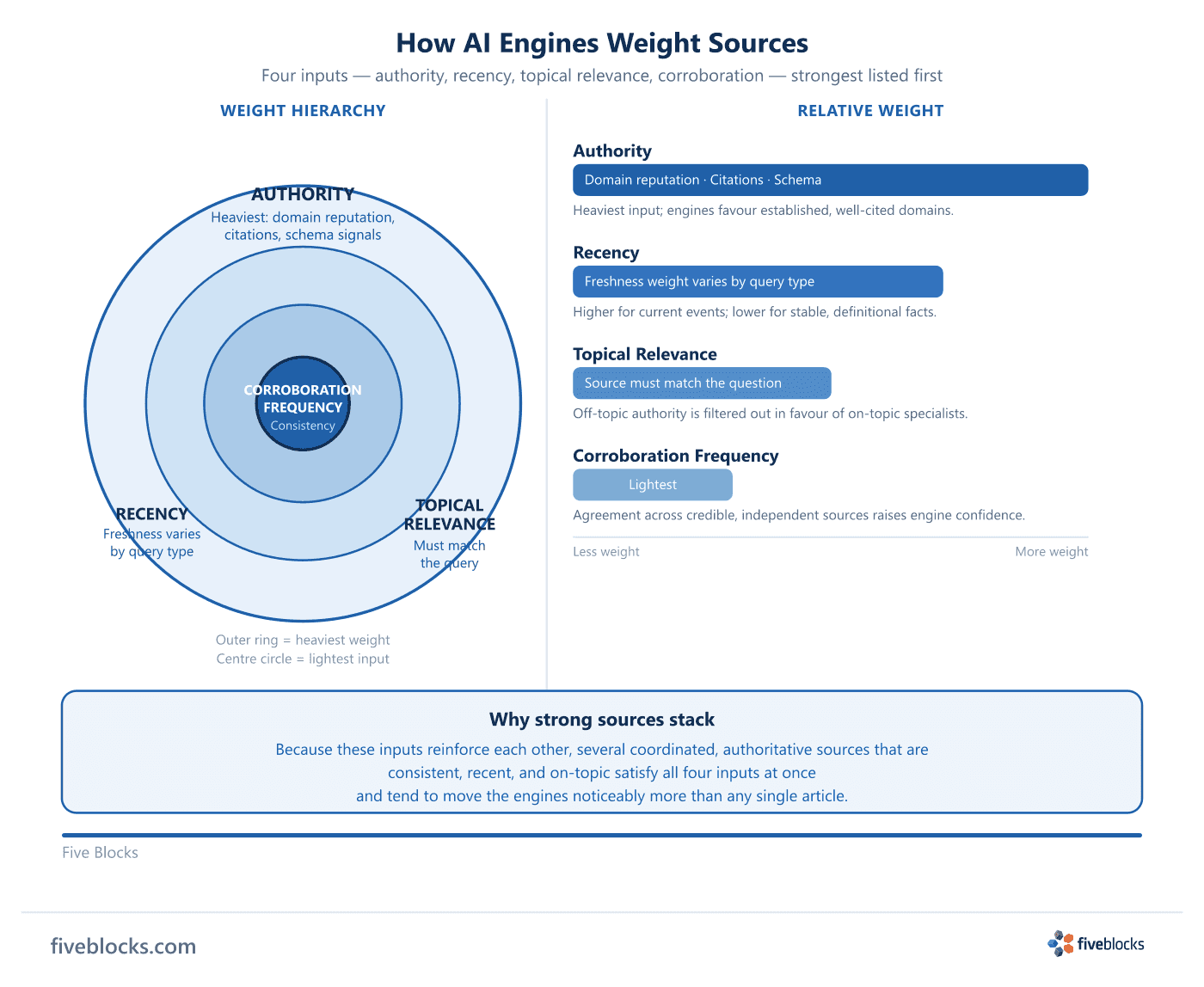
The four source-weighting inputs
- Authority
- The heaviest input. This covers a domain’s reputation, how often other authoritative domains cite or refer to it, and structural signals such as proper schema and clean information architecture. Engines lean on sources whose credibility is already established rather than judging each claim on its merits in the moment.
- Recency
- For time-sensitive questions, newer authoritative content usually beats older content of equal authority. How much freshness matters depends on the query. It counts for far more on a current-events question than on a stable definitional one.
- Topical relevance
- A source has to actually match the question. A high-authority but off-topic source loses out to one that covers the specific topic well. On a niche industry question, a specialist outlet beats a general-news article.
- Corroboration frequency
- How many credible sources say the same thing. When prominent, independent sources agree, that consistency reads as a trust signal and tends to raise the engine’s confidence in the answer it writes.
Why strong sources add up
These four inputs reinforce each other, so strong sources add up rather than compete. A single good article helps. Several coordinated articles across the right outlets, all consistent, recent, and on-topic, tend to move the engines noticeably more than any one of them alone, because together they satisfy authority, recency, relevance, and corroboration at once.
Last reviewed: 19/05/2026
