How do AI models decide which sources to trust about a company?
AI engines draw from a concentrated set of trust signals. Wikipedia and Wikidata rank highest because both are heavily weighted in training data and queried directly at retrieval time; major news outlets and government or academic domains come next; the company's own official site counts when it carries clean structured data. Authority is established in advance, not earned at the moment of a query.
AI engines do not evaluate a claim about a company on the merits in the moment they answer it. They lean on sources whose authority was already established, embedded in their training data, encoded in the reference graphs they can query, and expressed in the citation patterns of the wider web. Knowing which sources carry that pre-established authority is where any serious reputation program starts.
The leverage is concentrated. A small set of sources shapes most of what the engines say, and improving those specific sources is what moves the engines. Publishing volume into properties the engines do not weight does not.
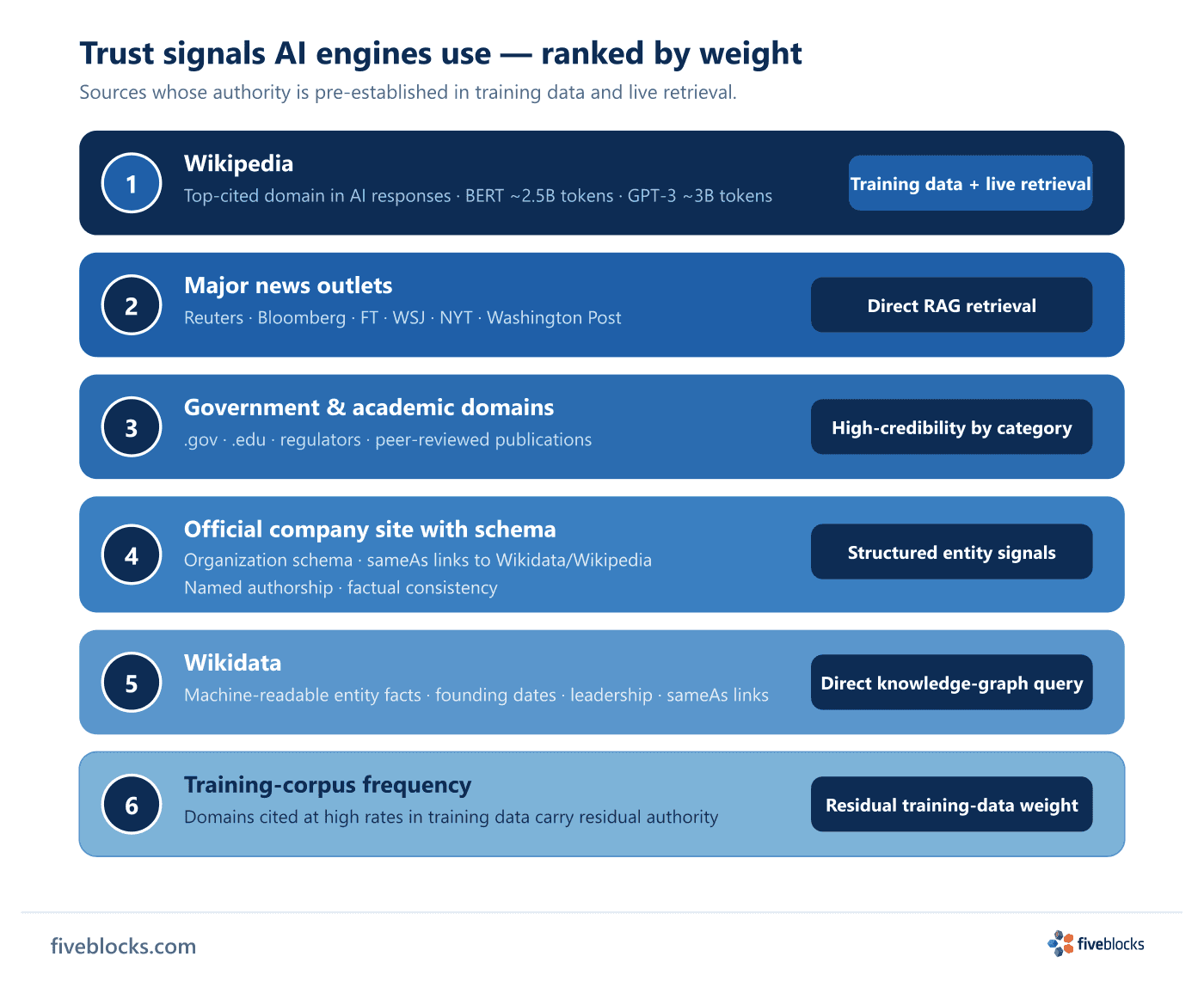
The trust signals AI engines appear to weight
- Wikipedia and its citations
- Wikipedia was part of the training corpus of every major model (BERT trained on approximately 2.5 billion Wikipedia words; GPT-3 included approximately 3 billion Wikipedia tokens) and is one of the most-cited live sources in retrieval-augmented engines. Across major AI platforms, Wikipedia ranks among the two most-cited domains in generated responses. Engines such as Gemini query the Knowledge Graph, built substantially on Wikipedia and Wikidata, directly when synthesizing entity facts. The citations inside Wikipedia articles carry weight too: a source that Wikipedia links to gains authority through that association.
- Wikidata
- Wikidata is the machine-readable counterpart to Wikipedia. It stores structured, sourced statements about entities (founding dates, leadership, parent-subsidiary relationships, regulatory IDs, sameAs links to other databases) in a form engines can query directly. Google’s Knowledge Panel, AI Overviews, and Gemini responses for entity questions draw on Wikidata alongside Wikipedia. A Wikidata entry with unsourced or missing statements weakens entity confidence across every engine that queries it.
- Major news outlets
- Mainstream publishers such as Reuters, Bloomberg, the Financial Times, The Wall Street Journal, The New York Times, The Washington Post, and credible regional equivalents are retrieved by the engines for current and evergreen queries alike. Coverage in these outlets enters AI responses two ways: through direct retrieval (RAG-based engines pull live pages) and through the summarization loop (secondary outlets and aggregators that re-cite primary stories become additional sources the engines retrieve as corroboration).
- Government and academic domains
- .gov and .edu domains, regulator websites, and peer-reviewed or scholarly publications. The engines treat these as high-credibility by category. Peer-reviewed research cited in a GEO context, such as the work on Generative Engine Optimization that documented how source selection shapes AI-generated responses, earns citation weight through the same academic-source signal the engines apply generally.
- The company’s own official site with clean structured data
- The official brand site carries weight when it has unambiguous entity signals: Organization schema with sameAs links to Wikidata and Wikipedia, named authorship, clear publication dates, and factual consistency with the rest of the public record. Without those signals, the engines may under-weight or misread the official site even though it is the primary source of truth.
- Frequently-cited training domains
- Domains cited at high rates within the training corpus may carry residual authority even when they are not retrieved live. This differs from domain authority in the SEO sense; it reflects how deeply embedded a source’s content appears to be across the text the model was trained on.
What this means for a reputation program
Because the leverage points concentrate in a small set of sources, the most effective moves are targeted improvements to those specific sources: Wikipedia (via disclosed COI edit requests), Wikidata (a structured entry with sourced statements and complete sameAs links), schema markup on owned properties, and earned media in outlets the engines actually weight. Effort spread thinly across dozens of lower-authority properties rarely moves what the engines say.
What this means for a content program
Publishing high volume into owned channels without authoritative third-party signals or structured data is unlikely to influence AI engine outputs, whatever the content quality or quantity. What the engines respond to is reaching into the trusted source set, or earning the schema and authorship signals that give owned properties authority. The GEO research from Princeton (ACM SIGKDD 2024) documented that content creators have to optimize for inclusion in the source pool the engine retrieves, not just for production volume.
Last reviewed: 19/05/2026
