How do you build an entity that AI models recognize and trust?
Build the entity in layers: a Wikipedia article where Notability is met, a Wikidata entry AI engines can query for structured facts, schema markup on owned properties (Organization, Person) with sameAs links that tie the entity to those canonical sources, and authoritative third-party coverage that corroborates the same attributes across the web. Engine confidence comes from consistency across every layer.
An entity that AI engines recognize and trust shows up the same way across their responses: same facts, same relationships, same context. Building one is a layered job, and the layers are not interchangeable. Each does a specific thing in how the engines understand and verify what they read about the subject.
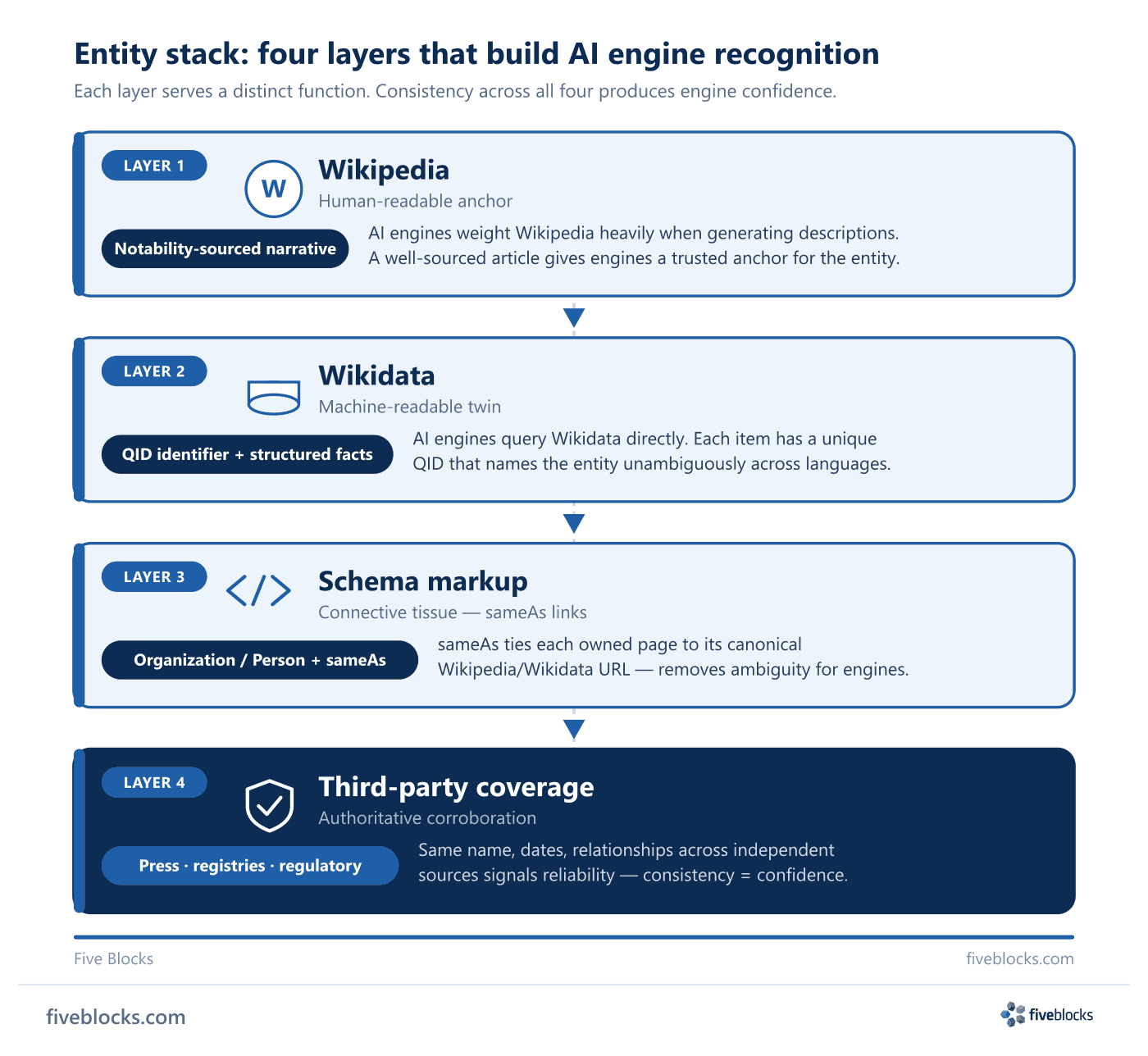
Step 1: Wikipedia (the human-readable anchor)
Wikipedia is the keystone for any entity that meets Notability standards. AI engines weight it heavily when they describe companies, people, and topics, and they read from it both during training and through live retrieval. A well-sourced, neutral, policy-compliant Wikipedia article gives the engines an authoritative narrative to anchor on.
- An article is possible only where the subject has significant coverage in reliable, independent, secondary sources. That is Wikipedia’s general Notability standard.
- For organizations, the relevant guideline is Wikipedia:Notability (organizations and companies), which applies the same sourcing logic to corporate subjects.
- Without a Wikipedia article, the engines fall back on weaker or less consistent sources for their narrative about the entity.
Step 2: Wikidata (the machine-readable twin)
Wikidata is a free, collaborative, multilingual knowledge base run by the Wikimedia Foundation that stores structured data AI engines can query directly. Where Wikipedia is prose a human reads, Wikidata is a set of machine-readable statements a system can process without interpreting text. Giving the entity a complete, accurate Wikidata item is a separate job from the Wikipedia work.
- Each Wikidata item has a unique persistent identifier (the QID) that names the entity unambiguously across languages and databases.
- AI engines query Wikidata directly as a structured knowledge source for entity facts.
- A missing or inaccurate Wikidata entry pushes errors into AI responses, and there is no clean way to correct them at the source until the Wikidata item itself is fixed.
Step 3: Schema markup with sameAs links (the connective tissue)
Schema markup on owned properties ties the entity together across the web by connecting each page to the canonical identifiers the engines already know. Organization schema and Person schema with proper sameAs links tell the engines exactly which entity a page is about.
- Schema.org defines the sameAs property as the URL of a reference web page that unambiguously indicates the item’s identity, for example, the URL of the item’s Wikipedia page or Wikidata entry.
- Without sameAs links, an engine reading an About page or an executive bio has to infer the entity connection from text alone, which lowers its confidence and raises the risk of conflation with similarly named entities.
- The schema types that matter for entity recognition: Organization (for the company), Person (for executives), Article (for owned editorial content).
Step 4: Authoritative third-party coverage (corroboration)
AI engines weigh several inputs when they answer questions about a company, including Wikipedia articles, the Knowledge Graph entity, owned content, and third-party coverage. Authoritative third-party citations, mainstream press, industry registries, regulatory pages, confirm that the entity is real and that its attributes hold up across independent sources.
- Coverage in outlets the engines treat as authoritative repeats the same name, affiliations, dates, and relationships found in Wikipedia, Wikidata, and schema markup.
- Engine confidence comes from consistency across all these layers: same name, same affiliations, same dates, same relationships everywhere.
- Inconsistency across layers, a name spelled differently on Wikidata than in press coverage, a founding date that differs between the Wikipedia article and schema markup, signals unreliability, and the engines can reflect it as ambiguity or factual drift in their responses.
Why the work compounds over time
Entity infrastructure built deliberately over time looks different in AI engine outputs than infrastructure that grew ad hoc. Each layer reinforces the others: the Wikipedia article supports the Wikidata item, the Wikidata item supports the schema sameAs links, and third-party coverage supports all three. The engines recognize and trust entities that show the same coherent picture across every layer they consult.
Last reviewed: 19/05/2026
