What is entity authority and how do you build it?
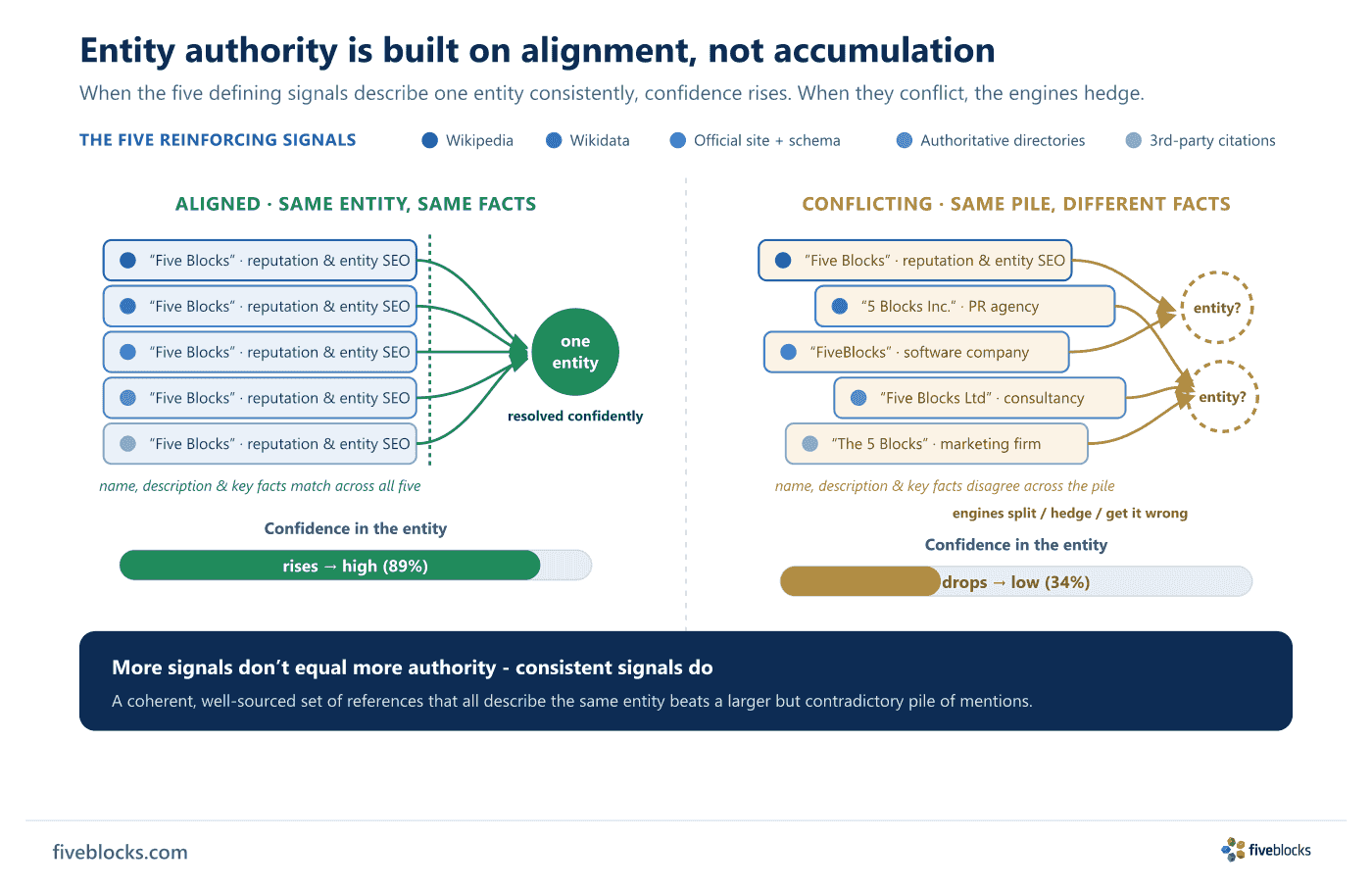
Entity authority is how confident Google and the AI engines are that they know who an entity is and that what they know is reliable. It is built from the strength and consistency of the signals that define the entity - Wikipedia, Wikidata, the official site with schema, authoritative directories, and credible third-party citations - and it rises most when those signals agree rather than simply pile up.
Entity authority is how confident Google and the AI engines are that they know who an entity is and that what they know is reliable. It is built from the strength and consistency of the signals that define the entity, and it is what earns an accurate Knowledge Panel and a confident, correct answer from the AI engines instead of a hedged or mistaken one.
The signals that define an entity
Entity authority comes from a connected web of references that describe the same entity consistently:
- Wikipedia – an article, where notability supports one, built from significant coverage in multiple reliable, independent, secondary sources. Knowledge Panels and the AI engines weight Wikipedia heavily.
- Wikidata – an accurate, well-linked entry. Google’s Knowledge Panel pulls its description and main facts from Wikipedia and Wikidata.
- The official site with schema – structured data that helps search and AI engines understand what a page asserts and attach it to the correct entity.
- Authoritative directories – presence in the reference sources platforms trust to identify a company.
- Third-party citations – coverage from credible, independent outlets, which shapes AI answers more than additional owned pages.
How you build it: alignment over accumulation
Consistency is what does the work. When the name, description, and main attributes match across all of these signals, confidence rises. When they conflict, the systems hedge and the entity becomes fuzzy. So building authority is as much about alignment as accumulation: a coherent set of well-sourced, mutually reinforcing signals beats a scattered set of mentions.
- Establish each signal accurately – a Wikipedia article where notability supports one, a correct Wikidata entry, the right schema on the official site, and presence in authoritative directories.
- Make them consistent – keep the name, description, and main attributes matching across every reference so they reinforce rather than contradict one another.
- Reinforce with credible citations – earn descriptions from independent outlets that repeat the same identity.
We build this as the entity layer of a program, because high entity authority is what earns an accurate Knowledge Panel and a confident, correct answer from the AI engines instead of a hedged or mistaken one.
Last reviewed: 20/05/2026
