What is the entity stack and how do you build one?
The entity stack is the full layered set of signals that together define an entity to search and AI systems - the entity home, Wikidata, Wikipedia, authoritative directories, social profiles, and press citations. It is a stack rather than a list because linkage and consistency - sameAs connections and matching descriptions - tie the layers into one recognized node. You build one by inventorying what exists, filling gaps in priority order, and aligning the descriptions so the layers agree.
The entity stack is the full layered set of signals that together define an entity to search and AI systems, built and maintained as a coherent whole rather than as disconnected assets. It is a stack rather than a list because linkage and consistency bind the layers into one recognized node instead of a loose pile of mentions.
The layers of the stack
From the foundation up:
- Entity home – the official site marked with Organization or Person schema; it anchors the identity and holds the canonical description that everything else should match.
- Wikidata – the machine-readable structured record. Unlike Wikipedia’s narrative text, it is data that machines can read and process, which gives search and AI engines an anchor independent of Wikipedia.
- Wikipedia – where genuine notability supports an article, it supplies the narrative that Knowledge Panels and the AI engines weight heavily.
- Authoritative directories and business references – credible third-party sources that corroborate the entity.
- Schema-marked social profiles – profiles linked back into the stack that signal an active, maintained presence.
- Press citations – third-party coverage that supplies validation and co-occurrence signals, and that engines weight more than additional owned pages.
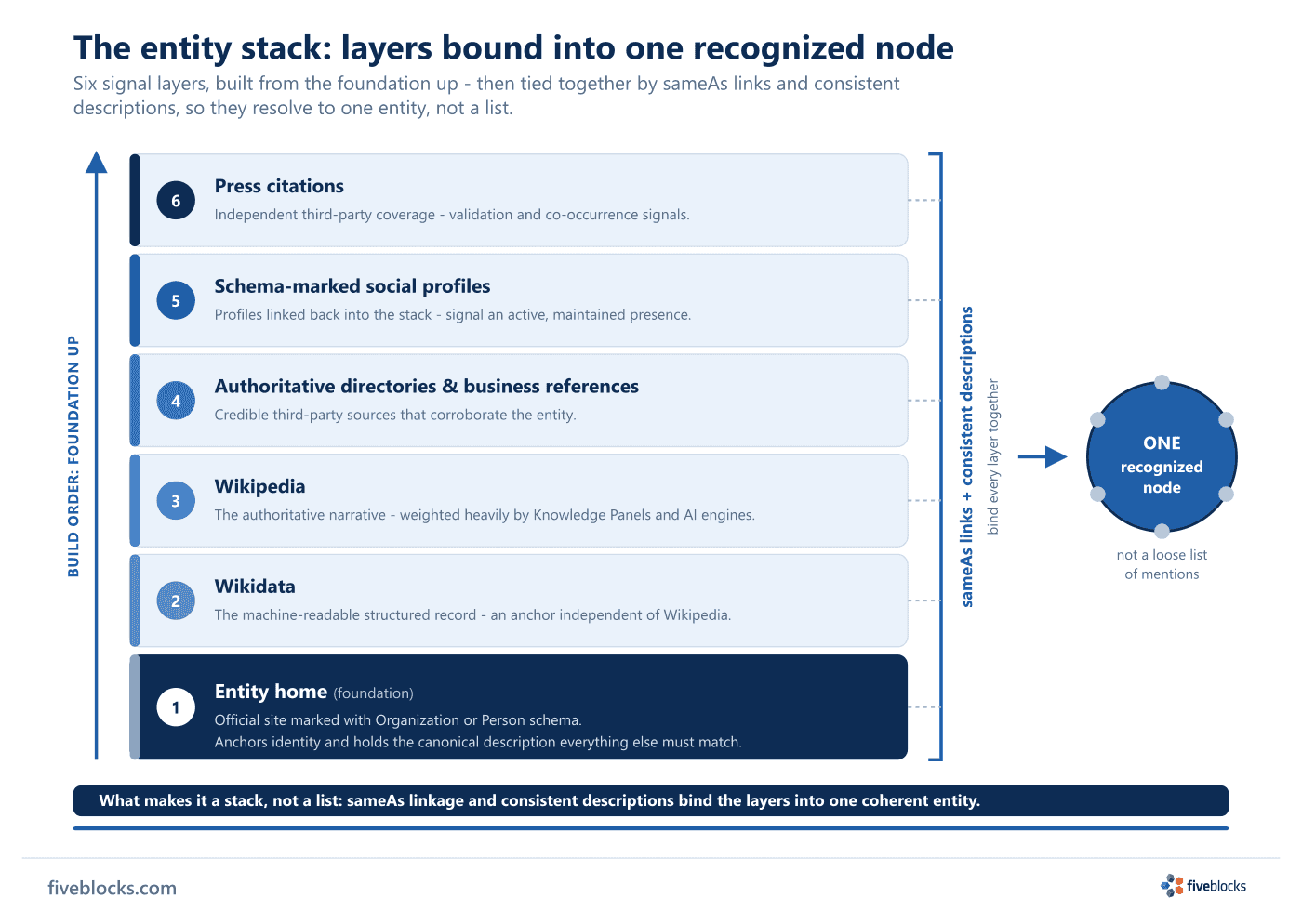
What turns a list into a stack: linkage and consistency
The engines will not assume that a website, a Wikidata entry, a LinkedIn page, and a press profile describe the same thing unless the signals say so. Two mechanisms bind the layers together:
- sameAs connections – schema links pointing from the entity home to each authoritative profile, telling search and AI systems that the referenced profiles are one identity.
- Consistent descriptions – matching name, role, and key facts across every layer, so the references resolve to one node with higher confidence rather than fragmenting.
How to build one
- Inventory what exists – take stock of the entity home, Wikidata, Wikipedia, directories, social profiles, and press across the full layer set.
- Fill the gaps in priority order – build the missing layers, starting with the ones doing the most to weaken recognition.
- Align the descriptions – reconcile the layers so they agree, and connect them with sameAs links.
We build and maintain the entity stack as the core of the entity layer.
Last reviewed: 20/05/2026
