How do social media profiles contribute to entity recognition?
Social media profiles corroborate entity recognition rather than anchor it. They can be linked to the entity home via sameAs, they signal an active presence, and they give search and AI engines more references to cross-check identity and attributes. They are corroboration, not foundation: they cannot substitute for the entity home, Wikidata, and authoritative citations, and inconsistent bios can lower confidence by introducing conflicting signals.
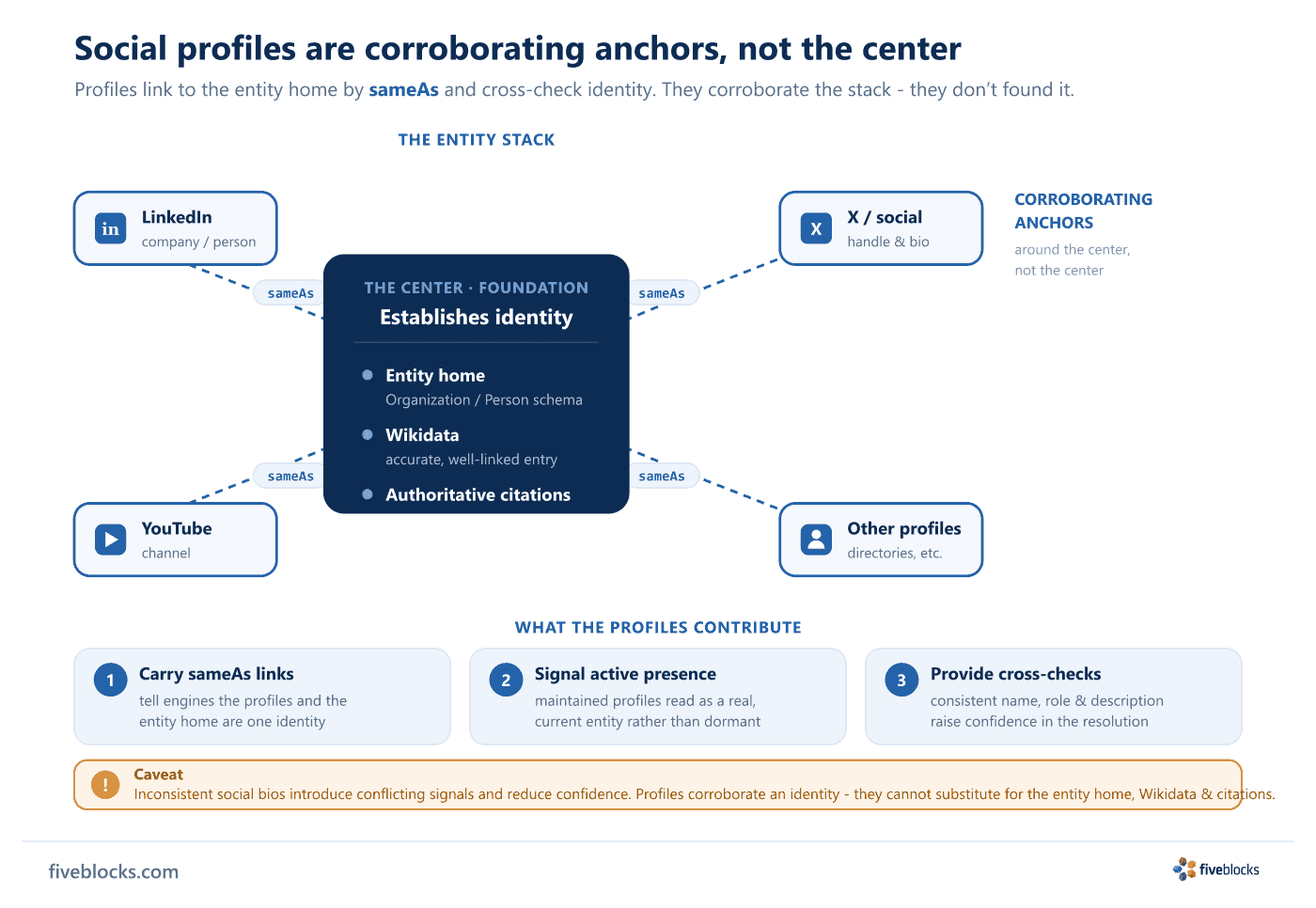
Social media profiles corroborate entity recognition rather than anchor it. They reinforce an identity that is established elsewhere, in the entity home, Wikidata, and authoritative citations, and they help in three ways.
How social profiles contribute
- They carry sameAs links. Profiles can be connected to the entity home through
sameAsstructured data, telling search and AI systems that the entity home and its social profiles are one identity rather than separate references. - They signal an active presence. Maintained, complete profiles read as evidence that the entity is real and current rather than dormant.
- They provide cross-check references. Search and AI use them to verify identity and attributes. A consistent name, role, and description across the major profiles raises confidence in how the engines resolve the entity.
Corroboration, not foundation
Social profiles corroborate an identity; they do not establish one. A strong social presence cannot substitute for the entity home, Wikidata, and authoritative third-party citations. The effect can also run the other way: inconsistent social bios introduce conflicting signals, and when name, description, and attributes conflict across the entity’s signals, the systems hedge instead of resolving confidently to one node.
Keeping profiles consistent
The work is to keep the major profiles complete, consistent with the canonical description, and linked into the stack with sameAs. Treat them as supporting layers, and judge their contribution by how the systems resolve the overall identity, not by the profiles in isolation.
Last reviewed: 20/05/2026
