What is entity resolution and why does it matter for reputation?
Entity resolution is how Google and the AI engines decide that a scatter of references (a LinkedIn profile, a Wikipedia article, a press mention, a directory listing) all point to the same person or organization. It matters for reputation because reliable resolution is what turns disconnected mentions into one accurately described entity, and it depends on sameAs links, consistent attributes, and authoritative anchors like Wikipedia and Wikidata.
Entity resolution is how Google and the AI engines determine that a scatter of references (a LinkedIn profile, a Wikipedia article, a press mention, a directory listing) all refer to the same person or organization. It matters for reputation because resolution is what turns disconnected mentions into a recognized entity.
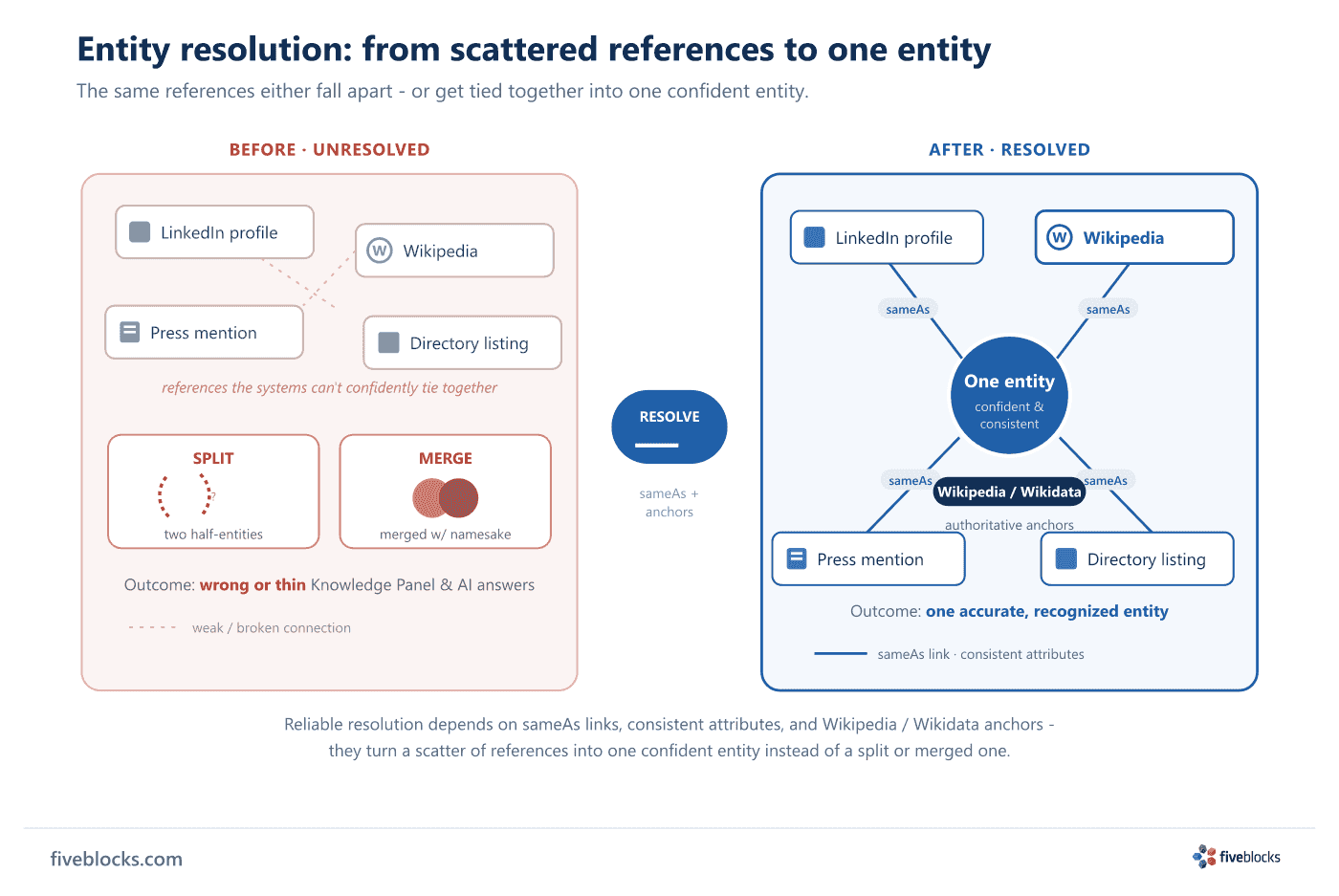
What happens when resolution succeeds, and when it fails
When resolution succeeds, the systems aggregate everything they know into one profile. When it fails, the same person can be split into two half-formed entities, or merged with a namesake, and the resulting Knowledge Panel and AI answers come out wrong or thin.
What reliable resolution depends on
- sameAs structured links that explicitly connect the canonical entity home to its other authoritative profiles.
- Consistent attributes (name, role, and description) across those references.
- Authoritative anchors such as Wikipedia and Wikidata.
We build these deliberately, because most entity problems we diagnose are resolution failures: the right signals exist, but the systems cannot confidently tie them together.
Last reviewed: 20/05/2026
