What is the sameAs property in schema and how does it connect entities?
The sameAs property is the schema mechanism that explicitly tells search and AI systems that a set of separate references - a website, a LinkedIn profile, a Wikipedia article, a Wikidata entry - all point to the same entity. Used within Person or Organization schema on the entity home, it links out to the entity's authoritative profiles (LinkedIn, Wikipedia, Wikidata, Crunchbase, IMDb), connecting the dots the systems would otherwise have to guess at. It is one of the core signals in entity resolution.
The sameAs property is the schema mechanism that tells search and AI systems that a set of separate references all point to the same entity, and it is one of the core signals in entity resolution. Used within Person or Organization schema on the entity home, sameAs links out to the entity’s authoritative profiles: LinkedIn, Wikipedia, Wikidata, Crunchbase, IMDb, and the relevant directories.
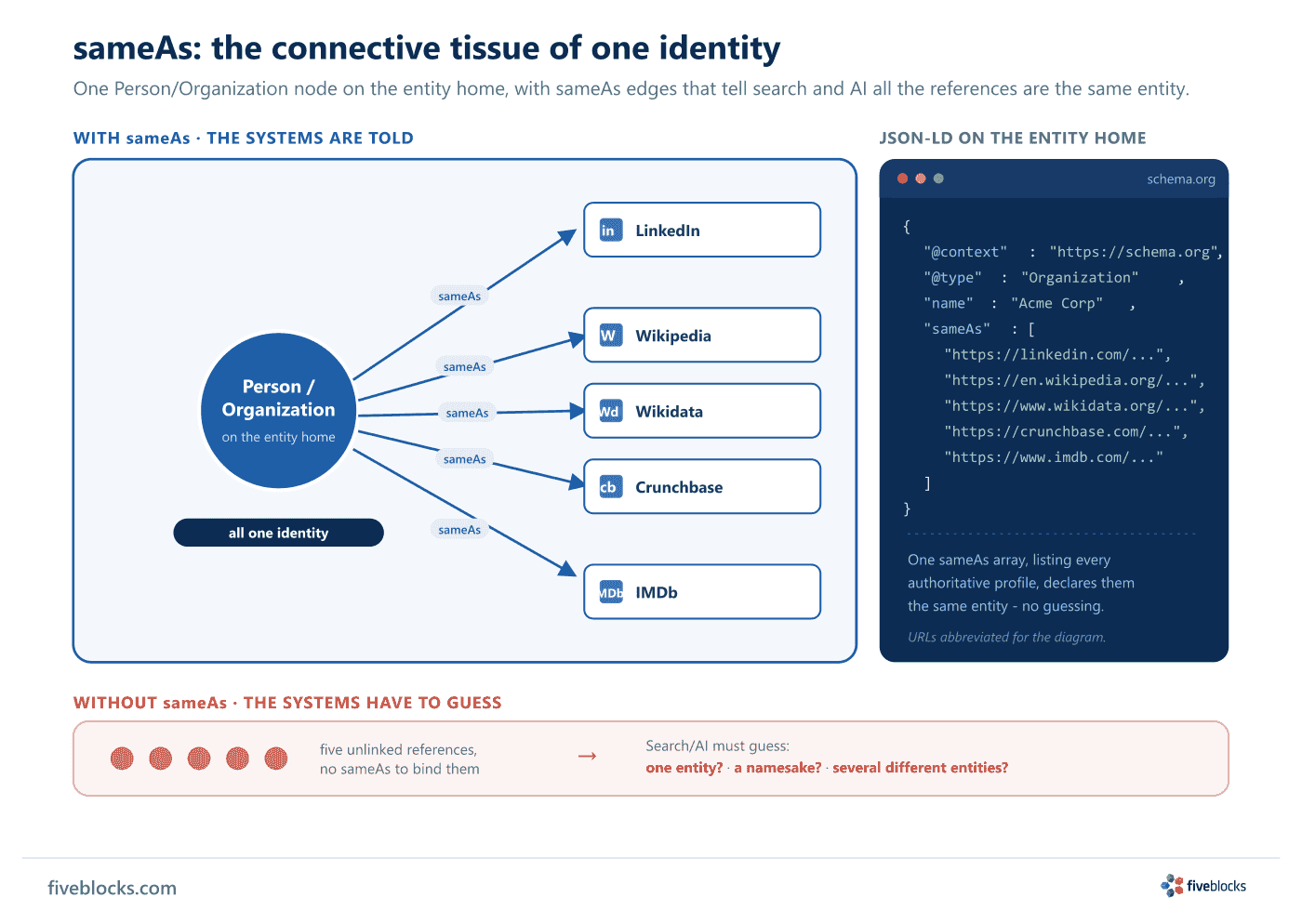
What sameAs does
It connects the dots the systems would otherwise have to guess at. Instead of leaving them to infer that a website, a Wikidata entry, and a LinkedIn profile are one identity, you tell them so directly. That improves resolution sharply for entities with common names or scattered footprints, because it anchors every reference to one canonical node.
Where sameAs points
- LinkedIn, the professional profile for a person or company.
- Wikipedia, where the entity is notable enough to have an article.
- Wikidata, the machine-readable canonical identifier.
- Crunchbase, for companies and their funding/leadership data.
- IMDb, for people and entities in media and entertainment.
- Relevant directories, authoritative third-party references that fit the entity’s domain.
The discipline
Point sameAs at genuinely authoritative, accurate profiles, and keep the set consistent with the rest of the entity stack. We treat sameAs as the connective tissue of the entity layer.
Last reviewed: 20/05/2026
