What types of schema markup are most important for reputation management?
Organization and Person carry the core entities, Article marks authored content, FAQPage makes Q&A extractable, BreadcrumbList conveys structure, and sameAs links the entity to its authoritative profiles. The values must match your canonical entity definition across the stack, since contradictory data makes the engines hedge.
A handful of schema types do most of the work in reputation markup, and the discipline is to deploy them consistently against one canonical entity definition rather than scattering markup across the site. Schema markup is structured data, usually JSON-LD, that describes a page’s entities in machine-readable terms. Search and AI engines read it directly as a signal about what a page is and how it connects to entity context.
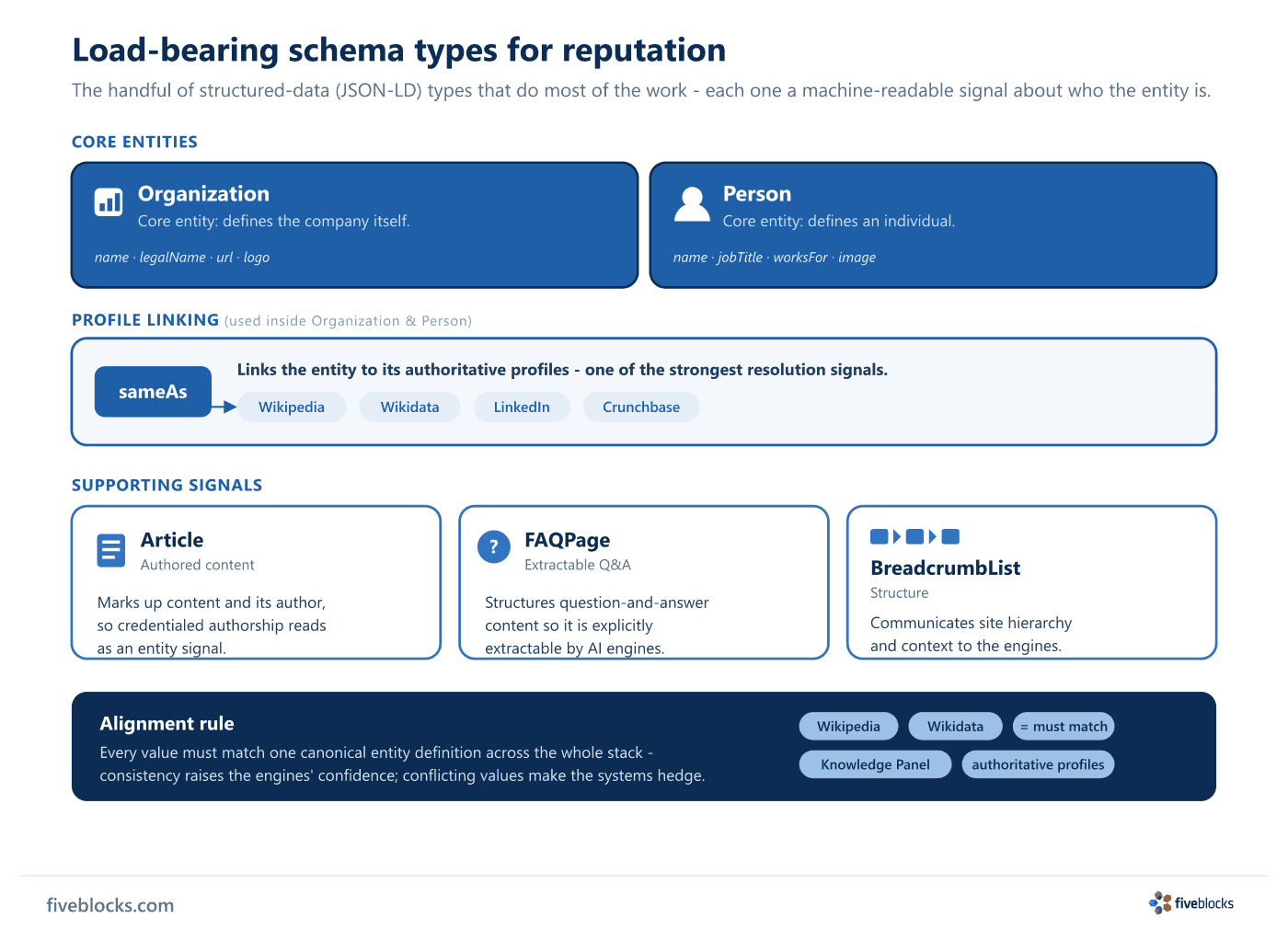
The schema types that matter
- Organization and Person
- These define the entities themselves with their attributes: for an organization, fields such as name, legalName, url, and logo; for a person, name, jobTitle, worksFor, and image. They give the engines a machine-readable anchor for who or what the page is about.
- Article
- Marks up authored content so the systems understand the material and its author. Clear, credentialed authorship is itself an entity signal.
- FAQPage
- Structures question-and-answer content so it is explicitly extractable, in the same clean Q&A format that AI engines and featured snippets pull from.
- BreadcrumbList
- Communicates site structure and context to the engines, and makes the site hierarchy legible to them.
- sameAs
- Used within Organization and Person, sameAs links the entity to its authoritative profiles: Wikipedia, Wikidata, LinkedIn, Crunchbase. It tells search and AI systems directly that these references are one identity, and it is one of the strongest entity-resolution signals available.
The alignment rule
The discipline that decides whether any of this works is alignment. Schema values must match the canonical entity definition across the rest of the stack: Wikipedia, Wikidata, the Knowledge Panel, and your authoritative profiles. When name, description, and attributes are consistent across those signals, the engines are more confident; when they conflict, the systems hedge. So we deploy and validate these types as a set rather than one page at a time, using Google’s structured-data tooling to confirm the markup is well-formed.
Last reviewed: 20/05/2026
