What is schema markup and why does it matter for reputation?
Schema markup is structured data added to a page so search and AI systems can read what its entities, relationships, and content type actually are, not just what words it contains. It matters for reputation because it removes ambiguity at exactly the entity layer where Knowledge Panels and AI answers are built.
Schema markup is structured data – a standardized vocabulary, usually in JSON-LD – added to a web page to tell search engines and AI systems what the page and its entities actually are, in machine-readable terms. Instead of leaving the systems to infer from prose that a page is about a person who is the CEO of a company, schema states it explicitly: this is a Person, their jobTitle is CEO, they worksFor this Organization, and here are the authoritative profiles (sameAs) that confirm the identity.
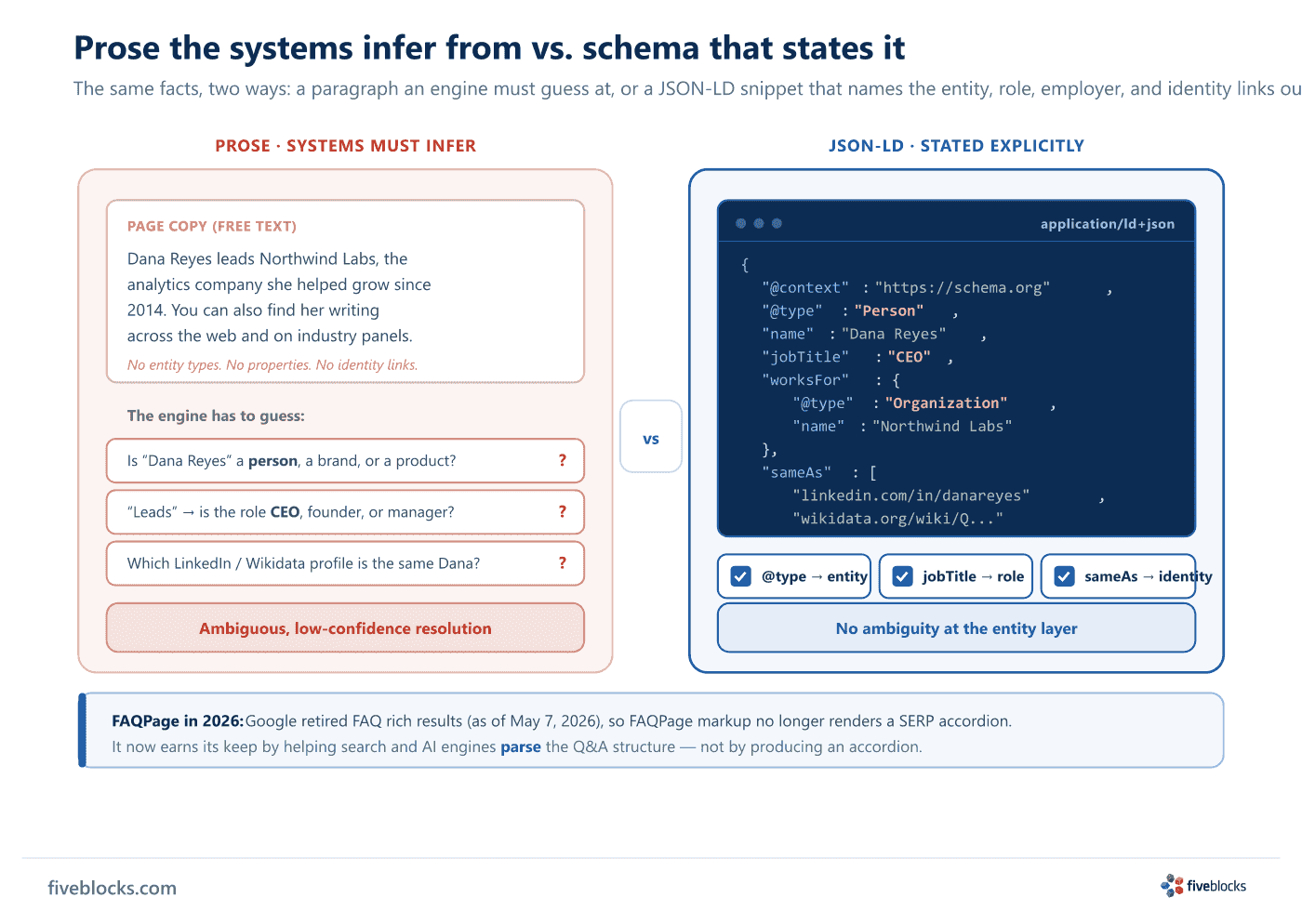
It matters for reputation because it removes ambiguity at the layer where Knowledge Panels and AI answers are built. Well-formed schema raises the systems’ confidence in the entity, makes eligible pages qualify for the rich results Google still supports, and supplies clean facts that the AI engines can extract and reuse more reliably than free prose.
The reputation-relevant schema types
These are the types we deploy on owned properties as a base layer of entity signals, because schema is one of the few signals a client controls directly and completely:
- Organization
- Declares the company as an entity and carries its identifying attributes and authoritative links, so the systems attach content to the right organization rather than a similarly named one.
- Person
- Declares an individual as an entity and states attributes such as job title and the organization they work for, giving the systems the facts that Knowledge Panels and AI bios are built from.
- Article
- Classifies a page as an article and supplies its structured facts, helping engines understand and attribute the content correctly.
- FAQPage
- Marks up a clean question-and-answer structure. Google retired FAQ rich results in 2026, so FAQPage markup now helps engines and readers parse the Q&A rather than producing a SERP accordion.
- sameAs
- Links the entity to the authoritative profiles that confirm its identity, telling search and AI systems explicitly that these references are all the same entity.
Last reviewed: 20/05/2026
Sources (4)
- Mark Up FAQs with Structured Data | Google Search Central | Documentation developers.google.com
- Intro to How Structured Data Markup Works | Google Search Central Documentation developers.google.com
- General Structured Data Guidelines | Google Search Central Documentation developers.google.com
- Google to no longer support FAQ rich results searchengineland.com
