How do you connect all your digital properties into a single recognized entity?
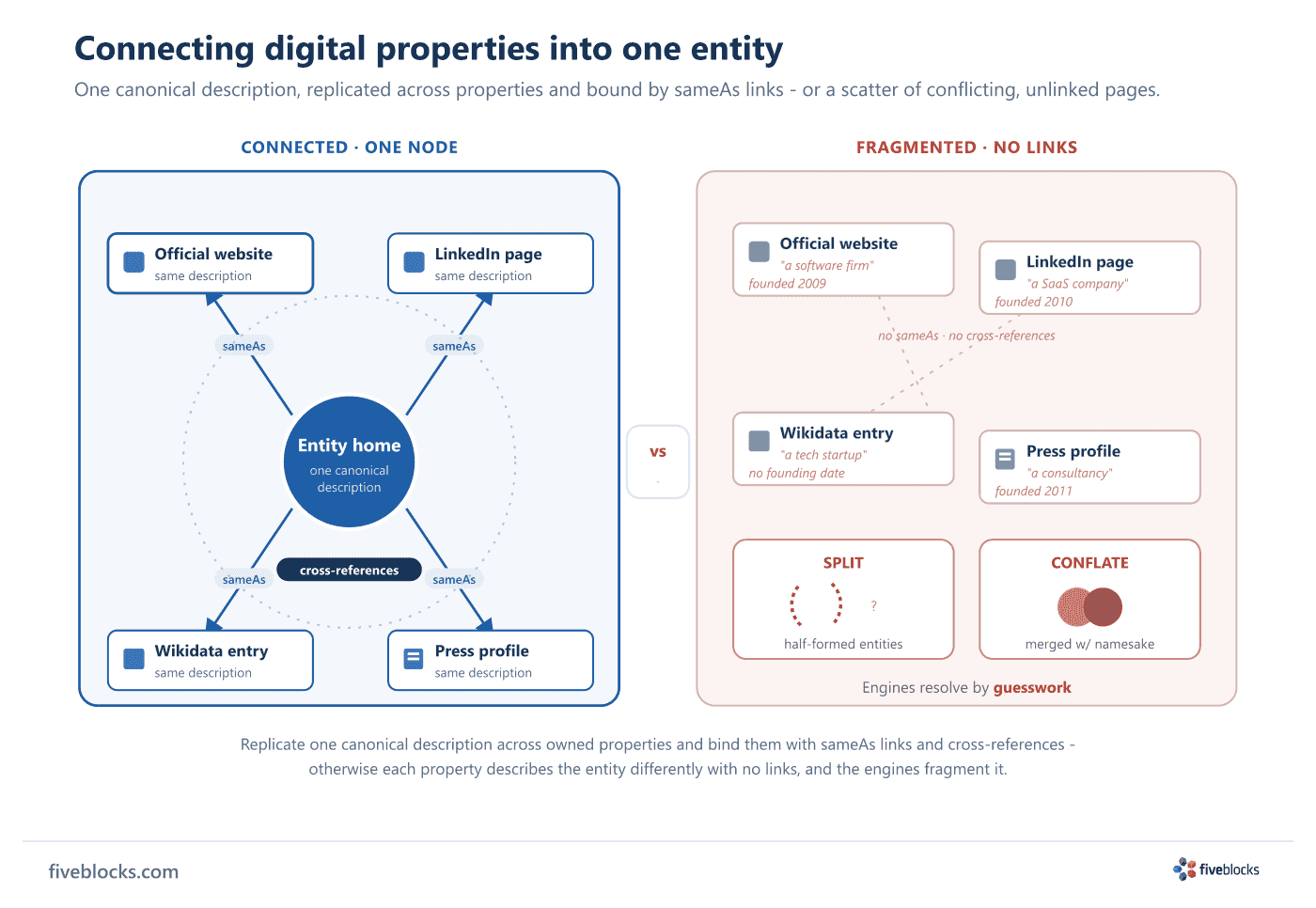
You connect scattered digital properties into one recognized entity through consistency and explicit linking: a single canonical description repeated across every owned property and profile, schema markup with sameAs links pointing from the entity home to each authoritative profile, and structured cross-references that bind the properties into one node. Search and AI engines will not assume a website, a LinkedIn page, a Wikidata entry, and a press profile are the same thing unless the signals say so.
Connecting scattered digital properties into a single recognized entity comes down to consistency and explicit linking. Google and the AI engines will not assume that a website, a LinkedIn page, a Wikidata entry, and a press profile are the same thing unless the signals say so, so the work is to make those signals unambiguous.
The mechanics
- Establish one canonical description on the entity home. Use that same description, verbatim or near-verbatim, across every owned property and profile. Conflicting descriptions reduce the engines’ confidence that the references are one thing.
- Deploy schema markup with
sameAslinks. PointsameAsfrom the entity home out to each authoritative profile. Its value is a “URL of a reference Web page that unambiguously indicates the item’s identity, e.g. the URL of the item’s Wikipedia page, Wikidata entry, or official website.” That is the clearest statement you can make that the references are one identity. - Maintain structured cross-references. Keep the properties linking back to the canonical home so the web of references reinforces a single node rather than a cloud of loosely related pages.
The failure mode: fragmentation
The failure mode is fragmentation: properties that each describe the entity slightly differently, with no explicit links, so the systems resolve them by guesswork. Weak entity infrastructure, meaning no consistent descriptions, no schema, and no sameAs paths, is what lets engines split a footprint into half-formed entities or conflate it with a namesake.
We build this as the connective layer of the entity work and verify the result with AIQ.
Last reviewed: 20/05/2026
