How do you maintain entity consistency across hundreds of digital properties?
At scale, consistency is an operations problem: hold one canonical description as the single source of truth, route every factual change through change governance, run automated schema validation and periodic audits across owned and third-party profiles, and assign a named owner for each medium (web, social, directories, press). The system exists to stop the gradual fragmentation that otherwise creeps in across hundreds of properties.
Maintaining entity consistency across hundreds of properties is an operations and governance problem as much as a technical one. At that scale, descriptions drift, listings go stale, and different teams introduce conflicting signals. Google and the AI engines will not assume that a website, a LinkedIn page, a Wikidata entry, and a press profile describe the same entity unless the signals consistently say so. The job is to run a governance system that keeps those signals aligned faster than they come apart.
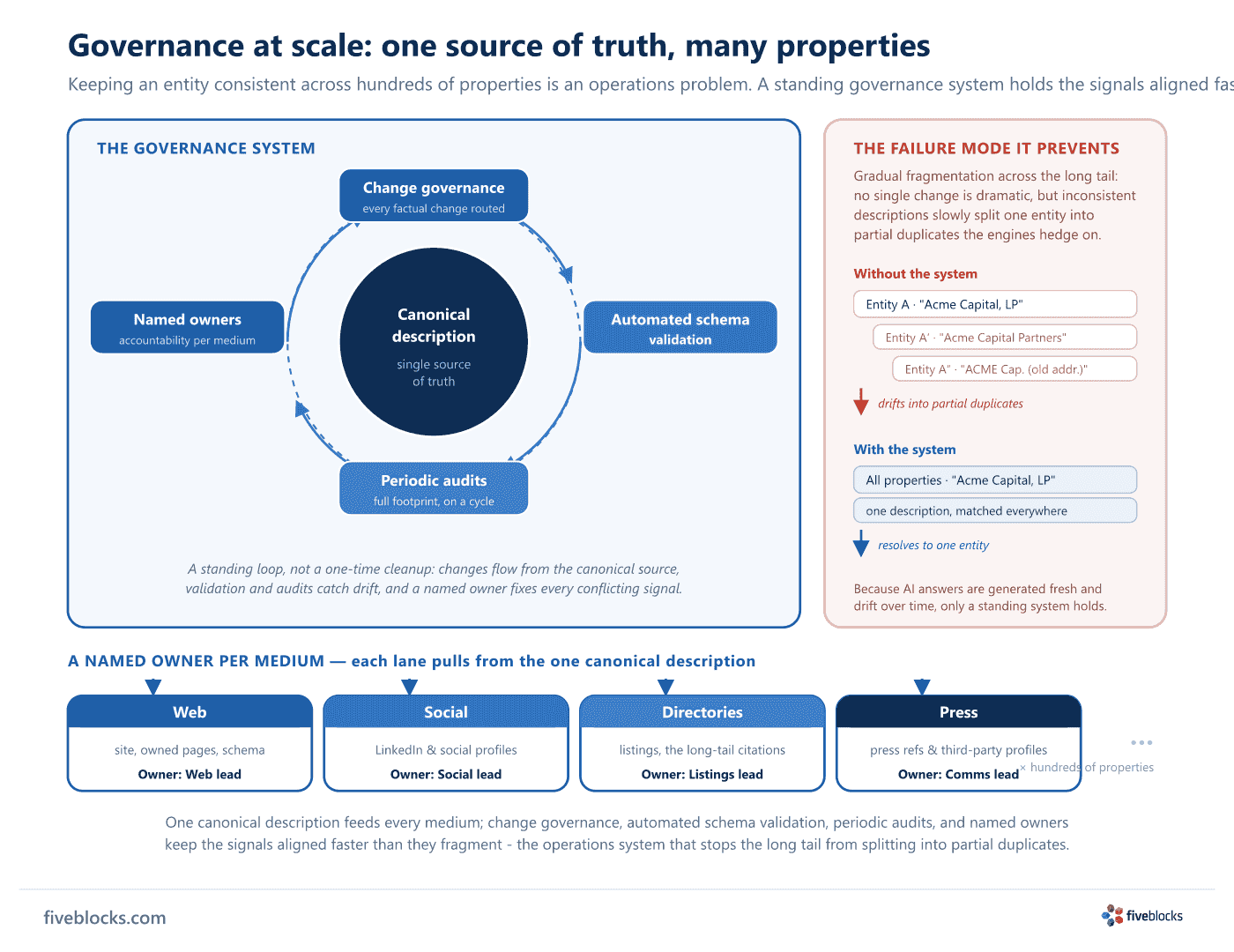
The governance system that holds consistency together
- One canonical description, as the single source of truth. Set a single authoritative description of the entity that every property is expected to match. When references carry consistent descriptions and link back to one another, the engines can resolve scattered mentions into a single, well-defined entity. Mismatched names, addresses, and descriptions make that harder.
- Change governance. Route updates to the entity’s facts through a deliberate process so a change propagates everywhere at once, rather than landing on a few properties and leaving the rest inconsistent.
- Automated schema validation. Keep checking that the structured data on owned properties stays well-formed and eligible as pages change, using validation tooling such as Google’s Rich Results Test. The engines read schema markup directly as a signal about what a page is and which entity it belongs to.
- Periodic audits. Re-check the full footprint, owned properties and third-party profiles alike, on a regular cycle. The long tail of directory listings and citations accumulates stale and conflicting data over time.
- Named owners per medium. Assign clear accountability for each medium (web, social, directories, press references) so no surface is left unmaintained and every conflicting signal has someone responsible for fixing it.
The failure mode this prevents
The risk at scale is gradual fragmentation. No single change is dramatic, but inconsistent NAP data and conflicting descriptions slowly split the entity into partial duplicates, and the systems hedge instead of resolving cleanly. Because AI answers are generated fresh and drift over time, the durable defense is a standing operations system, not a one-time cleanup. We build and run this governance as part of enterprise entity work and verify the result with AIQ.
Last reviewed: 20/05/2026
