How do you measure the strength of your entity across search and AI platforms?
You measure entity strength by what the systems return, not just what you publish: Knowledge Panel presence and accuracy, Wikipedia status, AI-response accuracy across the AI engines AIQ tracks, schema validation, branded-query rank, and named-entity recognition in third-party content. Five Blocks runs this as a standard assessment - AIQ for the AI-engine layer, IMPACT™ for search.
You measure entity strength by what the systems actually return about you. Recognition shows up in the output, not in the inputs alone. No single reading settles it; several measurable signals combine into one picture of how confidently search and AI engines resolve, describe, and attribute your entity.
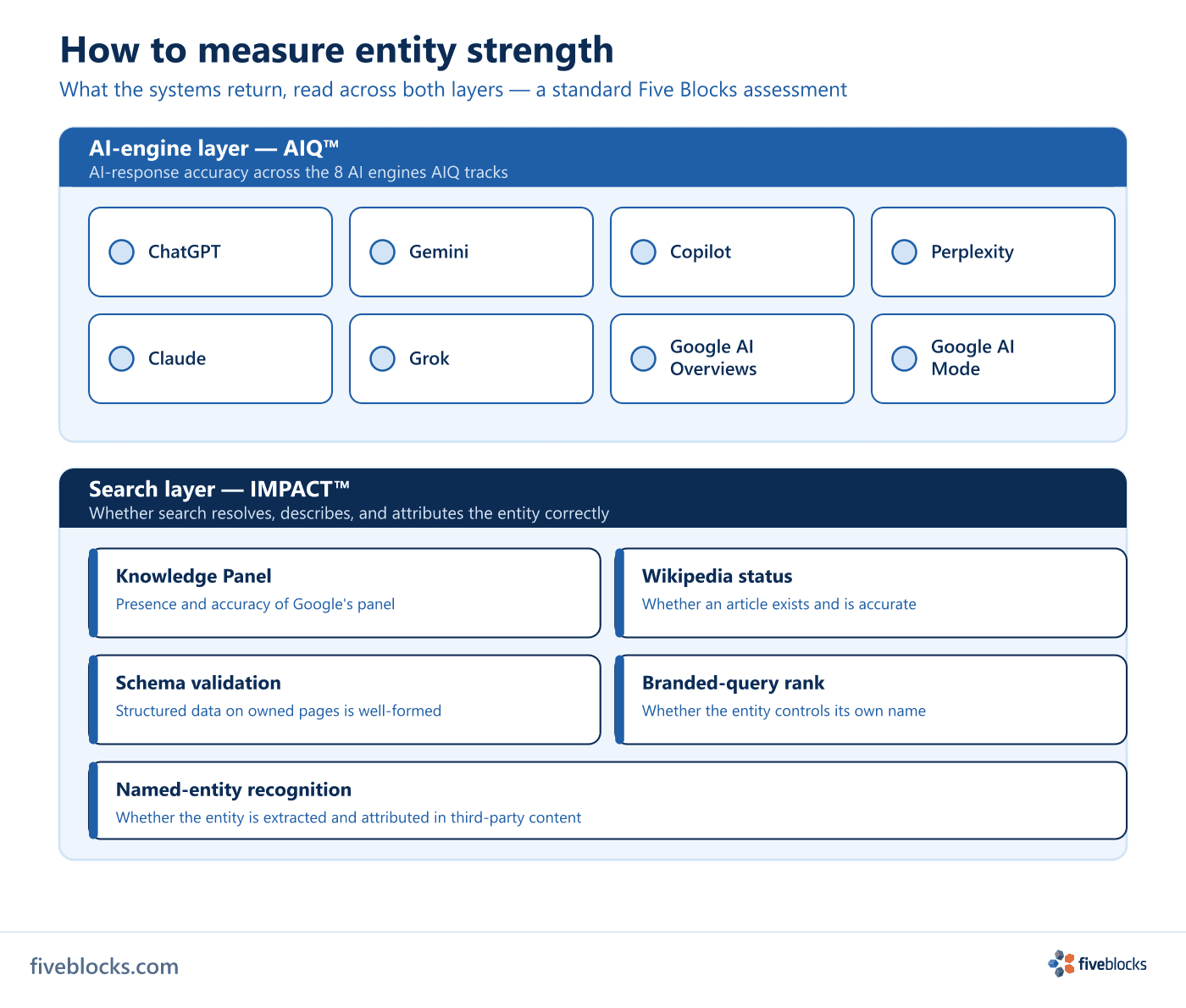
The measurable signals of entity strength
- Knowledge Panel presence and accuracy
- Whether Google has resolved the entity confidently enough to generate a panel, and whether the facts it shows are correct. The panel is assembled from entity signals across the web, so its presence and accuracy show how well those signals have been understood.
- Wikipedia status
- Whether an article exists where notability supports one, and whether it is accurate. Wikipedia is a major authority source, and its content feeds Google Knowledge Panels, the Knowledge Graph, and AI engines, so its state is a direct input to how the systems describe the entity.
- AI-response accuracy across the engines
- Whether ChatGPT, Gemini, Copilot, Perplexity, Claude, Grok, Google AI Overviews, and Google AI Mode describe the entity correctly, consistently, and confidently, or whether they hedge, conflate, or err. These engines answer the same question about the same brand differently, so you read accuracy engine by engine. Hedged, inaccurate, or conflated answers are a known symptom of weak entity signals.
- Schema validation
- Whether the structured data on owned properties is well-formed. Schema and structured data help search and AI engines understand what a page asserts and attach it to the correct entity.
- Branded-query search rank
- Whether the entity controls its own name, meaning what ranks when someone searches the brand directly. Strong entity recognition tends to surface the entity’s own and authoritative properties for its branded query.
- Named-entity recognition in third-party content
- Whether the systems are extracting and attributing the entity from credible sources. Named-entity recognition lets Google and AI engines identify and attribute unlinked brand mentions from natural language, independent of hyperlinks. Its strength shows whether third-party coverage is registering as being about you.
How Five Blocks runs the assessment
We run these measures as a standard entity assessment, reading the output across both layers. AIQ measures the AI-engine layer across the eight engines AIQ currently tracks, and IMPACT™ measures the search layer. Together they show where the entity is recognized cleanly and where the signals still need work.
Last reviewed: 20/05/2026
