How do you measure online reputation?
Quick answer
Online reputation is measured across four layers that feed each other: search composition (what ranks on priority branded queries), AI narrative (what the leading AI engines say, with what sentiment, and how it compares to peers), authoritative entity references (Wikipedia and the Knowledge Panel), and qualitative stakeholder feedback. Read them as one picture rather than four separate dashboards; that is what gives an accurate read on how an entity is perceived.
Measuring online reputation means reading several layers together, not collapsing them into one score or watching each in isolation. A problem in one layer usually explains a symptom in another. Treating them as a single connected picture is the discipline.
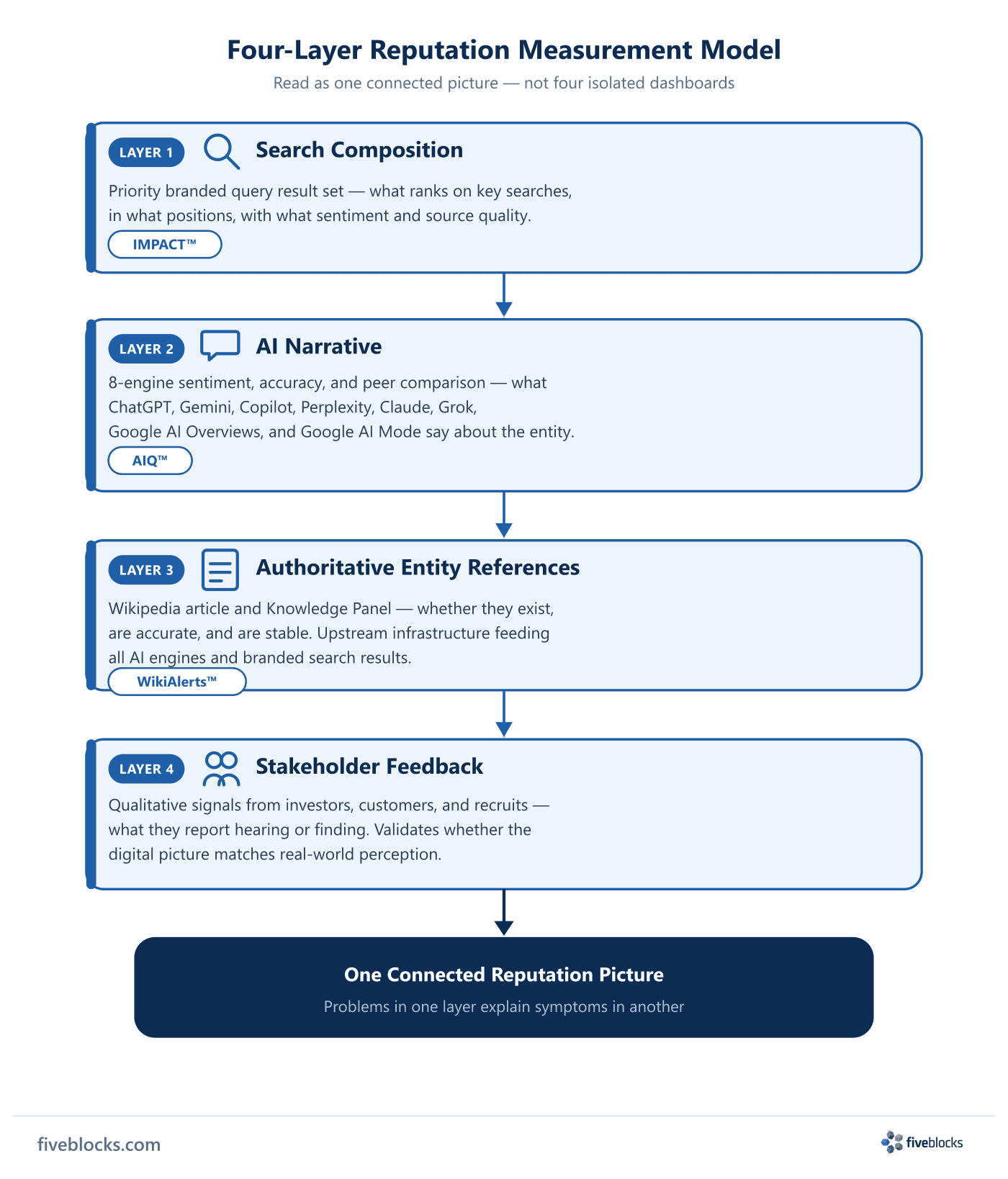
The four measurement layers
- 1. Search composition
- For the priority branded queries: what ranks, in what positions, with what sentiment and source quality. The page-one result set is what investors, customers, and recruits actually see when they research an entity. Tracked with IMPACT™, which records every ranking URL daily across priority keywords, geographies, and languages.
- 2. AI narrative
- What ChatGPT, Gemini, Copilot, Perplexity, Claude, Grok, Google AI Overviews, and Google AI Mode say about the entity: with what sentiment, drawing on which sources, and how the framing compares to peers. Perception is increasingly forming in AI answer engines, and each model can say something different. Tracked with AIQ™, which polls the eight engines AIQ currently tracks for sentiment, accuracy, source quality, and peer comparison.
- 3. Authoritative entity references
- The state of the Wikipedia article and the Knowledge Panel: whether they exist, whether they are accurate, whether they hold steady. Both feed directly into the AI engines and the branded result set, which makes them upstream infrastructure for the other layers. Monitored with WikiAlerts™.
- 4. Stakeholder feedback
- Qualitative signals from investors, customers, and recruits: what they report hearing or finding. The data layers cannot supply this check. It tells you whether the visible digital picture matches real-world perception, and it catches signals that have not yet reached rankings or AI responses.
Why the layers must be read together
- A negative result dropping in the search rankings may trace back to a Wikipedia edit that shifted the AI narrative, which changed what stakeholders found.
- An AI engine citing a hostile source may not affect SERP rankings yet, but it will surface in stakeholder feedback.
- Stakeholder concern about something not yet visible in search or AI is an early warning worth investigating upstream.
Last reviewed: 20/05/2026
