What is a reputation scorecard?
A reputation scorecard is a single executive view that aggregates five inputs: search composition, the AI narrative, Wikipedia and Knowledge Panel status, peer comparison, and crisis readiness. It attaches a trend line and a prioritized recommendation to each reading. That structure is what separates a scorecard from a data dump: it interprets the signals into a posture leadership can act on.
A reputation scorecard turns a program’s many signals into one view leadership can read at a glance. Instead of separate reports for search, AI, and Wikipedia, it puts them on a single card and adds two things a raw feed lacks: trend lines that show direction over time, and a prioritized recommendation attached to each reading. The report then drives decisions instead of describing a moment.
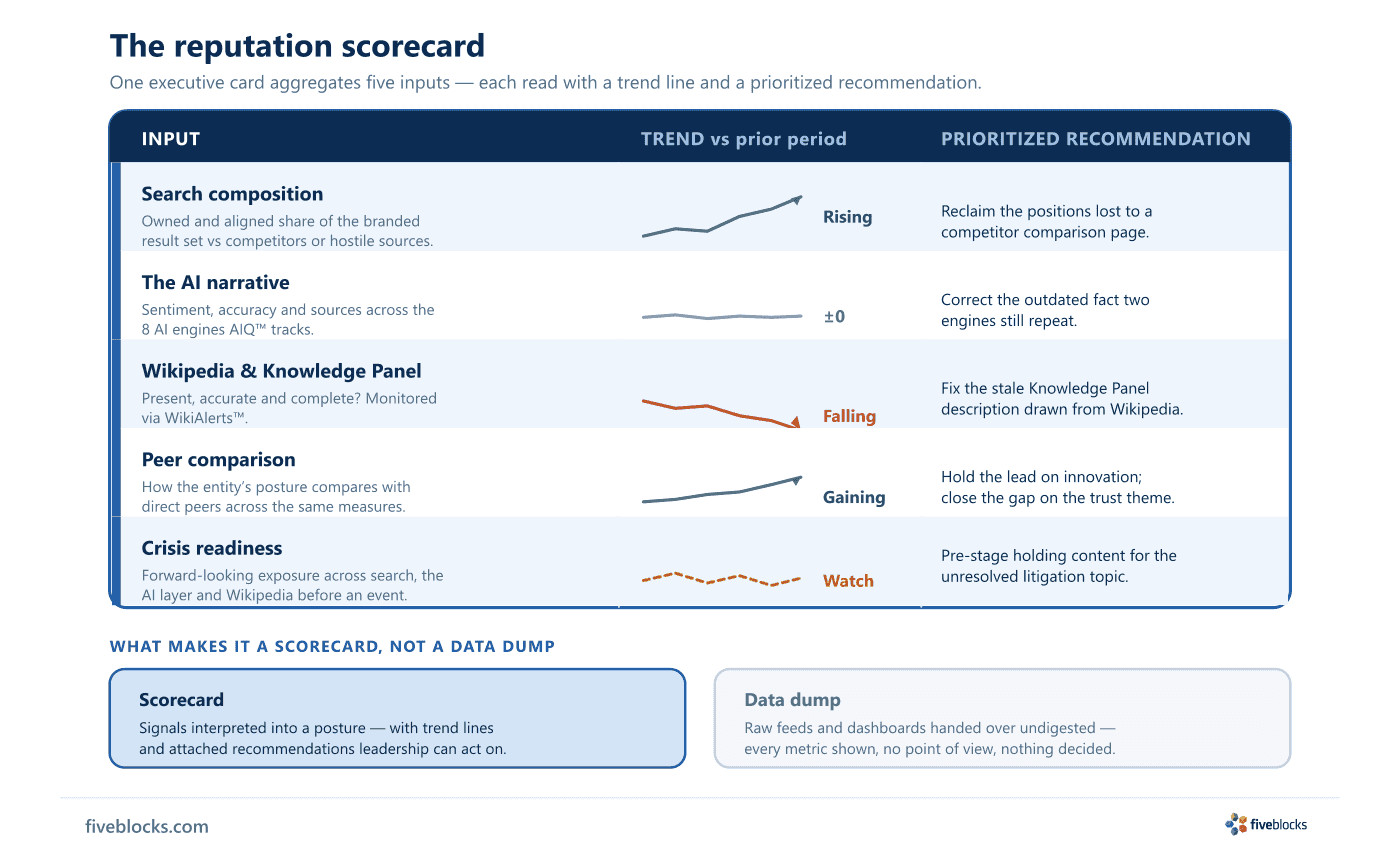
The five inputs a scorecard aggregates
- Search composition
- The makeup of the branded result set: what share of the visible positions belongs to the entity’s own and aligned content, and what share goes to competitors, hostile sources, or unrelated material. It also covers the sentiment and source quality of what ranks. This is the headline measure of control over the branded search page.
- The AI narrative
- What the AI engines say about the entity, with what sentiment, what accuracy, and from which sources. A growing share of perception forms in the AI layer, so the narrative each engine returns is its own input, not a footnote. Monitored with AIQ™, which tracks eight major AI engines: ChatGPT, Copilot, Gemini, Google AI Overviews, Perplexity, Grok, Claude, and Google AI Mode.
- Wikipedia and Knowledge Panel status
- Whether the Wikipedia article and the Google Knowledge Panel are present, accurate, and complete. Both are high-authority surfaces, and weakness on them spreads: the Knowledge Panel pulls its description and core facts from Wikipedia and Wikidata, and Wikipedia content also feeds the AI engines and search rankings. Monitored with WikiAlerts™.
- Peer comparison
- How the entity’s posture compares with direct peers on the same measures. Reputation is relative. A score means little without competitive context, and the peer read is what turns an absolute number into a position.
- Crisis readiness
- Exposure to a reputation event before one happens: the weak points across search, the AI layer, and Wikipedia where a crisis could take hold or an inaccurate narrative could spread. On the scorecard this is a forward-looking read, not a measure of current sentiment.
What separates a scorecard from a data dump
The difference is not the inputs but what is done with them. A data dump hands leadership raw feeds and dashboards to decode. A scorecard adds trend lines that show direction over time, so one reading becomes a trajectory, and attached recommendations that state a prioritized view of what to do next. Restraint matters as much as synthesis: a card carrying every metric communicates nothing. The audience is executives and boards, who need the posture distilled into priorities and choices.
We build scorecards from IMPACT™, AIQ™, and WikiAlerts™ data, with trend lines and prioritized recommendations, so reputation reaches leadership as decisions rather than noise.
Last reviewed: 20/05/2026
