How do you report reputation management results to a board or leadership team?
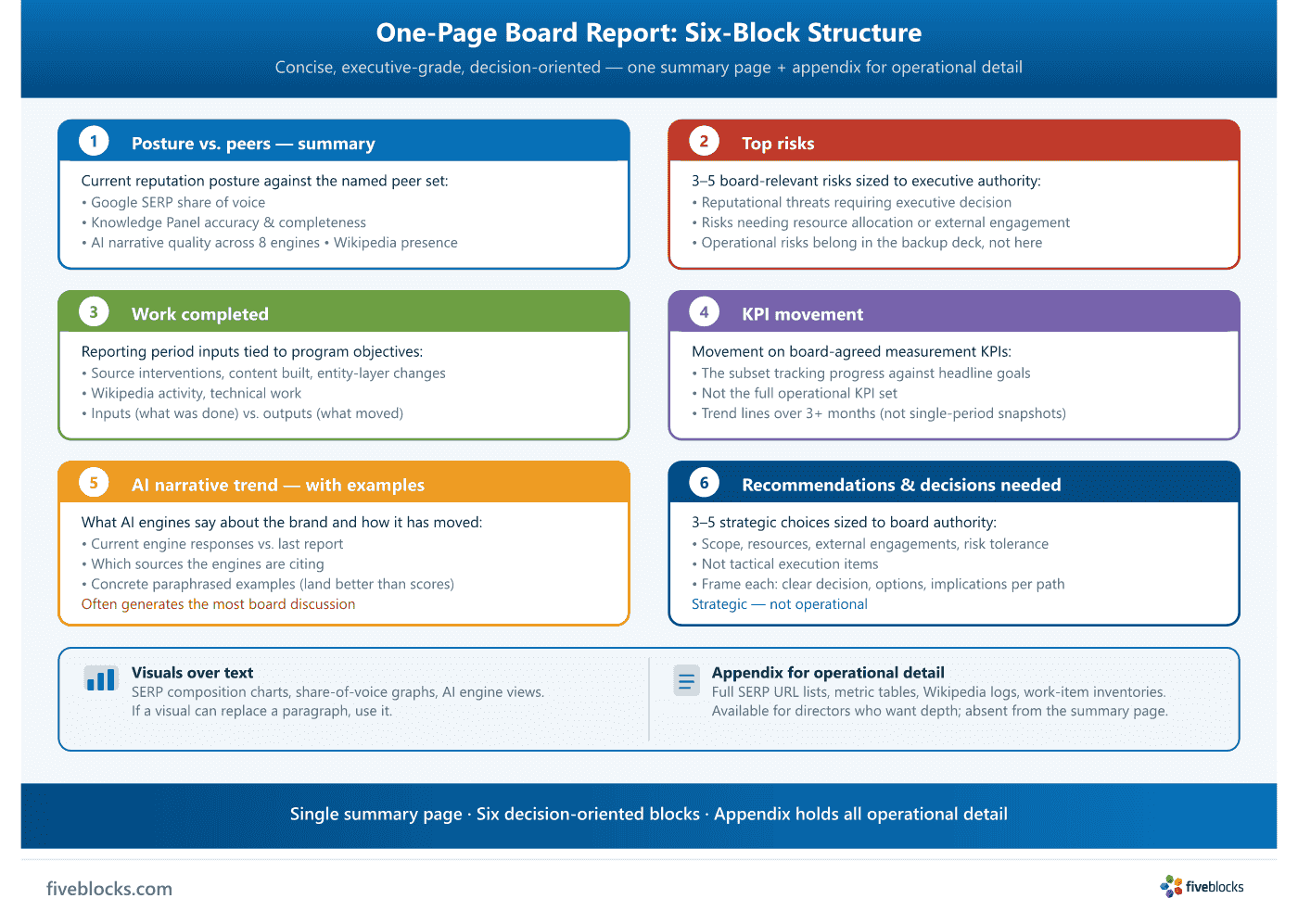
Board-level reputation reporting should fit one page: current posture against peers, top risks, work completed, KPI movement, AI narrative trend with examples, and three to five recommendations or decisions needed. Visuals (SERP composition charts, share-of-voice graphs, engine comparison views) carry the summary more efficiently than prose; full operational detail belongs in an appendix.
Board and leadership reporting on reputation should be short, executive-grade, and built around decisions. The structure below fits a single summary page, with an appendix holding operational detail for any director who wants to go deeper.
-
Posture vs. peers, summary
Open with a single-page view of current reputation posture against the named peer set across the priority layers: Google SERP share of voice, Knowledge Panel accuracy and completeness, AI narrative quality across the eight engines AIQ™ monitors, and Wikipedia presence. This is the executive anchor; everything else in the report explains how this picture moved.
-
Top risks
Three to five risks the board should be aware of, sized to their scope of authority. A risk is board-relevant when it threatens the reputational picture in ways that require executive decision, resource allocation, or external stakeholder engagement. Operational risks belong in the backup deck, not on the summary page.
-
Work completed
A short summary of the work performed during the reporting period, tied to the agreed program objectives: source-level interventions, content built, entity-layer changes, Wikipedia activity, technical work. Separate inputs (what was done) from outputs (what moved); durable change typically lags the work by weeks to months.
-
KPI movement
Movement on the KPIs the board has agreed are the measurement standard. Not the full operational KPI set, but the subset that tracks progress against the headline program goals. Trend lines over at least three months tell you more than a single-period snapshot.
-
AI narrative trend, with examples
What the AI engines are currently saying about the brand, how it has moved since the last report, and which sources the engines are citing. Concrete examples of engine responses (paraphrased or quoted) land better with executive audiences than abstract sentiment scores. This section often draws the most board discussion, because the AI narrative is frequently the reputational layer executives run into directly.
-
Recommendations and decisions needed
Three to five recommendations or decisions sized to the board’s authority. Not tactical execution items, but strategic choices about scope, resources, external engagements, or risk tolerance. Frame each as a clear decision with options and the implications of each path.
Format guidance
- Visuals over text. SERP composition charts, share-of-voice graphs, and AI engine comparison views carry more information per inch than prose paragraphs. If a visual can replace a paragraph, use it.
- Appendix for operational detail. Full SERP URL lists, monthly metric tables, detailed Wikipedia activity logs, and work-item inventories belong in an appendix or backup deck: available for directors who want depth, kept off the summary page.
Last reviewed: 19/05/2026
