What is a reputation risk score and how is it used?
A reputation risk score is an assessment of how exposed an entity is to a reputation event before one happens, rather than a measure of current sentiment. It aggregates vulnerabilities across search, the AI engines, and Wikipedia into a single exposure reading. That gives a risk committee a number in its own language and points the program at the weaknesses worth closing first.
A reputation risk score assesses how exposed an entity is to a reputation event before one happens. That is what makes it usable for risk-committee reporting and for deciding where to invest. Rather than measuring current sentiment, it looks at vulnerability: the places where a crisis could take hold or an inaccurate narrative could spread. Those vulnerabilities are assessed across the layers where perception forms, then aggregated into one measure of exposure.
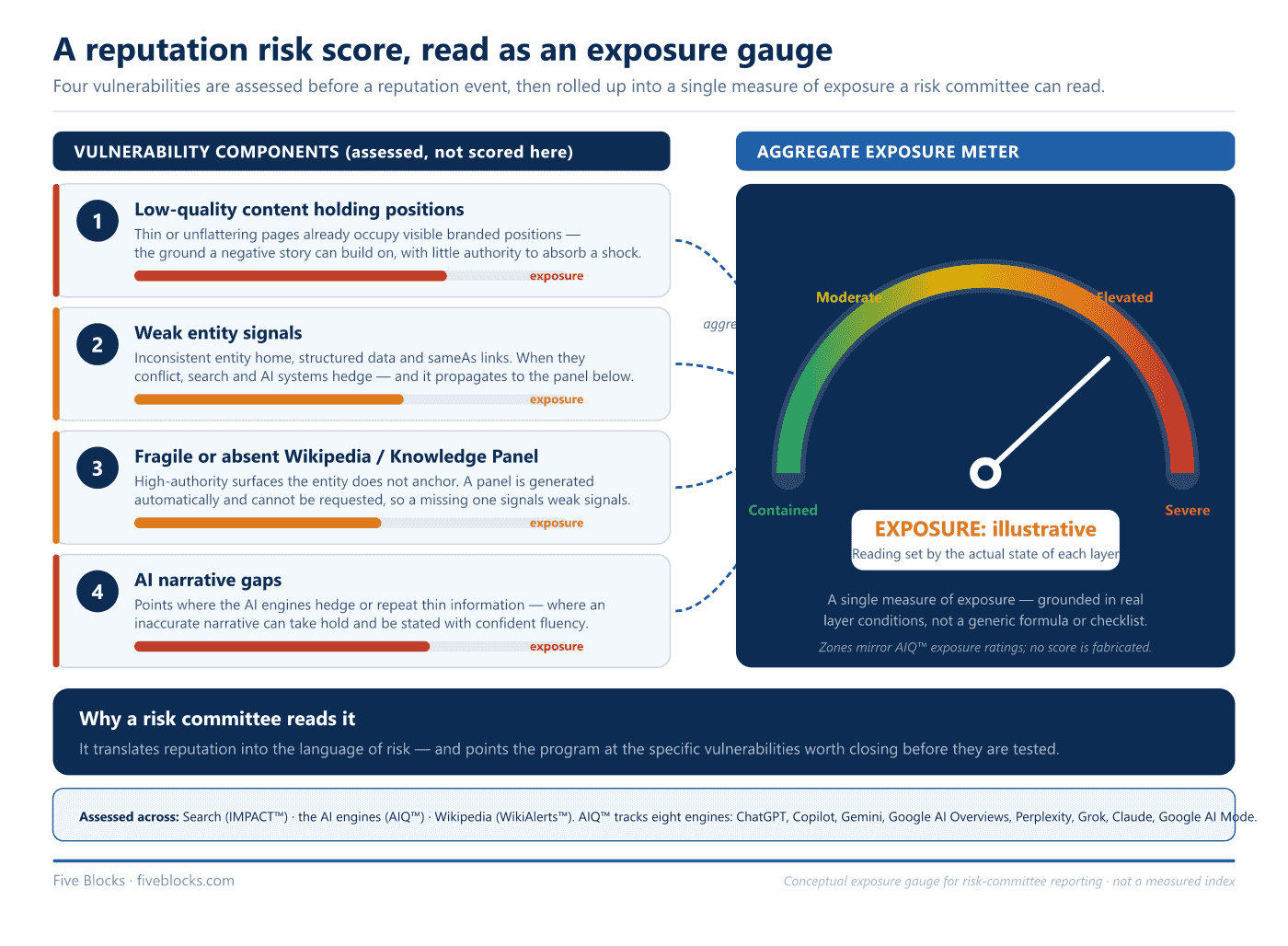
The vulnerability components it weighs
- Low-quality content already holding positions
- Thin or unflattering material that already occupies visible positions on the branded result set. This is a standing vulnerability: it gives a negative story ground to build on, and it means there is little authoritative content in place to absorb a shock.
- Weak entity signals
- The references that identify a company or person to the platforms are inconsistent or incomplete: the entity home, structured data, authoritative profiles, and the
sameAslinks between them. When name, description, and core attributes agree across those signals, search and AI systems become more confident. When they conflict, the systems hedge, and weak signals can leave an entity harder to surface reliably across search and AI features. Entity signals also feed the Google Knowledge Panel, so weakness here spreads into the other components. - A fragile or absent Wikipedia article or Knowledge Panel
- Wikipedia and the Knowledge Panel are high-authority surfaces, so missing or fragile coverage there is an exposure in its own right. Google generates a Knowledge Panel automatically once it is confident enough about an entity, and a panel cannot simply be requested. A missing panel is often a symptom of the weak entity signals above, and it leaves a high-visibility surface the entity does not anchor.
- AI narrative gaps
- Points where the AI engines hedge or repeat thin information about the entity. The engines assemble answers from the source content available about a subject, so weak or sparse signals tend to produce hedged, inaccurate, or conflated answers. AI systems also have a documented tendency to state uncertain claims with confident fluency. A gap here is a place where an inaccurate narrative could take hold.
How the score is used
Each component is a place where a crisis could take hold or an inaccurate narrative could spread, so the score rolls all four into an aggregate measure of exposure: the gauge a risk committee reads. Two things make that worth doing. It puts reputation in the language risk committees already use, and it points the program at the specific vulnerabilities worth closing before they are tested. What keeps the reading honest is grounding it in the actual state of each layer rather than a generic checklist, so the number reflects real exposure and not a formula.
We assess exposure across search, the AI engines, and Wikipedia using IMPACT™, AIQ™, and WikiAlerts™, and report it as a risk picture leadership can act on. AIQ™ tracks eight major AI engines: ChatGPT, Copilot, Gemini, Google AI Overviews, Perplexity, Grok, Claude, and Google AI Mode.
Last reviewed: 20/05/2026
