What is a SERP sentiment score?
A SERP sentiment score is a single composite number built from the sentiment of every URL ranking for a branded query. Each URL is classified positive, neutral, or negative, then weighted by its position and by the query's search volume. The result is one figure that can be tracked over time and compared against peers.
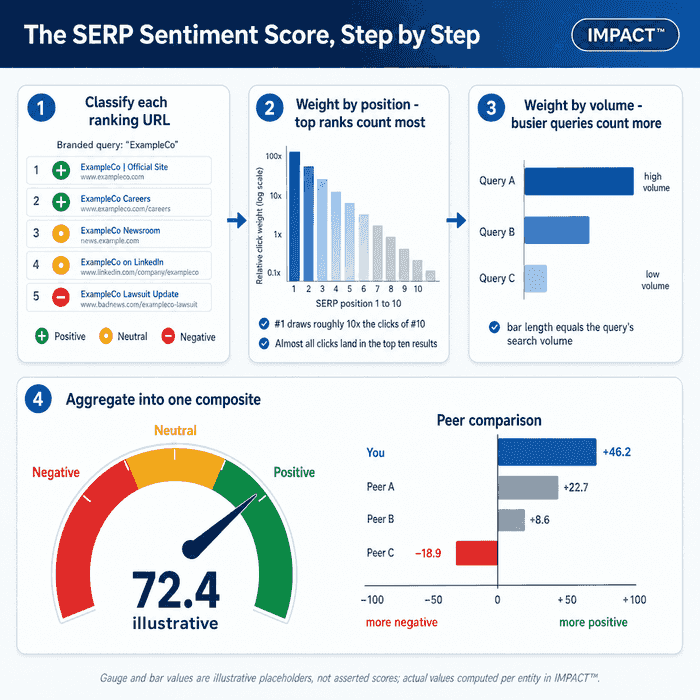
A SERP sentiment score condenses a branded result set into one comparable number, so reputation can be tracked over time and benchmarked against peers. It is built by classifying every ranking URL by sentiment, then aggregating those classifications into a weighted composite.
How the score is built
Four inputs go into the composite:
- Sentiment classification
- Each URL ranking for a branded query is labeled positive, neutral, or negative. Those labels are the raw material the rest of the calculation weights and rolls up.
- Position weighting
- A result’s weight rises with how high it ranks, because attention concentrates at the top of the page. Almost all clicks land in the top ten results, and the first position draws roughly ten times the clicks of the tenth. A negative result near the top therefore counts far more than one further down.
- Search-volume weighting
- Results on higher-traffic queries count for more than results on rarely searched ones. That keeps the score anchored to the queries that actually shape perception instead of treating every query as equal.
- Aggregation into a composite
- The weighted classifications roll up into one number that reflects both whether negative content exists and how visible it is.
Why it is useful
The point is comparability. One figure tracked over the life of a program shows whether the page-one picture is improving, and the same figure set against competitors’ scores shows relative standing.
How to read it
A score is a summary, so read it alongside the underlying composition rather than on its own. Automated sentiment classification is imperfect on nuance, sarcasm, and context, which makes the score a directional measure that needs human judgment, not ground truth. Five Blocks computes sentiment scores within IMPACT™, which tracks both movement over time and peer comparison.
Last reviewed: 20/05/2026
