What is sentiment analysis and how does it apply to search results?
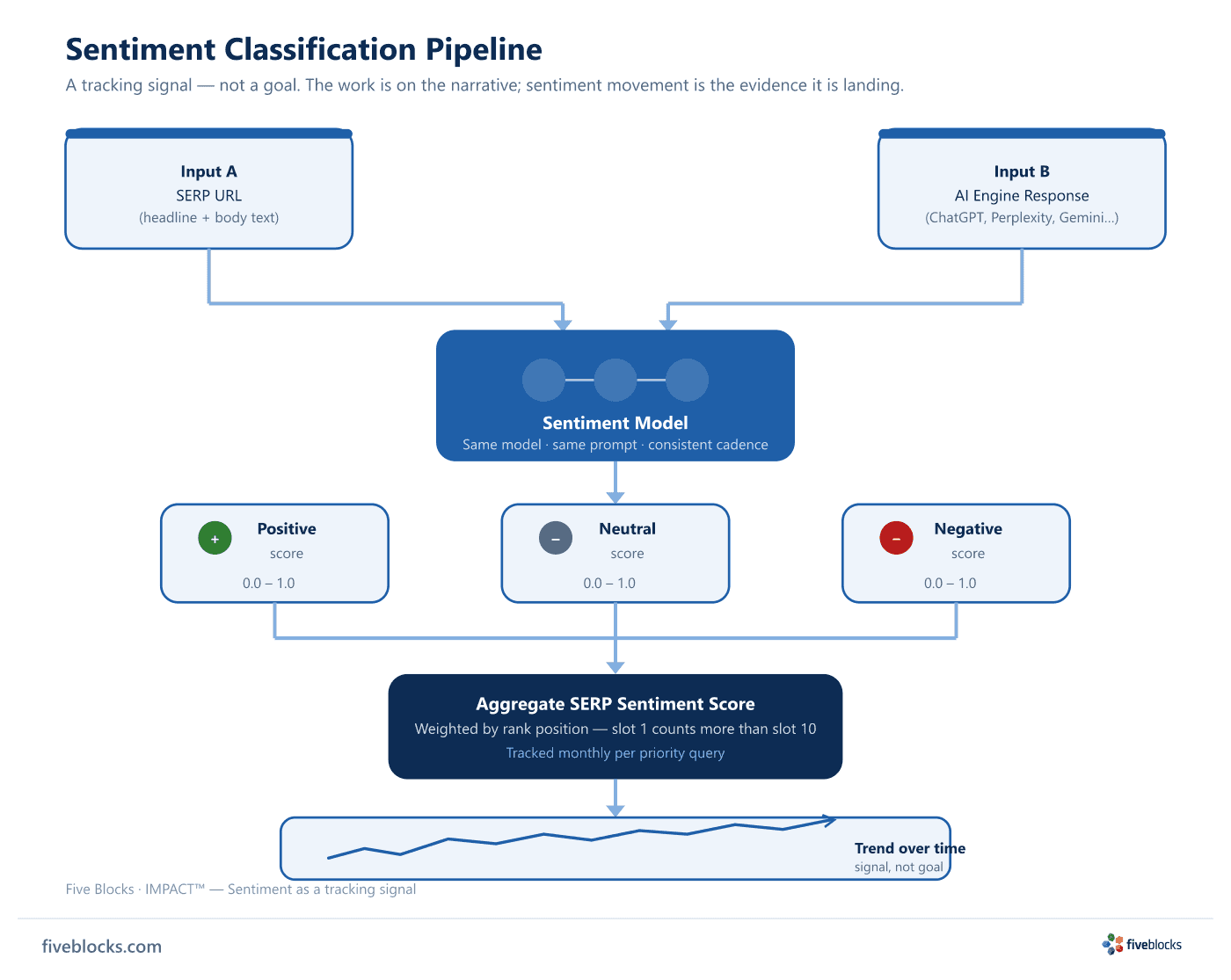
Sentiment analysis classifies content, a URL, an article, or an AI engine response as positive, neutral, or negative. In SERP reputation work it is a tracking signal: each ranking URL on a priority query is scored, the aggregate page-one sentiment is tracked monthly, and AI engine responses are scored per engine, with trend lines over time showing narrative drift. Sentiment is a leading indicator, not a goal. The work is on the underlying narrative, not on the score.
Sentiment analysis classifies content on a positive, neutral, or negative axis. For reputation work it is a tracking signal rather than a decision criterion, because the same content can register different sentiment scores depending on the model and the prompt used.
What is classified
- SERP URLs
- Each ranking URL on a priority query is scored: headline tone, body sentiment, and overall framing. The aggregate sentiment of page one is tracked monthly. Higher-ranked slots are weighted more heavily than lower ones because they drive more of the first-impression effect.
- AI engine responses
- Each response returned by an AI engine, ChatGPT, Perplexity, Gemini, and the others AIQ™ monitors, is scored per engine. A single snapshot means less than the trend. Sentiment movement over weeks or months shows whether the narrative is improving, stable, or deteriorating inside each model.
- Individual sources and articles
- Specific articles or profiles that anchor a SERP or appear often in AI citations can be scored individually, to identify which sources are pulling the aggregate up or down.
Why sentiment varies across models
Different AI models often produce different sentiment scores for the same input, and even small changes in prompt phrasing can shift the classification. A single-model snapshot is not ground truth. Trend comparisons stay valid over time only when the method is held constant: same model, same prompt structure, same cadence.
The failure mode to avoid
The most common misuse of the metric is treating sentiment as a goal rather than a signal. A program aimed at improving the sentiment score can produce cosmetic changes, such as commissioning positive content that scores well but leaves the underlying narrative untouched, without fixing the actual reputation state. The work is on the narrative: the sources, themes, and attributions that shape what engines say and what page one shows. Sentiment movement is the evidence that the narrative work is landing.
Last reviewed: 19/05/2026
