How do you measure search result sentiment over time?
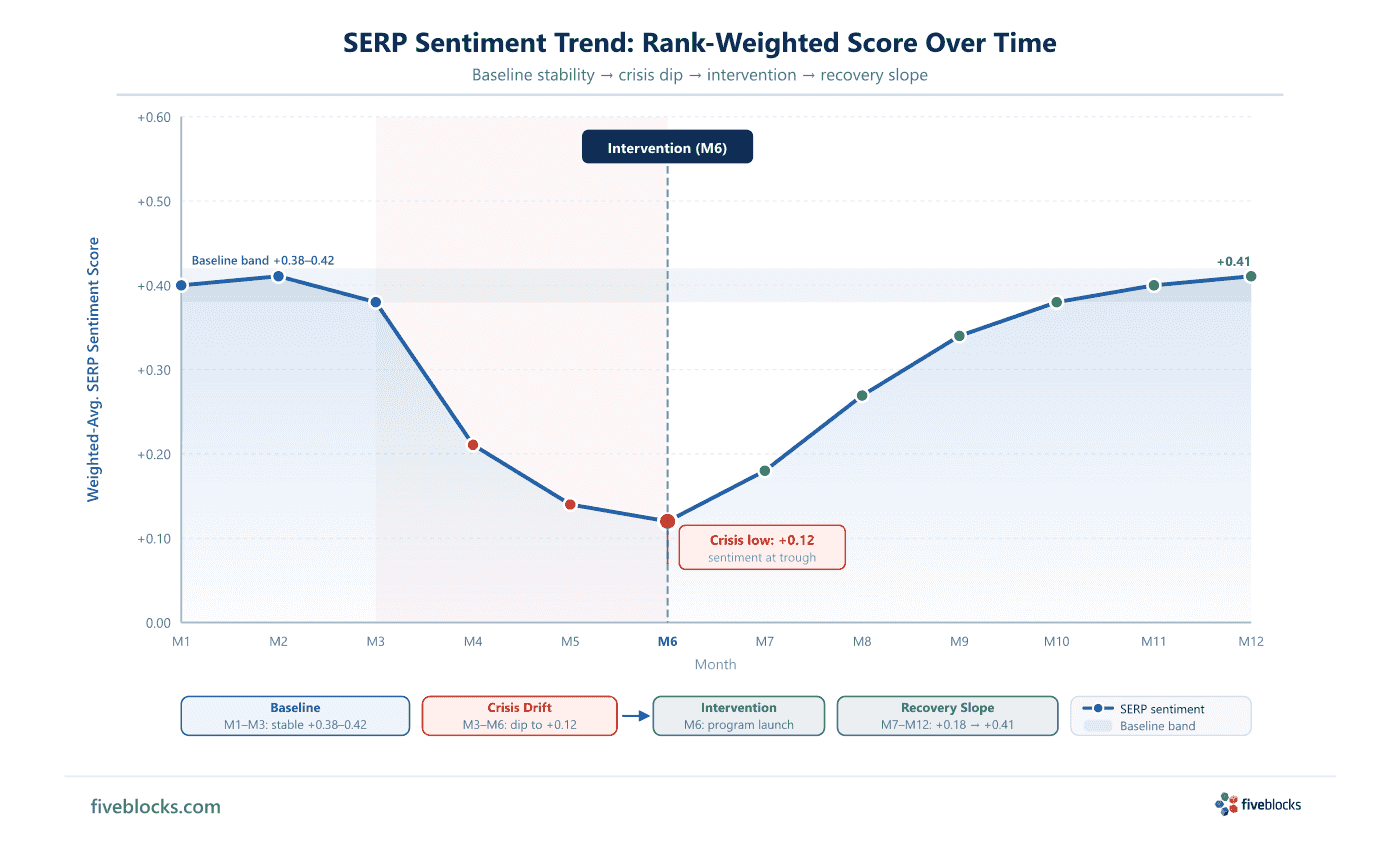
Search result sentiment is measured over time by classifying every ranking URL on priority queries as positive, neutral, or negative, then aggregating into a rank-weighted score that accounts for position (higher slots count more). Capturing this data at a consistent cadence, weekly or monthly, produces trend lines that show narrative drift before it becomes obvious and confirm whether specific interventions have moved the needle. The same approach runs inside AIQ™ for AI engine responses, producing per-engine sentiment trends alongside the SERP view.
Tracking sentiment over time turns a snapshot into a signal you can act on. The trend tells you whether the brand’s narrative is improving, holding steady, or deteriorating across both search results and AI engine responses; a single measurement does not.
Step 1: Capture every ranking URL at consistent intervals
For each priority query, IMPACT™ captures every URL appearing on page one and page two at consistent intervals. Search result positions shift continuously, so a single snapshot is not enough. The cadence (daily data with weekly or monthly reporting cuts) is what makes trend comparisons valid over time.
Step 2: Score each URL on its actual content
Each captured URL is sentiment-scored on its actual content, headline tone, body framing, and overall impression, rather than on surface signals like the domain name alone. The classification is positive, neutral, or negative. Applying the same method across every measurement period keeps the trend lines comparable.
Step 3: Aggregate into a rank-weighted SERP sentiment score
The per-URL scores are combined into an aggregate sentiment figure for the full SERP, weighted by ranking position: URLs in higher slots count more than lower-ranked results, because they draw more of the first-impression exposure. This weighted average is the number that gets trended over weeks and months.
Step 4: Apply the same logic to AI engine responses
Inside AIQ™, every response from the eight AI engines AIQ currently monitors is sentiment-scored per engine on the same positive, neutral, or negative basis. The per-engine trend lines show which models are improving or worsening in how they treat the brand, and whether intervention work (new content, source-layer remediation, entity updates) is registering differently across engines.
What the trend lines show
- Narrative drift: A gradual shift in aggregate sentiment, even when no single new hostile article stands out, means the mix of ranking content is changing in a way that will eventually affect how stakeholders see the brand. Catching drift early allows intervention before the picture sets.
- Intervention impact: When sentiment moves in response to specific work (a new article ranking, a source-level remediation, an AI entity update), the trend line is evidence that the intervention landed. Without a trend baseline, attributing impact is largely guesswork.
- Per-engine divergence: AI engines can score the same brand’s narrative differently, since even small changes in prompt phrasing shift classification results. Tracking per-engine trends shows which models need a different source-layer or content approach.
The discipline: consistency over precision
Sentiment classification is imperfect on nuance, context, and tone, and no method removes all the noise. What makes sentiment tracking useful in reputation work is applying the same classification consistently over time, so that movement in the trend lines reflects real narrative change rather than measurement variation. The trend is the signal; treat no single snapshot as a verdict.
Last reviewed: 19/05/2026
