How do you measure the impact of a news article on search results?
Measuring a news article's real impact on search reputation requires tracking five signals: SERP placement (does it rank for branded queries, at what position, for how long), SERP feature presence (Top Stories, AI Overviews, knowledge panels), AI engine citation adoption (do engines start citing the article's framing across ChatGPT, Gemini, Perplexity, and the other engines AIQ currently tracks), engagement or traffic signals where available, and downstream coverage (does the article get picked up by other publishers). Page views alone do not tell you whether the article actually moved the needle.
When a notable article publishes, positive or negative, measuring its actual reputational impact takes more than tracking page views. Five signals together tell you whether the article moved the needle or just produced a news-cycle blip.
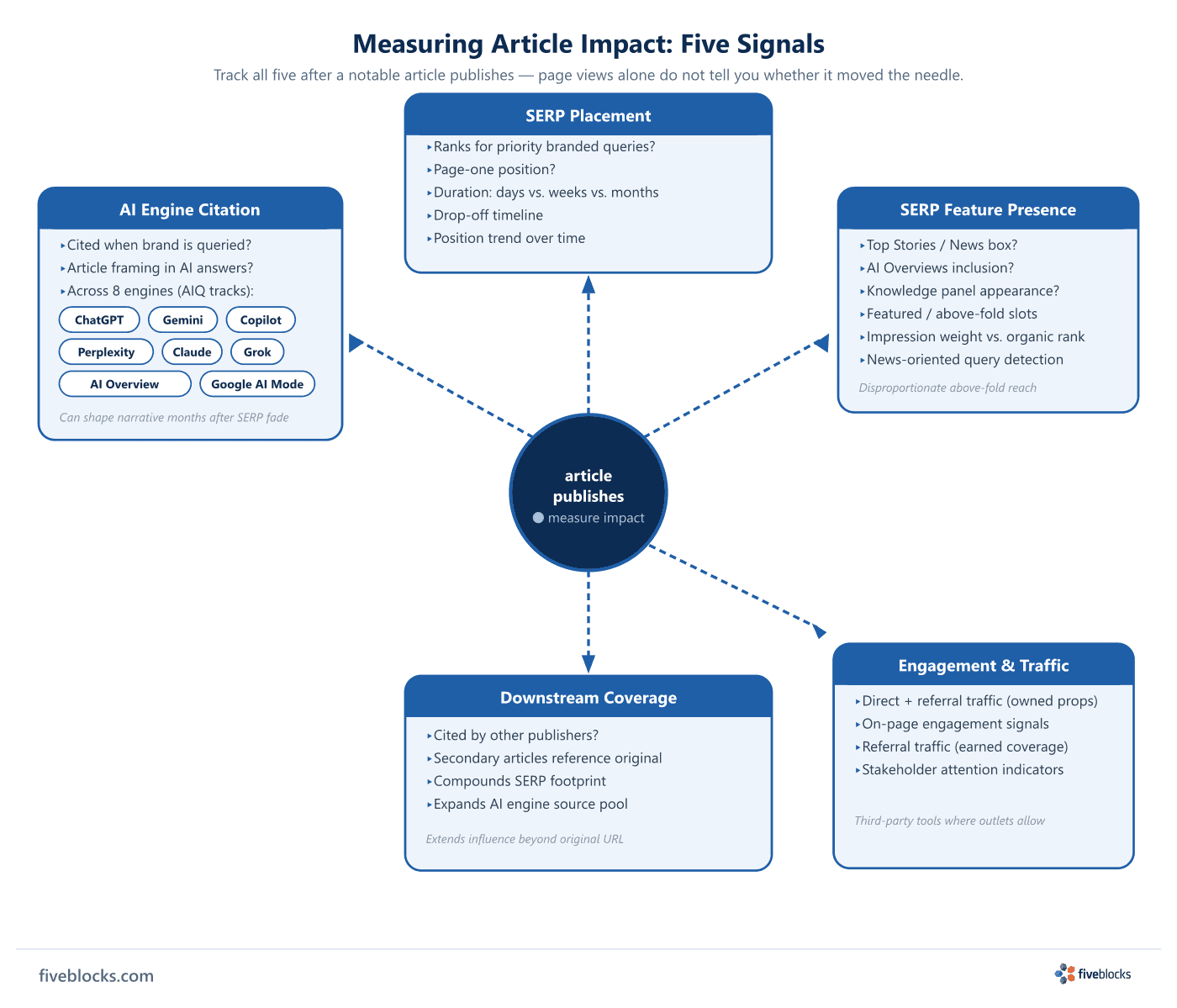
- SERP placement
- Does the article rank for the priority branded queries? At what position? For how long? An article that holds page one of a name search for weeks or months has a very different impact than one that drops off within days.
- SERP feature presence
- Does the article surface in Top Stories or news boxes, which Google shows when it detects a news-oriented search? Does it appear in AI Overviews, knowledge panels, or other featured placements? These slots draw more impressions than their ranking alone would suggest, because they sit above the fold regardless of organic position.
- AI engine citation adoption
- Do the AI engines start citing the article when answering questions about the brand? Does the article’s framing show up in engine responses? AIQ tracks this directly across the eight engines it currently monitors: ChatGPT, Copilot, Gemini, AI Overview, Perplexity, Grok, Claude, and Google AI Mode. An article that several engines adopt as a source can shape the narrative for months, even after it fades from the organic SERP.
- Engagement and traffic signals
- For owned-property articles, analytics show direct traffic and on-page engagement. For earned coverage, third-party tools can surface referral traffic where the outlet makes it accessible. These signals tell you whether the article is drawing real stakeholder attention or sitting unread.
- Downstream coverage
- Do other publishers cite or reference the article, extending its reach? Secondary coverage that cites the original adds to both the SERP footprint and the AI engine source pool, carrying the article’s influence well beyond its own URL.
Last reviewed: 19/05/2026
