How do you measure the search impact of a PR campaign?
Measuring the search impact of a PR campaign means reading four indicators together: movement in SERP positions on priority branded and topic queries before, during, and after; how often AI engines cite or pull campaign content into their answers; lift in branded search volume; and what the coverage adds to the authoritative source layer and entity signals that feed both search and AI over time.
Coverage volume answers the wrong question. What matters is whether the campaign changed what people find when they search, and a placement that never reshapes a result page or enters an AI engine’s source pool has no search reputation effect, however impressive the outlet. Four indicators, read together, give the answer.
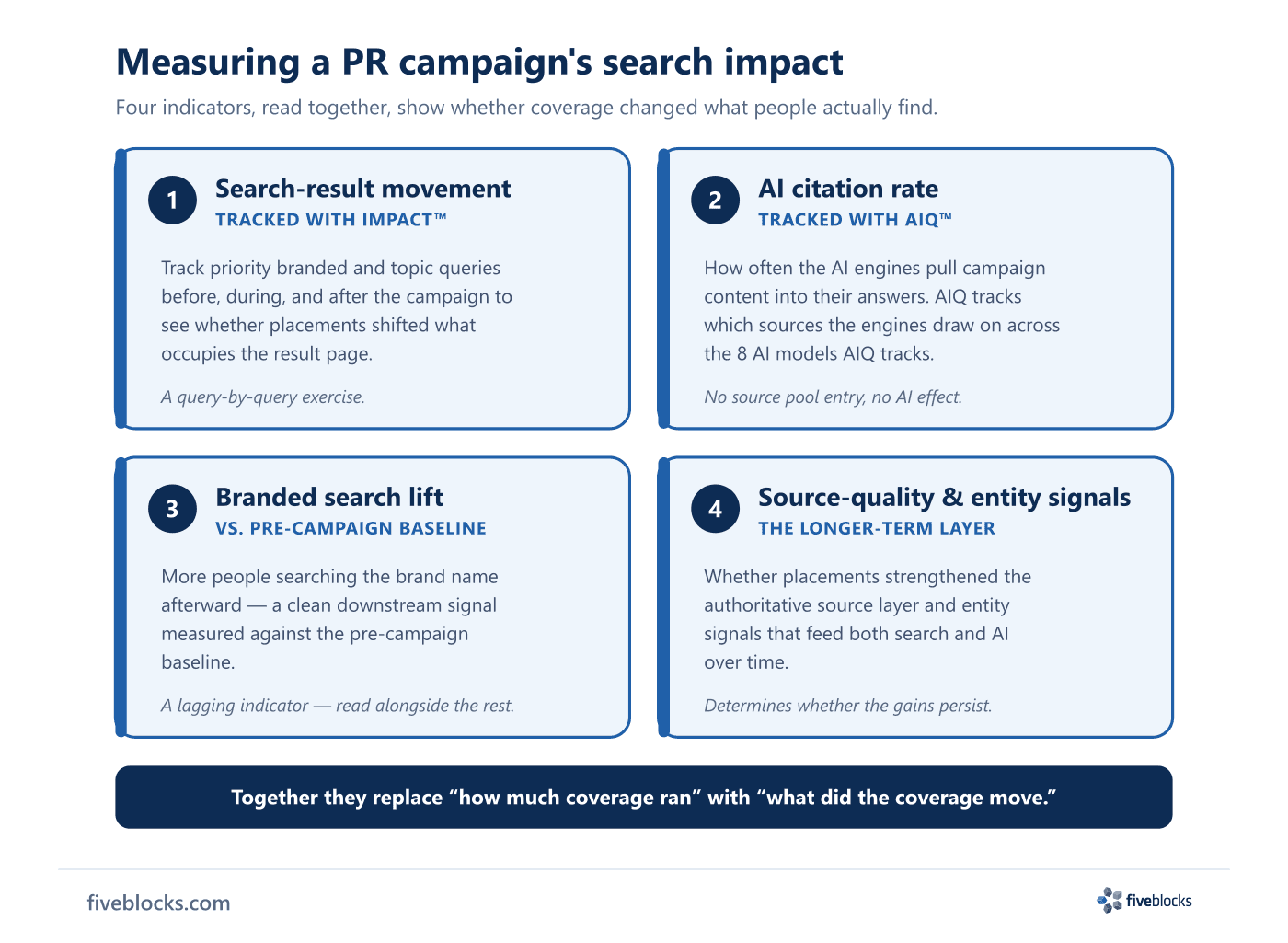
1. Search-result movement
Track the priority queries, branded and topic-specific, before, during, and after the campaign to see whether the placements shifted what occupies the result page. Work query by query: a campaign often moves one high-value query and leaves the rest where they were. IMPACT™ handles this kind of before/during/after tracking of SERP composition across priority keywords.
2. AI citation rate
Check whether the AI engines pulled campaign content into their answers. A placement that never enters the engines’ source pool has no AI effect regardless of its reach. One that gets cited across ChatGPT, Gemini, Perplexity, and the other major models keeps working long after the original audience has moved on. AIQ™ tracks which sources the engines draw on across eight AI models, so the citation rate of campaign content is something you can see rather than assume.
3. Branded search volume lift
A campaign that worked usually shows up as more people searching the brand name afterward. Branded search lift is a clean downstream signal: it shows whether the campaign reached people who were not already searching, and it can be measured against the pre-campaign baseline. It lags, so read it next to the SERP and AI metrics rather than on its own.
4. Source-quality and entity-signal contribution
Past the campaign window, ask whether the placements strengthened the authoritative source layer and the entity signals that feed both search and AI over the longer term. Coverage that other authoritative sources cite, that is anchored to the entity record and absorbed into the knowledge graph, keeps paying out. Coverage that is not stays a moment in time. This is the metric that ties a short-term PR program to a durable search reputation.
Reading the four together
No single indicator is enough on its own. SERP movement without AI citation means the campaign is winning in classic search and absent from the emerging channel where more queries now resolve. AI citation without branded search lift can mean the campaign shaped the narrative without reaching new audiences at scale. The source-quality contribution determines whether this campaign’s gains carry into the next one. Read together, the four metrics replace “how much coverage ran” with “what did the coverage move.”
Last reviewed: 20/05/2026
