How do you measure the combined impact of PR and reputation management programs?
Measuring PR and reputation programs together takes one coordinated scorecard: SERP composition on branded queries (tracked with IMPACT™), AI narrative trend across the major engines (tracked with AIQ™), the authority earned media contributes to the source layer that feeds search and AI, share of voice across models versus peers, and downstream business signals such as branded search lift and referral patterns. Read as one system, those five metrics expose interactions that neither program's own reporting can show.
Measuring PR and reputation programs together means reading one coordinated scorecard instead of two disconnected ones. The programs feed each other. Earned media strengthens the source layer that shapes AI answers, a stronger AI narrative drives branded search volume, and SERP composition shifts as that volume grows. Metrics read in isolation miss those interactions. Five indicators, tracked together, tell leadership whether the combined investment is moving what matters.
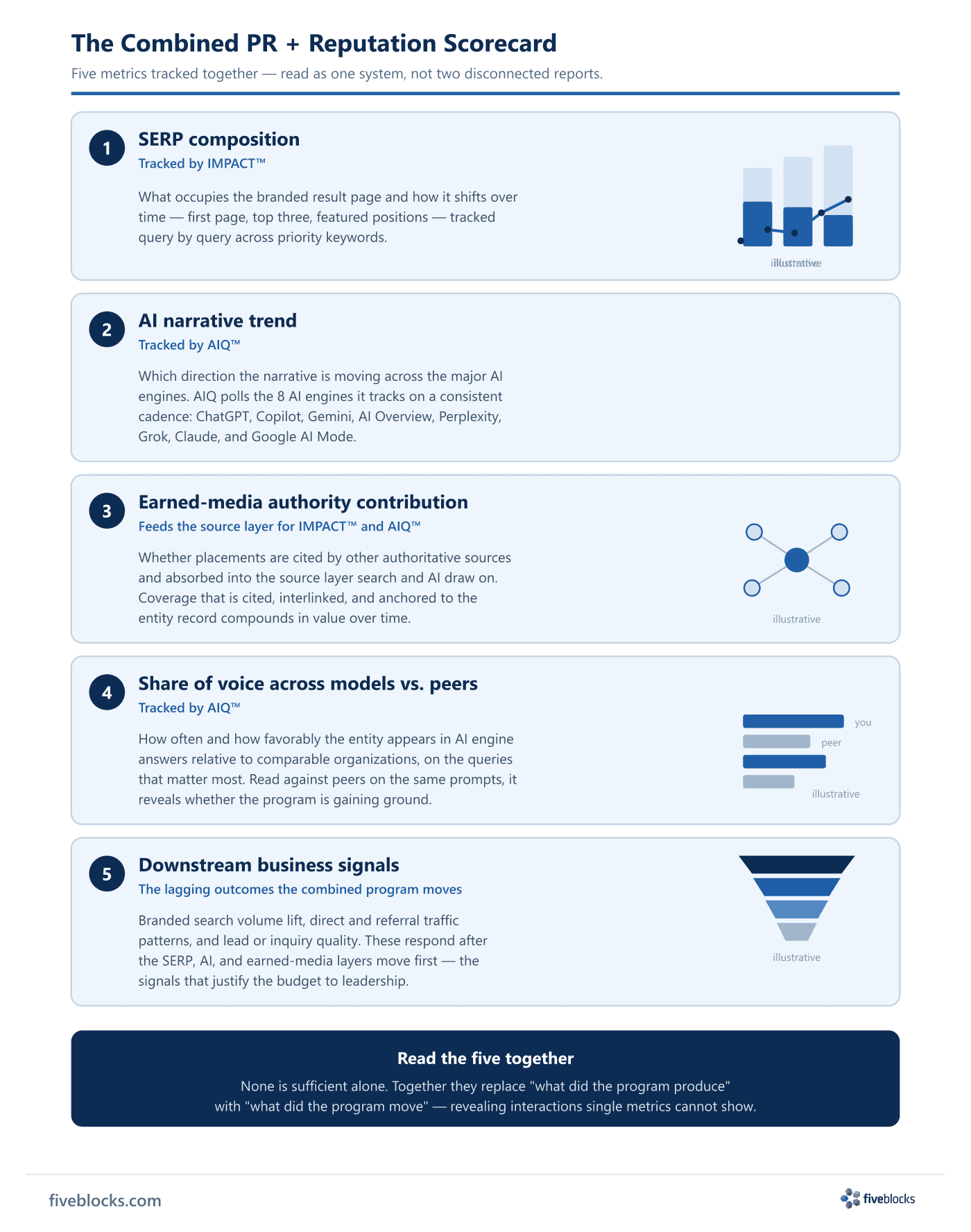
- SERP composition
- What occupies the branded result page and how that changes over time, tracked query by query. Positive results existing is not the same as positive results holding the positions that matter: the first page, the top three, the featured positions. IMPACT™ tracks this across priority keywords, so movement is measured rather than assumed.
- AI narrative trend
- What the major AI engines say about the entity, and which direction the narrative is moving. A single point-in-time check tells you very little. What informs program decisions is the direction and the rate of change: improving, stable, or deteriorating. AIQ™ polls the eight AI engines it currently tracks on a consistent cadence (ChatGPT, Copilot, Gemini, AI Overview, Perplexity, Grok, Claude, and Google AI Mode) and records what each says and which sources shape those answers.
- Earned-media authority contribution
- Whether placements get cited by other authoritative sources and absorbed into the source layer that search and AI engines draw on. Coverage that is cited, interlinked, and anchored to the entity record gains value over time. Coverage that is not stays a moment. This metric ties the PR program’s output to the long-term reputation asset instead of treating each placement as an event to report and forget.
- Share of voice across the models versus peers
- How often and how favorably the entity appears in AI engine answers relative to comparable organizations, on the queries that matter most to stakeholders. A reputation number on its own is hard to interpret. Read against peers on the same prompts, it shows whether the program is gaining ground, holding position, or falling behind. AIQ™ gives this cross-entity, cross-model view.
- Downstream business signals
- The outcomes the combined program exists to move: branded search volume lift, direct and referral traffic patterns, lead or inquiry quality, and whatever else the organization already tracks. These lag the rest. They respond only after the SERP, AI, and earned-media layers have moved. They are also the numbers that justify the budget to leadership and connect reputation work to commercial results.
Reading the five together
No one of the five is enough on its own. A strong AI narrative trend with flat SERP composition means the program is winning the emerging channel and losing ground in classic search. Rising earned-media authority with no share-of-voice gain against peers can mean the placements are strengthening the entity layer without breaking through competitively. Downstream business signals by themselves give leadership nothing to pull on. Read together, the five answer “what did the program move” rather than “what did the program produce.”
Last reviewed: 20/05/2026
