What is integrated reputation management and how does it differ from siloed approaches?
Integrated reputation management runs earned media, owned channels, Wikipedia, search, and AI monitoring as one discipline instead of separate workstreams. Siloed programs leave contradictions between channels, and AI engines now surface those contradictions where stakeholders can see them.
Integrated reputation management treats earned media, owned channels, Wikipedia, search, and AI narrative as one system rather than a set of independent projects. The distinction matters because the channels read each other. An inconsistency that used to sit unnoticed in one corner of the program now turns up in an AI answer, where stakeholders read it.
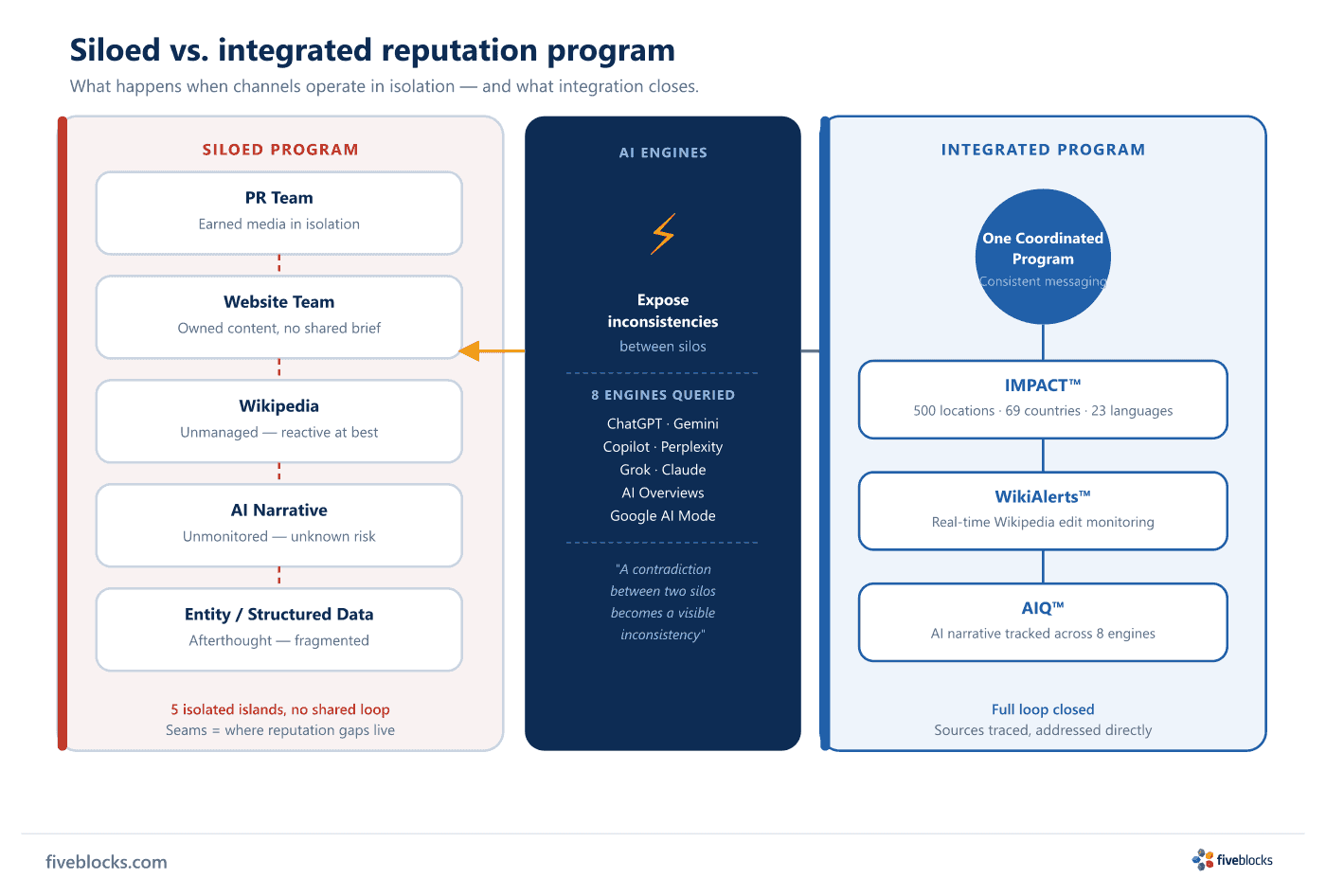
What a siloed approach looks like
- PR team: runs earned media on its own, without visibility into what the other channels are saying.
- Website team: manages owned content independently, with no shared messaging brief.
- Wikipedia: unmanaged, or handled reactively, with nobody watching for edits or inconsistencies.
- AI narrative: unmonitored. Nobody knows what ChatGPT, Gemini, Perplexity, or other engines say about the brand.
- Entity signals: an afterthought, so structured data stays fragmented across sources.
Each workstream can be competent on its own terms while none of them knows what the others are doing. The seams are where reputation problems collect.
What an integrated approach looks like
- One coordinated program: messaging, tone, and factual claims match across earned, owned, Wikipedia, and AI channels.
- Search visibility tracked at scale: IMPACT™ monitors rankings and SERP features continuously, covering 500 locations across 69 countries in 23 languages.
- Wikipedia monitored in real time: WikiAlerts™ flags edits and changes as they happen, so nothing drifts undetected.
- AI narrative tracked across the engines AIQ monitors: AIQ™ polls the eight engines it currently tracks, ChatGPT, Copilot, Gemini, AI Overview, Perplexity, Grok, Claude, and Google AI Mode, and shows what each one says and why.
- The loop is closed: what the AI engines say is traced back to the sources shaping those answers, and those sources get addressed directly.
Why integration matters more now
AI engines cite media coverage and Wikipedia. Wikipedia draws on the same media. Search results blend AI-generated answers with links. So a contradiction between two silos does not stay contained in either one; it becomes a visible inconsistency that an AI answer can repeat and a well-briefed stakeholder can catch. The argument for integration comes from how the information environment now works.
Last reviewed: 20/05/2026
